On this page
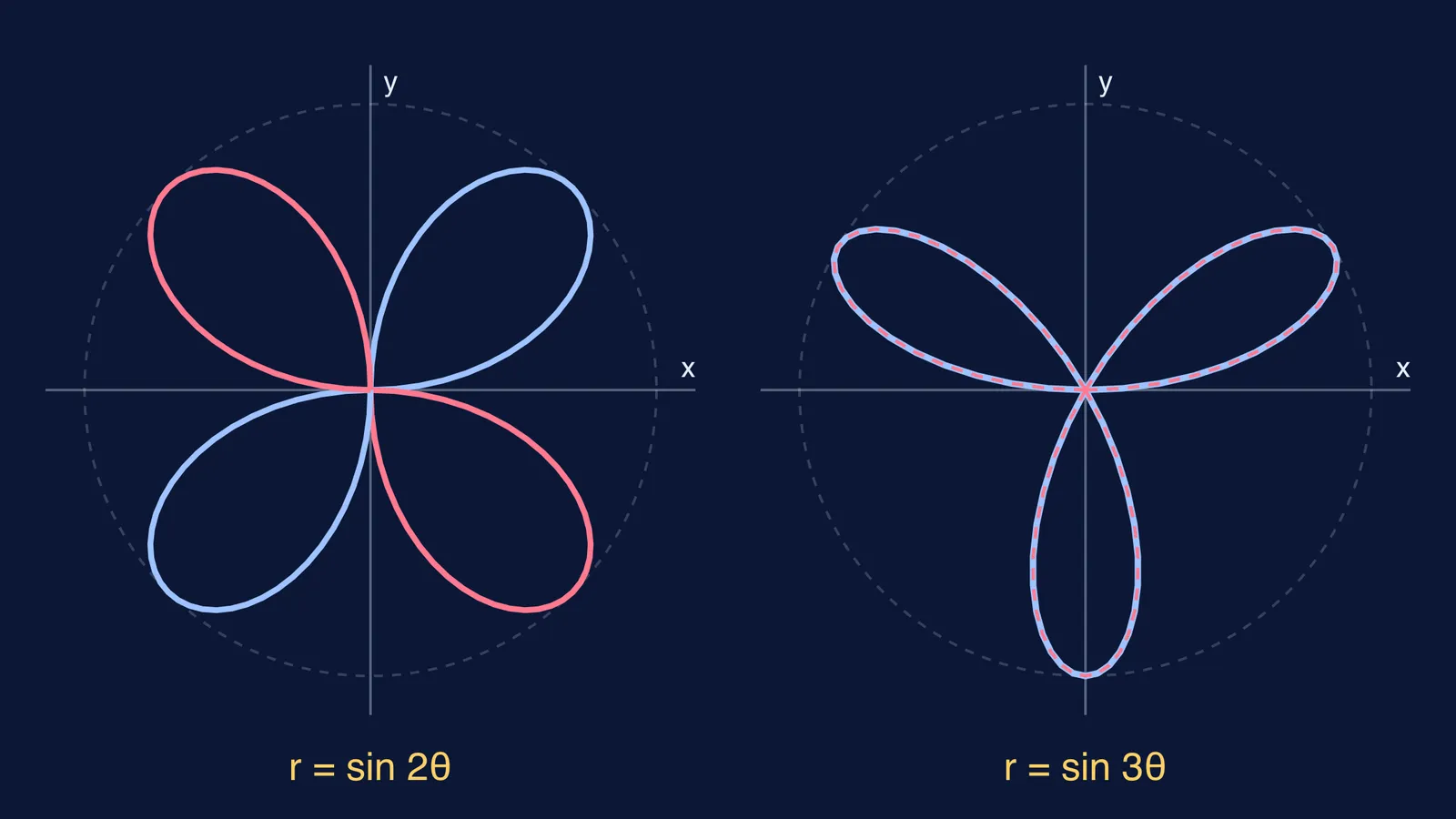
You graph r = sin 2θ expecting two petals and get four. Then r = sin 3θ gives three. Wolfram MathWorld's rose curve entry states the rule plainly: "If n is odd, the rose is n-petalled. If n is even, the rose is 2n-petalled." Below, you plot points yourself and see why.
What does a negative r mean in a polar graph?
A polar point (r, θ) means: face direction θ, then walk a distance r. If r is negative, you walk backwards, so (−r, θ) lands at the same place as (r, θ + 180°). Katherine Yoshiwara's open textbook Trigonometry makes the same point: every point has several polar names, such as (r, θ) and (−r, π + θ). If polar form feels new, our post on writing complex numbers in polar form builds the r and θ picture.
How do you plot r = sin 2θ by hand?
Draw axes with spokes every 15°, then fill in the rows below: θ, 2θ, r = sin 2θ, and where the point actually goes. The values come from the standard 30°, 45°, 60° table and the sine values at quadrantal angles.
θ = 0°: 2θ = 0°, r = 0, plot at the origin
θ = 15°: 2θ = 30°, r = 0.50, plot 0.50 along 15°
θ = 45°: 2θ = 90°, r = 1, plot 1 along 45° (the tip of the first petal)
θ = 75°: 2θ = 150°, r = 0.50, plot 0.50 along 75°
θ = 90°: 2θ = 180°, r = 0, back at the origin
θ = 105°: 2θ = ___, r = ___, plot ___ along ___
θ = 135°: 2θ = ___, r = ___, plot ___ along ___
θ = 165°: 2θ = ___, r = ___, plot ___ along ___
Answers: at 105°, r = sin 210° = −0.50, so plot 0.50 along 285°. At 135°, r = −1, so the tip lands along 315°. At 165°, plot 0.50 along 345°. The second petal sits in the fourth quadrant, even though θ was moving through the second.
From 180° to 270°, r is positive again: a petal centred on 225°. From 270° to 360°, r is negative and the points flip into the second quadrant. Four petals, one per quadrant.
Why does r = sin 3θ have only 3 petals?
Now track only the petal tips of r = sin 3θ.
θ = 30°: r = sin 90° = 1, tip along 30°.
θ = 90°: r = sin 270° = −1, tip flips to 270°.
θ = 150°: r = sin 450° = 1, tip along 150°.
θ = 210°: r = sin 630° = −1, tip flips to 30°, already drawn.
θ = 270°: r = sin 810° = 1, tip along 270°, already drawn.
θ = 330°: r = sin 990° = −1, tip flips to 150°, already drawn.
By θ = 180° all three petals exist; the second half-turn retraces them. The Wikipedia article on rose curves) agrees: odd roses close after π radians, even ones after 2π.
Why do odd and even n behave differently?
One line of algebra settles it: sin(n(θ + 180°)) = sin(nθ + n × 180°), which equals sin nθ when n is even and −sin nθ when n is odd.
Even n: half a turn later, r is unchanged, so the new point is the old one reflected through the origin. Every petal gets an opposite partner: 2n.
Odd n: half a turn later, r has flipped sign. Walking backwards along θ + 180° lands exactly on the old point, so the curve retraces itself: n.
Another way to count: over a full turn, sin nθ has 2n humps, and each hump draws one petal. For even n all 2n are distinct; for odd n they pair up, leaving n.
For r = a sin nθ, each petal has area πa²/(4n), according to the Wikipedia article), so the total is πa²/2 for even n and πa²/4 for odd n.
What happens as you step n from 1 to 6?
Predict each count, then plot.
n = 1: one petal, which is a full circle through the origin (r = sin θ rearranges to x² + y² = y)
n = 2: 4 petals
n = 3: 3 petals
n = 4: 8 petals
n = 5: 5 petals
n = 6: 12 petals
The count jumps 1, 4, 3, 8, 5, 12 because the odd and even sequences interleave. Yoshiwara's textbook gives the same rule for r = a cos nθ, which is the same rose turned.
For ideas that are easier to see than to read, the Fermi Simulation Lab has interactive simulations. Use it after your paper table, not instead of it. Polar curves appear outside textbooks too: see why a heart-shaped light appears in your cup.