

On this page
“An Empire Across Three Continents” is Theme 2 of the NCERT Class 11 book Themes in World History. It is about Rome, and it asks how one government held together a huge, mixed territory, who did the work and who got the money. Below: the big ideas, the key dates and a four-session revision plan.
What does “an empire across three continents” mean in Class 11 history?
The NCERT chapter (2026-27 reprint) says the Roman Empire covered most of Europe, a large part of the Fertile Crescent and North Africa. The Mediterranean Sea was its heart. The Rhine and the Danube formed its northern boundary, and the Sahara its southern one.
The Delhi Directorate of Education's 2026-27 syllabus sets the focus as the Roman Empire from 27 BCE to 600 CE. It lists five subtopics: political evolution, economic expansion, the religio-cultural foundation, late antiquity, and historians' views on slavery, plus map work.
How was the Roman empire run?
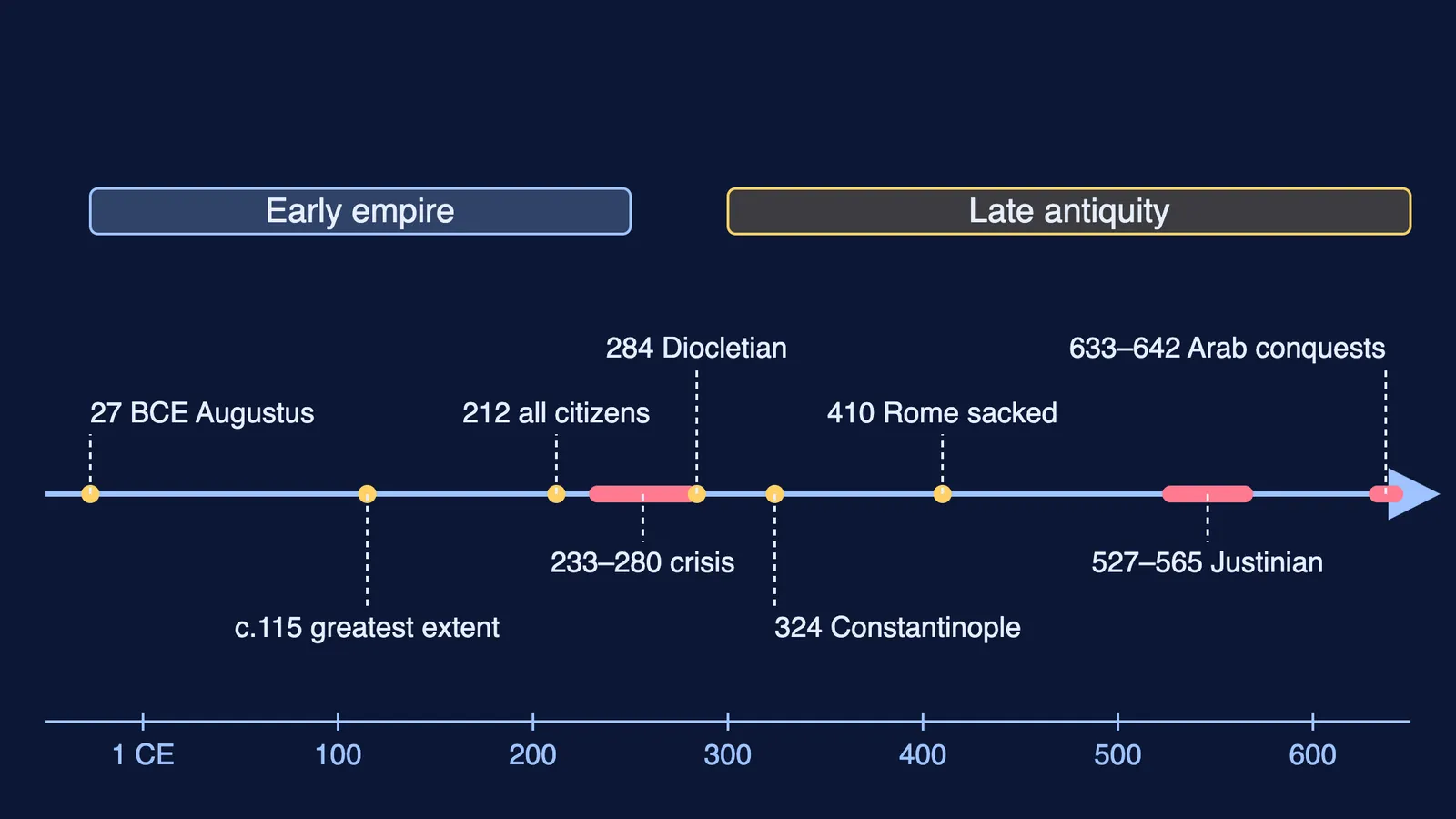
The NCERT text names three main “players”: the emperor, the aristocracy (the Senate) and the army. Augustus became the first emperor in 27 BCE. His regime was called the Principate, and it kept up the fiction that he was only the “leading citizen” (princeps).
The army was a paid professional force, not a conscripted one like Iran's. Soldiers served at least 25 years, and by the fourth century it was the largest organised body in the empire, about 600,000 men. When armies split, the result was civil war, as in 69 CE, when four emperors took the throne in quick succession.
How did an emperor govern some 60 million people in the mid-second century with no modern bureaucracy? Through cities. Carthage, Alexandria and Antioch were the biggest, and local upper classes collected taxes from the countryside around them. In 212, all free inhabitants became Roman citizens.
How did the Roman economy work?
The empire had a large infrastructure of harbours, mines, quarries, brickyards and olive oil factories, according to the NCERT chapter. Wine and olive oil travelled in clay jars called amphorae. Monte Testaccio in Rome is said to contain the remains of over 50 million of them.
One shape, the Dressel 20, carried Spanish olive oil, a trade that peaked in the years 140-160. Where those jars turn up shows that Spanish producers beat Italian ones, and North African producers later took over.
Under Augustus there were still 3 million slaves in an Italian population of 7.5 million. But the chapter argues that this was no longer true of the empire as a whole: slaves did not do the bulk of its labour, and employers also used cheaper wage labour and debt bondage.
What were the social hierarchies in the Roman empire?
Tacitus described five groups in the early empire: senators, leading equestrians (equites), the respectable middle, the lower class (plebs sordida) and slaves. By the late empire, the NCERT text explains, senators and equites had merged into one wealthy aristocracy. Below it came a middle class of imperial officials, army men, merchants and farmers, then the lower classes, the humiliores.
Women had strong property rights: a married woman kept her rights in her father's property, and either partner could end a marriage. But women married in their late teens or early twenties, men in their late twenties or early thirties, and many wives were dominated by their husbands.
What changed in late antiquity?
Late antiquity means roughly the fourth to seventh centuries, per the NCERT chapter. It began after a third-century crisis: war with the new Sasanian dynasty in Iran, Germanic invasions from 233 to 280, and 25 emperors in 47 years.
Diocletian (284-305) cut back territory and separated civil from military power. Constantine introduced the solidus, a coin of 4.5 grams of pure gold, and founded Constantinople in 324. The chapter says he decided to make Christianity the official religion. The West broke into post-Roman kingdoms, while the East stayed prosperous, peaking under Justinian. By 642, Arab armies had taken large parts of the eastern Roman and Sasanian empires.
How should you revise this chapter?
Use the timeline at the top of this page as your spine, then run four short sessions:
Map and structure: draw the empire from memory (Mediterranean, Rhine, Danube, Sahara, Euphrates) and list the three players.
Economy: explain the amphorae evidence in five sentences, out loud.
Society: make two columns, “rights” and “limits”, for women, slaves and the poor.
Late antiquity: put Diocletian, Constantine, 410, Justinian and 642 in order without notes.
For a long answer, use “claim, evidence, but”: state the point, give one fact from the chapter, then add the limit. Turning the chapter into a one-page mind map for revision helps, and the same source-reading skill appears in how Harappan finds are read in Class 12. For source passages, practise how to answer case-based questions.
If you also study a science or maths subject, Fermi's AI tutor can work out what you already know and build a plan for the session, so you sit down to a clear next step there too.


