

On this page
You do not need a memorised table for the four angles that sit on the axes. At 0°, 90°, 180° and 270° the answer is a point you can picture, and every value, including the undefined ones, follows from that point.
What are sin, cos and tan at 0°, 90°, 180° and 270°?
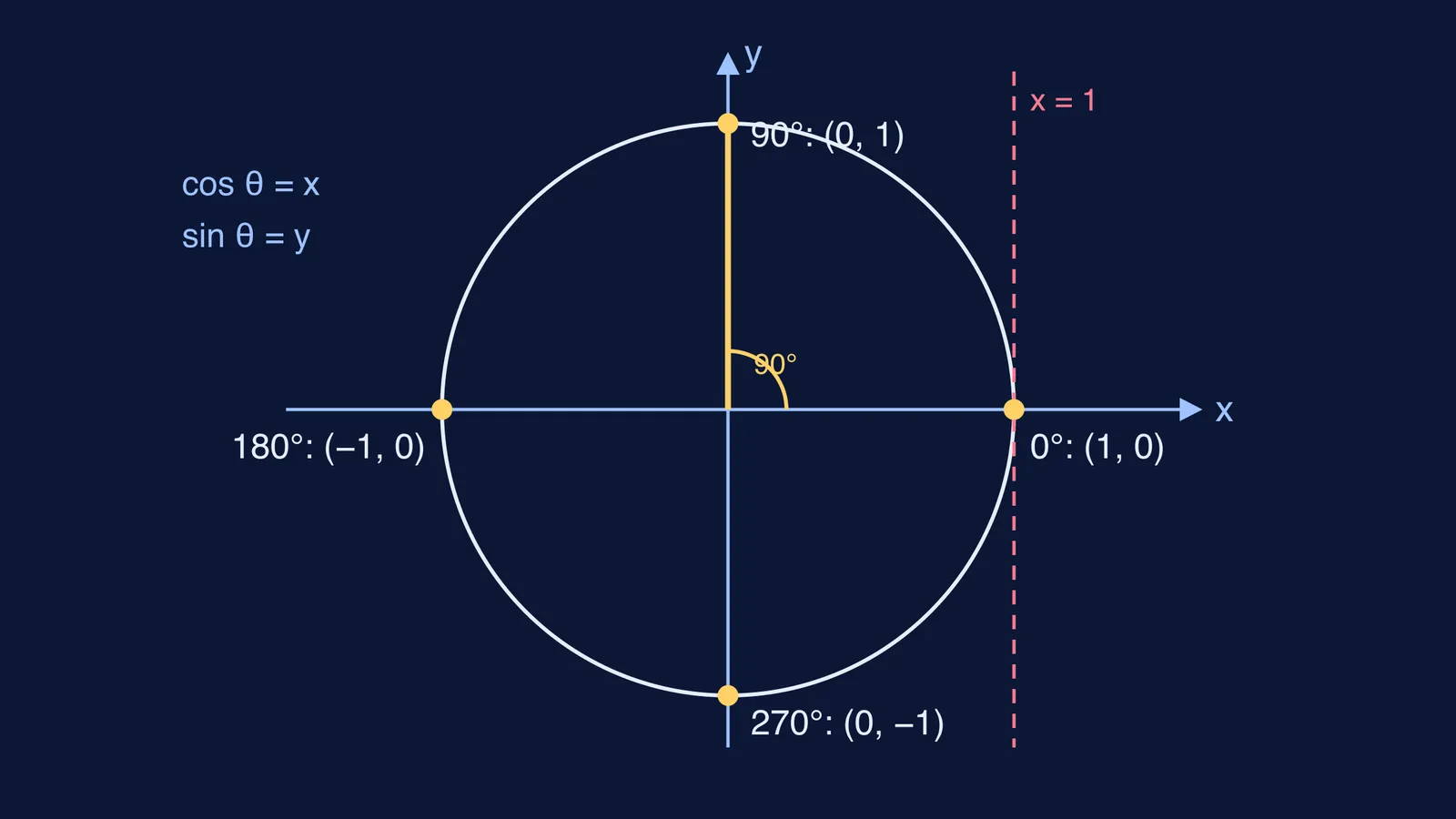
The NCERT Class 11 Mathematics textbook defines the functions on a unit circle centred at the origin: for the point P(a, b) reached by turning through angle x, cos x = a and sin x = b (NCERT Class 11 Mathematics, Chapter 3, Section 3.3). In plain words, cos is the x-coordinate and sin is the y-coordinate.
Angles that are integral multiples of 90° (π/2) are called quadrantal angles, and their points on the unit circle are (1, 0), (0, 1), (−1, 0) and (0, −1) (NCERT, Chapter 3). OpenStax puts it the same way: for quadrantal angles, the point on the unit circle falls on the x- or y-axis (OpenStax Algebra and Trigonometry 2e, Section 7.3).
Tan is sin ÷ cos, so it is y ÷ x:
0°, point (1, 0): sin 0° = 0, cos 0° = 1, tan 0° = 0
90°, point (0, 1): sin 90° = 1, cos 90° = 0, tan 90° is undefined
180°, point (−1, 0): sin 180° = 0, cos 180° = −1, tan 180° = 0
270°, point (0, −1): sin 270° = −1, cos 270° = 0, tan 270° is undefined
360° brings you back to (1, 0), so its values match 0°
Why are tan 90° and sec 90° undefined?
Both tan and sec have cos in the denominator. NCERT defines tan x = sin x / cos x and sec x = 1 / cos x, each only for x ≠ (2n + 1)π/2, where n is any integer (NCERT, Chapter 3). Those excluded angles are 90°, 270°, −90° and so on: exactly where the point sits on the y-axis and its x-coordinate is 0.
At 90° you would be computing tan 90° = 1 ÷ 0 and sec 90° = 1 ÷ 0. Division by zero has no answer, so the value is undefined. It is not 0 and it is not "infinity" written as a number.
The same logic, flipped, covers the other pair. Cosec x = 1 / sin x and cot x = cos x / sin x are defined only for x ≠ nπ (NCERT, Chapter 3), so cosec and cot are undefined at 0°, 180° and 360°, where sin is 0.
Our post on the domain and range of sec, cosec and cot shows these gaps on a graph.
How do you find these values without a table?
Sketch a small circle with the x- and y-axes. Mark the angle by turning anticlockwise from the positive x-axis.
Write the point where you land: (1, 0), (0, 1), (−1, 0) or (0, −1).
Read cos as x and sin as y.
For tan, sec, cosec or cot, divide. If the denominator is 0, write "undefined" and stop.
Worked example: evaluate 3 sin 90° − 2 cos 180° + tan 180° + sec 0°.
90° lands on (0, 1), so sin 90° = 1 and 3 sin 90° = 3.
180° lands on (−1, 0), so cos 180° = −1 and −2 cos 180° = +2.
tan 180° = 0 ÷ (−1) = 0.
0° lands on (1, 0), so sec 0° = 1 ÷ 1 = 1.
Total: 3 + 2 + 0 + 1 = 6.
Now change one term: 3 sin 90° − 2 cos 180° + tan 270°. At 270° the point is (0, −1), so tan 270° = −1 ÷ 0, which is undefined. The whole expression is undefined, so check every denominator before you add.
For more problems like this, the Fermi Problem Library has worked problems with a step-by-step solver that explains the reasoning rather than printing an answer, so you can check which step went wrong.
What mistakes do students make with quadrantal angles?
Swapping sin and cos. The point at 0° is on the x-axis, so its height, sin 0°, is 0, not 1.
Dropping the minus sign at 180° and 270°. The points (−1, 0) and (0, −1) carry the sign for you. The ASTC rule for signs of trig functions explains the pattern in between.
Writing tan 90° = 0 or tan 90° = ∞. It is undefined, because cos 90° = 0.
Forgetting cosec and cot. They break at 0° and 180°, the opposite pair to tan and sec.
The same habit works for any angle. Our guide to finding trig ratios from a terminal point extends it to points such as (−3, 4).
If the unit circle itself still feels shaky, the Fermi Concept Library has a lesson for every concept in mathematics, each with its place in the map, so you can go back one step and rebuild from there.


