On this page
You finish ten physics questions and paste them into an AI chatbot to check. It says six are right, and it is tempting to move on. But the score hides the most useful thing you could learn: whether you knew you were right. A one-letter confidence rating, written before you check, turns that check into a map of what to revise.
Why rate your confidence before checking answers with AI?
Because a right answer you guessed and a right answer you understood look the same on a score sheet. Only you know the difference, and only before you see the solution. Once the AI's working is on screen, it is easy to feel you knew it all along.
Knowing what you know is a skill, and people are often poor at it. In four studies by Justin Kruger and David Dunning, participants who scored in the bottom quartile on tests of grammar, logic and humour estimated themselves at the 62nd percentile when their scores put them in the 12th (Kruger and Dunning, 1999). Rating, then checking, is daily practice at noticing where your certainty is off.
What does research say about confident mistakes?
The surprising finding is that being sure and wrong is a good moment to learn. Brady Butterfield and Janet Metcalfe stated the effect in the title of their 2001 paper: errors committed with high confidence are hypercorrected. In a later review, Metcalfe wrote that "Errors committed with high confidence are corrected more readily than low-confidence errors", and that corrective feedback which includes analysing the reasoning behind the mistake is crucial (Metcalfe, Annual Review of Psychology, 2017).
College students in an introductory horticulture class answered course questions, rated their confidence, got the correct answers, and later took a posttest; the researchers found a significant hypercorrection effect (Carpenter and colleagues, Memory, 2018).
How do you score your confidence before checking?
Solve each question fully on paper, as you would in an exam.
Next to each answer write S (sure), F (fairly sure) or G (guess).
Only now ask the AI to check. Give it the question and your working, not your rating, and ask it to check each step rather than just say right or wrong.
When the AI and the answer key disagree, settle it with the key or your textbook. An AI can go along with a confident wrong answer, so read why AI agrees with your wrong answer, and how to test it.
Mark each question R (right) or W (wrong) beside your rating.
What does a confidence log look like?
Here is a made-up example. Riya, a Class 11 student, checks ten questions on laws of motion:
Q1 to Q5: S and R.
Q6, a block on a rough incline pulled by a string: S but W. She drew friction along the motion.
Q7, a block in an accelerating lift: S but W. She added the pseudo force in the wrong direction.
Q8, a banked road: G but R. A lucky guess.
Q9 and Q10, circular motion: G and W. She has not revised that topic yet.
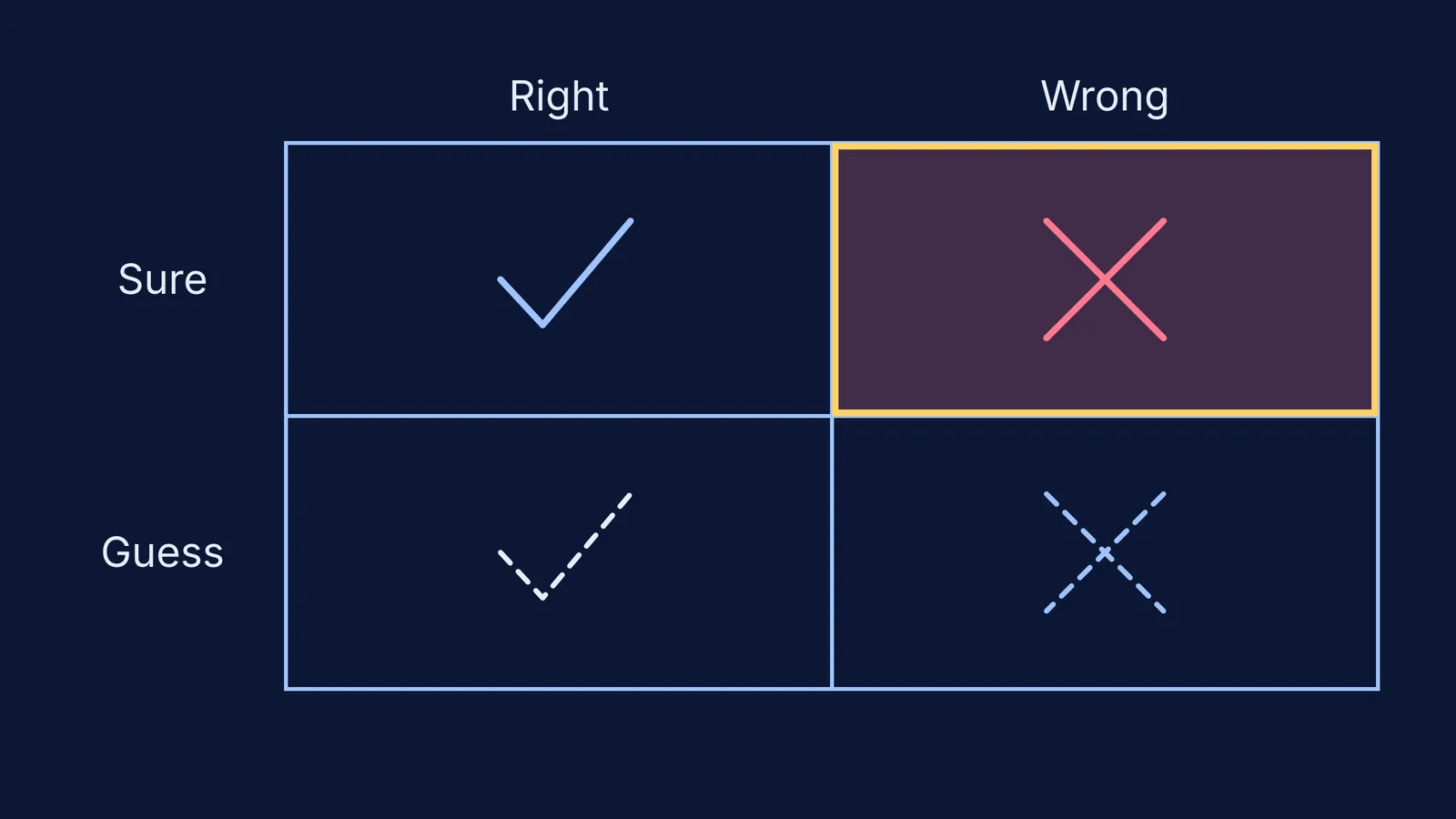
Her score is 6 out of 10, but the log says more. Every answer lands in one of four boxes:
Sure and right: you know it. Recheck it later in a mixed test.
Sure and wrong: a misconception. Revise these first, while the surprise is fresh, and write one line on why the wrong idea seemed right.
Guess and right: luck, not knowledge. Redo it without the solution in a day or two.
Guess and wrong: a known gap. Learn the idea before doing more problems.
Treat a wrong F like a wrong S. Riya's plan follows directly: friction direction and pseudo force first, then circular motion from the start, then the banked road again.
How do you turn the gaps into a revision plan?
Keep the log for two weeks (chapter, rating, result, and a reason when wrong), then look for clusters.
Sure-and-wrong answers bunch in one chapter: your method is off. Rework one problem slowly with an explanation of each step, for example in the Fermi Problem Library, where the step-by-step solver explains the reasoning rather than printing an answer.
Guesses bunch in one chapter: the concept is missing. Start with the idea, not more problems; the Fermi Concept Library has a lesson for every concept in physics, chemistry, biology, mathematics and computing.
You can paste a fortnight of log lines into an AI and ask it to find patterns in your mistakes. For a pen-and-paper version, see how to mark confidence while solving practice questions.
If you would rather not track it all by hand, Fermi's AI tutor works out what you already know, notices where you are stuck and builds a plan for the session.
Tonight, take ten questions, write S, F or G beside each, and only then press check.