On this page
Before you read any further, make a guess. Drop three dots at random inside a square and join them. Is the triangle more likely to be acute (all three angles under 90°) or obtuse (one angle over 90°)? Write down a number, say "acute 60%", and keep it next to you.
Most people guess acute, because textbook triangles usually are. You can check the real answer with a spreadsheet in ten minutes.
What is the probability a random triangle is obtuse?
For three points chosen independently and uniformly in a square, the probability of an obtuse triangle is 97/150 + π/40 ≈ 0.7252, proved by Langford in 1969 according to MathWorld's square triangle picking page.
So roughly 72 or 73 triangles in every 100 are obtuse, and only about 27 are acute. Obtuse wins by more than two and a half to one.
Change the square to a circular disk and the number barely moves. MathWorld's obtuse triangle page gives 9/8 − 4/π² ≈ 0.7197 for points picked uniformly in a disk, a result it credits to Woolhouse (1886). The same page cites a 1993 article by Richard Guy with the playful title "There Are Three Times as Many Obtuse-Angled Triangles as There Are Acute-Angled Ones."
Why are obtuse triangles so common?
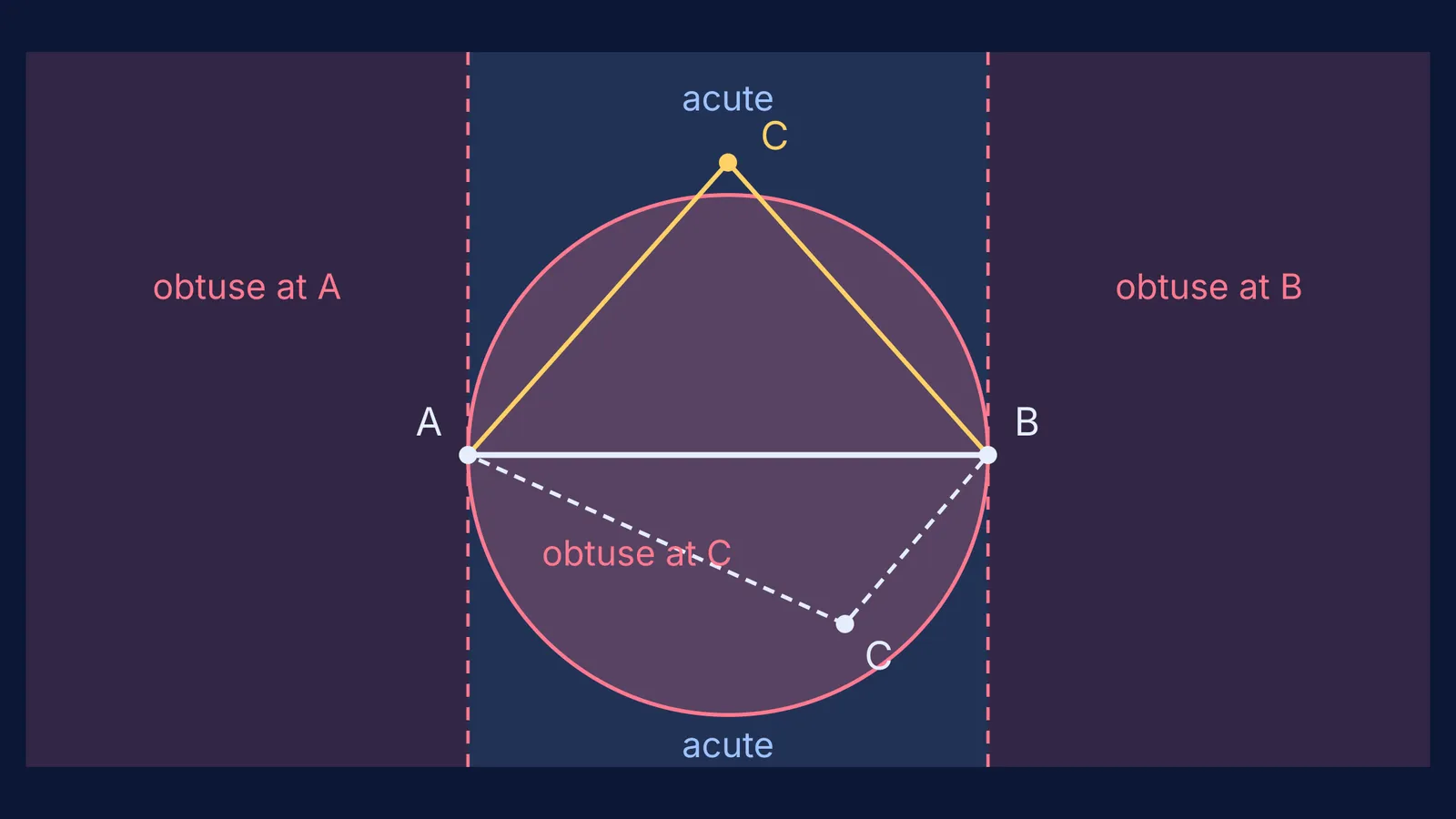
The picture at the top of this post shows why. Fix two corners, A and B, and ask where the third corner C can go.
If C lies inside the circle that has AB as its diameter, the angle at C is obtuse. On the circle it is exactly 90°; this is the "angle in a semicircle" theorem.
If C lies beyond the line through A perpendicular to AB, the angle at A is obtuse. The same goes for B.
Only the region between the two perpendiculars and outside the circle gives an acute triangle.
An acute triangle has to pass three tests, one for each angle. An obtuse triangle only has to fail one.
How can you generate thousands of triangles and count?
You do not need to code. A spreadsheet (Google Sheets or Excel) is enough. Here is the plan.
In cells A2 to F2 type =RAND() six times. These are x1, y1, x2, y2, x3, y3, three random points in a 1 by 1 square.
In G2 type =(A2-C2)^2+(B2-D2)^2 for the squared length of one side.
In H2 type =(C2-E2)^2+(D2-F2)^2 and in I2 type =(A2-E2)^2+(B2-F2)^2 for the other two.
In J2 type =IF(2*MAX(G2:I2)>SUM(G2:I2),1,0). This is the one-line test above: the largest square beats the other two exactly when twice the largest beats the total. It shows 1 for obtuse, 0 for acute.
Copy row 2 down to row 1001, which gives you 1,000 triangles.
In any empty cell type =AVERAGE(J2:J1001). That is your fraction of obtuse triangles.
Compare it with your guess. Edit any empty cell to recalculate and watch the number wobble. With 1,000 triangles it should usually land within about 3 percentage points of the true 0.725 from Langford's result. If you copy down to 10,000 rows, the wobble shrinks to about 1 point. The reason is the same one we explain in 10,000 coin tosses and the law of large numbers: more trials, steadier fraction.
This is the same random-points trick used to estimate pi with random points. If you would rather move a point around and watch shapes change than read a formula, the Fermi Simulation Lab has interactive simulations for ideas that are easier to see than to read.
Does the answer depend on how you pick the triangle?
Yes, and this is where the puzzle gets interesting. "Random triangle" is not one thing until you say how the points are chosen.
Clayton Shonkwiler of Colorado State University collects the main answers in a talk titled "What's the probability that a random triangle is obtuse?". Lewis Carroll's method gives about 0.64 when the triangle is built on its longest side, and about 0.82 when it is built on the second-longest. Vertices uniform in a disk give about 0.72. Any spherically symmetric choice of the six coordinates, such as independent bell-curve (Gaussian) values, gives exactly 3/4, a result the talk credits to Portnoy. A different measure on triangle shapes, from Cantarella, Needham and Stewart, gives 3/2 − 3ln2/π ≈ 0.838.
Mathematicians Alan Edelman and Gilbert Strang explore the Gaussian version in Random Triangle Theory with Geometry and Applications, where they show triangle shapes naturally fall on a hemisphere.
The numbers differ, but obtuse wins in every version listed here. The same lesson, that the method of choosing decides the answer, is behind Bertrand's paradox about a random chord.
If you get stuck setting up the sheet or want to know why your answer moved, Fermi's AI tutor can work through it with you, deciding whether to explain, ask or show, and running the simulation as it goes. Start with a guess, then count.