

On this page
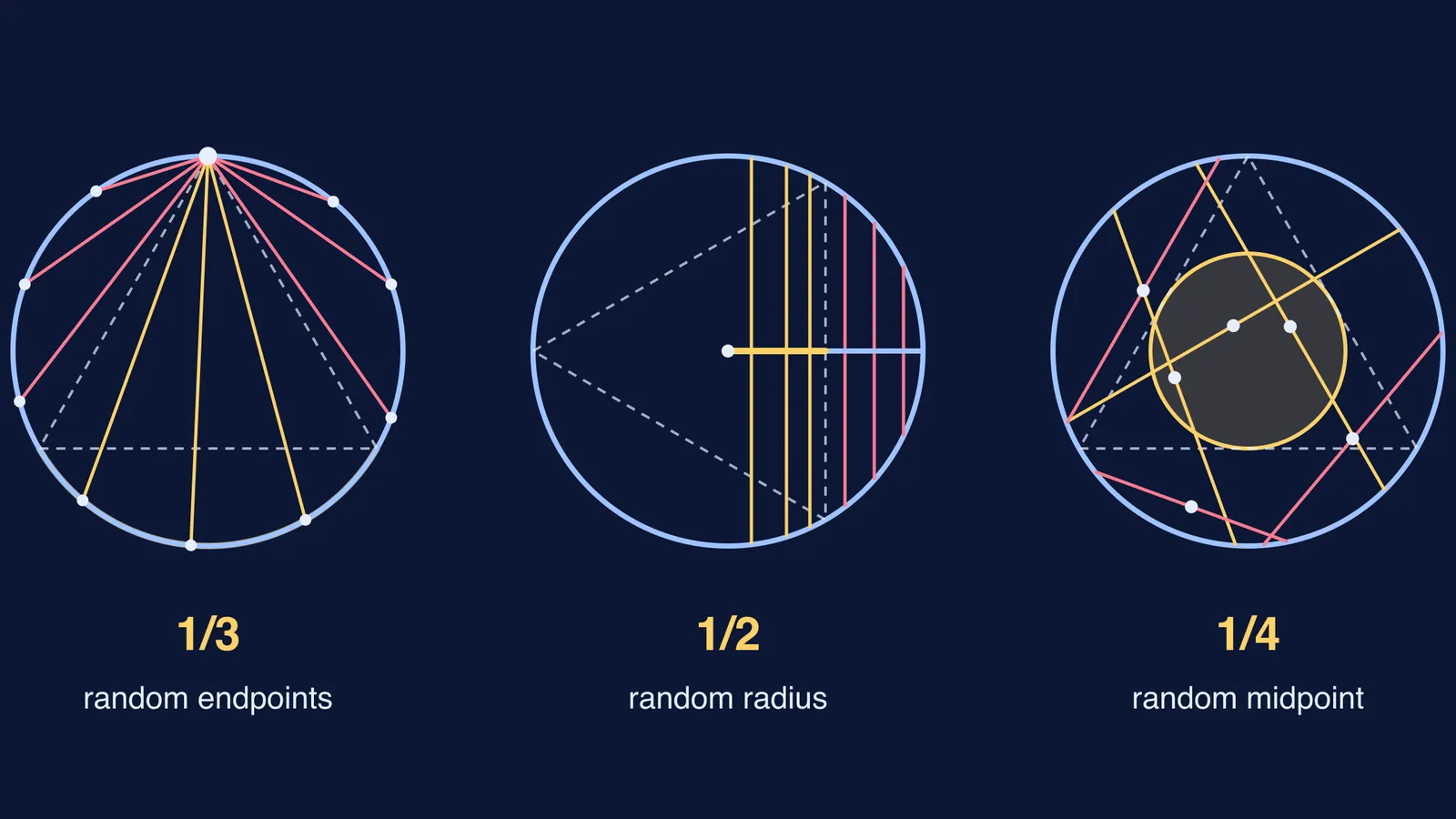
Ask three careful students to pick “a random chord” of a circle and you can get three different probabilities, each one calculated correctly. This is Bertrand's paradox, and it is a classic example of why a probability question has to say how the random thing is chosen.
What is Bertrand's chord paradox?
The French mathematician Joseph Bertrand posed it in his 1889 book Calcul des probabilités. Draw an equilateral triangle inside a circle of radius R, with its corners on the circle. Each side of that triangle has length √3R, about 1.73R. Now pick a chord “at random”. What is the probability that the chord is longer than a side of the triangle?
The physicist E. T. Jaynes laid out the three classic answers in his 1973 paper “The Well-Posed Problem” in Foundations of Physics: 1/2, 1/3 and 1/4, depending on what you treat as equally likely.
One fact does all the work below. A chord's length depends only on how far it is from the centre: a chord at distance d has length 2√(R² − d²). Set that equal to √3R and you get d = R/2. A chord is longer than the triangle's side exactly when it passes closer than R/2 to the centre.
Why do three methods give three different answers?
Each method below matches one of the three choices listed in Jaynes's paper.
Method 1: random endpoints gives 1/3
Pick two points on the circle independently and uniformly. Fix the first endpoint and put one corner of the triangle there. The chord beats the triangle's side only if the second endpoint lands on the arc between the other two corners. That arc is 120° of the 360° circle, so the probability is 120/360 = 1/3.
Method 2: random point on a radius gives 1/2
Pick a radius, pick a point on it uniformly, and draw the chord through that point at right angles to the radius. The chord is long when the point lies within R/2 of the centre. That is half the radius, so the probability is 1/2.
Method 3: random midpoint gives 1/4
Pick a point uniformly anywhere inside the circle and make it the chord's midpoint. The chord is long when the midpoint lies inside a smaller circle of radius R/2, which is exactly the circle that fits inside the triangle. That smaller circle's area is π(R/2)², a quarter of πR², so the probability is 1/4.
So which answer is correct?
Jaynes reviewed ten earlier authors and reported that most of them, Bertrand included, concluded that the problem has no definite solution because the phrase “at random” is undefined (Jaynes, 1973). Jaynes disagreed for one concrete setting: straws tossed onto a circle by someone with no special skill, where the problem says nothing about the circle's exact size or position. He argued that the answer should not change if the circle were a little bigger or shifted slightly, and showed that these conditions leave only the 1/2 answer.
Then he tested it. Jaynes writes that he and Charles E. Tyler tossed broom straws from a standing position onto a 5-inch-diameter circle drawn on the floor, and that 128 successful tosses, sorted into ten ranges of chord length, matched the distribution of chord lengths he had predicted (Jaynes, 1973).
That does not make 1/3 or 1/4 wrong: a machine that really picks two points on the rim gives 1/3. The process defines the randomness, and once it is described, the paradox goes away.
How do you handle “at random” in a probability problem?
Use this five-step check whenever a point, length, angle or area is chosen at random.
Name the random object. Is it a point, an angle, a length, or a pair of numbers?
Ask “uniform over what?” A uniform angle is not a uniform length, and a uniform length is not a uniform area.
Write the sample space before calculating. If you are unsure what counts as an outcome, revise sample space and types of events.
Turn the good event into a region (an arc, a segment or an area) and take the ratio of sizes.
State your assumption in one line, then sanity-check it. A quick random-points experiment, like the one in estimating pi with random points, shows whether your number is close.
Here is a line you can copy into an answer when a question is vague: “I take the chord's midpoint to be uniformly distributed over the area of the circle, so P = (R/2)² ÷ R² = 1/4.”
The same sample-space thinking settles other geometry puzzles, such as the probability that three sticks form a triangle.
For more practice with worded probability problems, the Fermi Problem Library has worked problems with a step-by-step solver that explains the reasoning rather than printing an answer. For ideas that are easier to see than to read, the Fermi Simulation Lab has interactive simulations.
Next time you read “chosen at random”, ask one question before you calculate: random how?


