

On this page
Problems asking for the probability that three chosen sticks form a triangle appear frequently in competitive exams like JEE and math olympiads. They test two distinct mathematical skills at once: your ability to count combinations systematically, and your understanding of geometric rules.
Here is how to solve the classic version of this problem using the sample lengths 2, 3, 4, 5, and 6.
How many ways can you choose three sticks?
First, you need to find the total number of possible stick selections. If you have five distinct lengths—2, 3, 4, 5, and 6—you are selecting three items without caring about the order they are drawn in. This means you are calculating a mathematical combination. This is fundamentally different from a permutation, where drawing the 2-unit stick first or last would count as a separate event.
The combinations formula states that the number of ways to select r objects from a set of n distinct objects is given by n! / (r! × (n−r)!) (Cuemath).
For selecting 3 lengths from a set of 5, the math becomes (5 × 4 × 3) / (3 × 2 × 1), which gives exactly 10 possible combinations.
Because the set is small, you can quickly write out these 10 groups to avoid any calculation errors: {2, 3, 4}, {2, 3, 5}, {2, 3, 6}, {2, 4, 5}, {2, 4, 6}, {2, 5, 6}, {3, 4, 5}, {3, 4, 6}, {3, 5, 6}, and {4, 5, 6}.
What is the triangle inequality theorem?
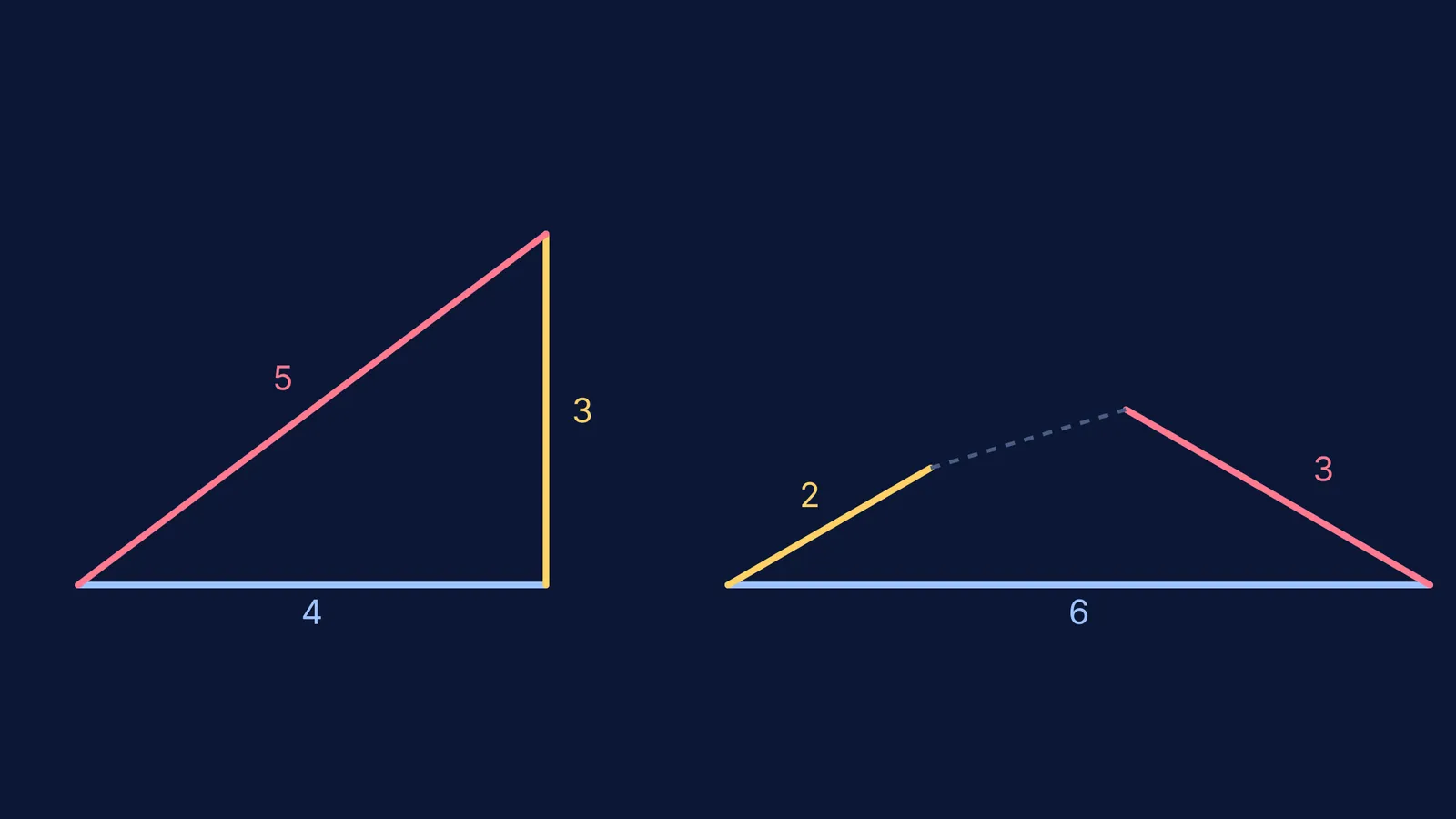
Not every set of three sticks can close to form a three-sided shape. If you have two very short sticks and one very long stick, the short ones will simply hang in the air without touching.
The Triangle Inequality Theorem states that the sum of the lengths of any two sides of a triangle must be greater than the length of the third side (Cuemath).
In practice, you do not need to test all three pairs of sides for every combination. You only need to check the shortest two sides of your chosen trio. If the sum of the two shortest sticks is strictly greater than the longest stick, the three pieces will successfully close the shape. If the sum is equal to or less than the longest stick, the pieces will fail to connect at the corners.
Read more: Why the angles of a triangle add to 180 degrees
Testing the 10 combinations
Let us apply this geometric shortcut to our 10 combinations to see which ones succeed as valid triangles:
{2, 3, 4}: The two shortest sides are 2 and 3. Since 2 + 3 = 5, and 5 > 4, this forms a triangle.
{2, 3, 5}: Since 2 + 3 = 5, and 5 is not greater than 5, this fails.
{2, 3, 6}: Since 2 + 3 = 5, and 5 < 6, this fails.
{2, 4, 5}: Since 2 + 4 = 6, and 6 > 5, this forms a triangle.
{2, 4, 6}: Since 2 + 4 = 6, and 6 is not greater than 6, this fails.
{2, 5, 6}: Since 2 + 5 = 7, and 7 > 6, this forms a triangle.
{3, 4, 5}: Since 3 + 4 = 7, and 7 > 5, this forms a triangle.
{3, 4, 6}: Since 3 + 4 = 7, and 7 > 6, this forms a triangle.
{3, 5, 6}: Since 3 + 5 = 8, and 8 > 6, this forms a triangle.
{4, 5, 6}: Since 4 + 5 = 9, and 9 > 6, this forms a triangle.
Out of the 10 possible groups, exactly 7 combinations form a valid triangle.
A step-by-step framework for probability geometry problems
When you encounter a variation of this problem in an exam—such as finding the probability that three sticks form a right-angled triangle—you can use a reliable three-step framework.
Count the sample space: Determine the total number of ways to choose the required items. If you are drawing sticks without replacement, use the combinations formula.
List the conditions: Write down the mathematical rule that defines a success. For a standard triangle, this is the Triangle Inequality Theorem. For a right-angled triangle, the condition changes to Pythagoras' theorem, where the square of the longest side must equal the sum of the squares of the other two sides.
Filter and divide: Systematically list all combinations, cross out the ones that fail the condition, and count the survivors. Divide the surviving favorable outcomes by the total sample space to get the final probability.
Read more: Ambiguous case of the sine rule: zero, one or two triangles
Calculating the final probability
With the combinations listed and tested, the final step is to find the ratio. Probability is simply the number of successful outcomes divided by the total number of possible outcomes.
With 7 valid triangles out of 10 total combinations, the fraction is 7/10. Therefore, the probability that three chosen sticks form a triangle is 70% (Cuemath).
When you are preparing for exams, memorising the final 70% figure is less helpful than practising the method. Rote learning fails when the question changes the starting lengths to {1, 3, 5, 7, 9} or asks for a different shape. If you want to test your understanding on variations of this setup, the Fermi Problem Library has worked problems with a step-by-step solver that explains the reasoning rather than printing an answer.
Read more: What each symbol means in a formula: how to ask AI


