On this page
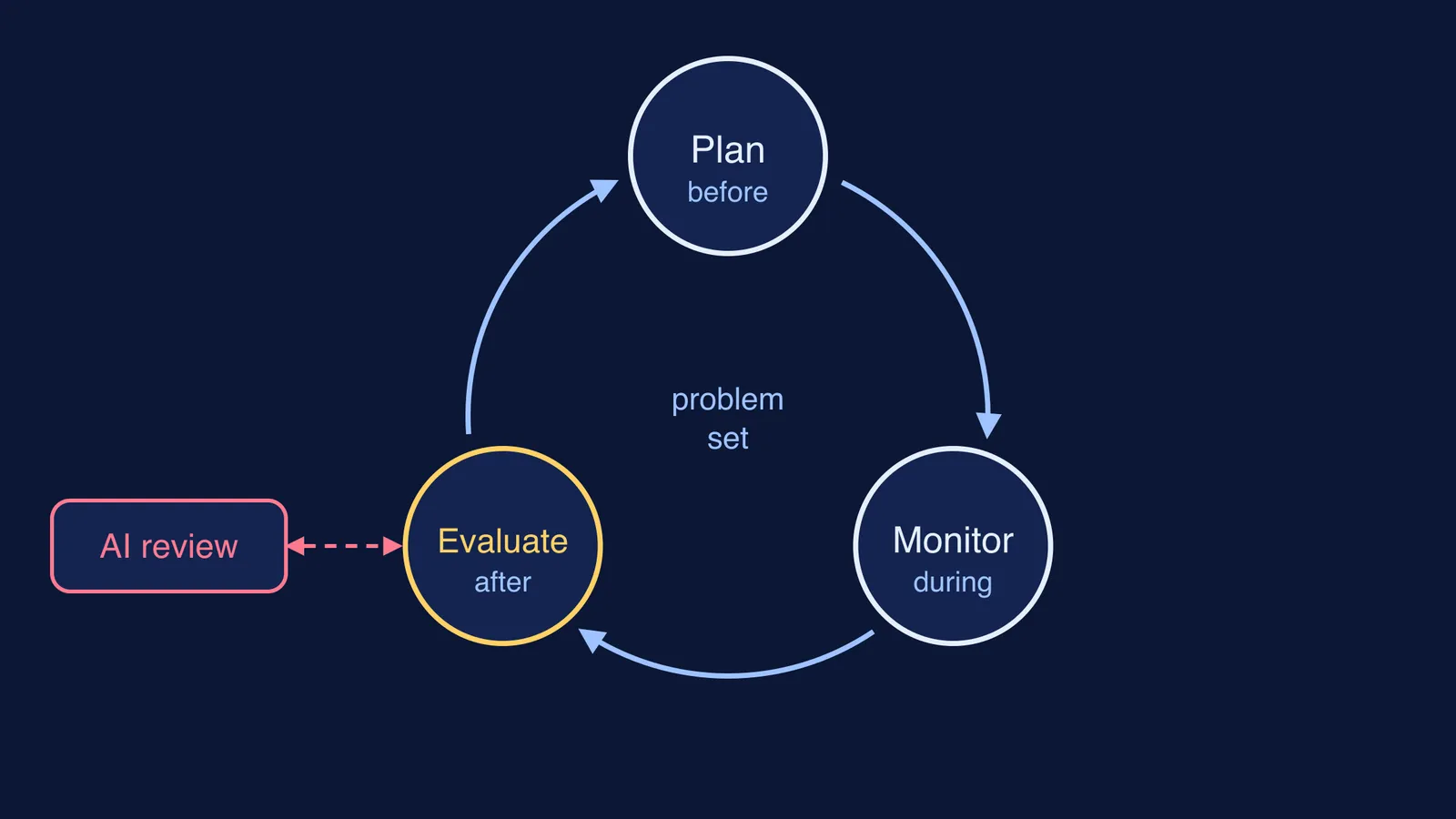
You finish a problem set, check the answers, feel good or bad about the score, and move on. The habit that turns that hour into learning is smaller than it sounds: ask yourself one question before you start, one while you work, and one when you finish. Researchers file this under metacognition: plan, monitor, evaluate.
What does plan, monitor, evaluate mean in studying?
A 2021 evidence-based guide by Julie Dangremond Stanton, Amanda Sebesta and John Dunlosky in CBE—Life Sciences Education uses an earlier definition of metacognition: "awareness and control of thinking for learning".
The same guide describes three steps:
Planning is "deciding what strategies to use for a future learning task and when you will use them".
Monitoring is "assessing your understanding of concepts and the effectiveness of your strategies while learning".
Evaluating is "appraising your prior plan and adjusting it for future learning".
The authors add that self-testing, such as answering practice questions, gives you a chance to monitor your understanding and find the gaps. The term is usually credited to the developmental psychologist John Flavell, who studied metacognition; his 1979 paper in American Psychologist is one of the field's early papers.
Does planning before you study actually help?
In a study published in Psychological Science in 2017, Patricia Chen and colleagues tested a short online exercise in two cohorts of a college introductory statistics class. Before each exam, students randomly assigned to the exercise planned which resources they would use to study, why each would help and how they would use it. Those students reported being more self-reflective, used their resources more effectively, and outperformed the control group by an average of one third of a letter grade.
The three-question routine for every problem set
Use one notebook page per problem set and answer each question in writing, in a line or two.
Before (plan): "What is this set testing, and which method will I try first?" Name the chapter idea and your first approach, for example "energy conservation before forces".
During (monitor): "Could I explain why this step works without looking at my notes?" Ask it whenever you hesitate. If the answer is no, put a question mark beside the problem and keep going.
After (evaluate): "What went wrong, why, and what will I change next set?" Sort every miss into one of three causes: concept gap, wrong method or careless slip.
Before you check answers, it also helps to rate your confidence on each problem, so your evaluation compares what you thought with what happened.
What does a good evaluation note look like?
Say you did a set on rotational motion and missed four. Your evaluation note might read:
Plan said: torque about the centre of mass first. It worked for most.
Monitor flags: two question marks, both on rolling without slipping.
Misses: two concept gaps (direction of friction in rolling), one wrong method (used energy when angular momentum was conserved), one slip (sign error).
Next set: draw the friction arrow before writing any equation, and ask "is anything conserved?" before choosing a method.
The last line is the point. An evaluation that does not change the next plan is just a score.
Where should AI fit in metacognition?
In a field experiment with nearly a thousand high school maths students, reported in PNAS in 2025, Hamsa Bastani and colleagues found that GPT-4 access during practice raised grades by 48% with a standard chat interface. When access was taken away, those students scored 17% lower than students who never had it; a version with prompts designed to safeguard learning largely avoided that drop. Without guardrails, the authors write, students tried to use GPT-4 as a "crutch".
The study did not test this routine, so we take a cautious line: keep AI out of the plan and monitor steps, where you have to do the thinking. Once your evaluation note is written, paste it in and ask:
"Here is my evaluation of a problem set. Which of my careless slips look like concept gaps instead?"
"Does my plan for the next set address the misses I listed? Ask me questions; don't give me solutions."
"What one question should I ask myself during the next set?"
If a reply surprises you, write it into your notes in your own words. A five-line daily study journal is a good home for these notes, so patterns across weeks become visible.
We built Fermi's AI tutor to teach rather than answer: it can work out what you already know and build a plan for the session. If your notes keep saying "wrong method", the Fermi Problem Library has a step-by-step solver that explains the reasoning rather than printing an answer; open it after you have written your own evaluation, not before.
How can parents support this without hovering?
Ask about the note, not the marks. "What will you do differently in the next set?" invites the evaluation step; "How much did you get?" often ends the conversation.
Start with your next problem set: three questions, three short answers, and one note for AI to read.