On this page
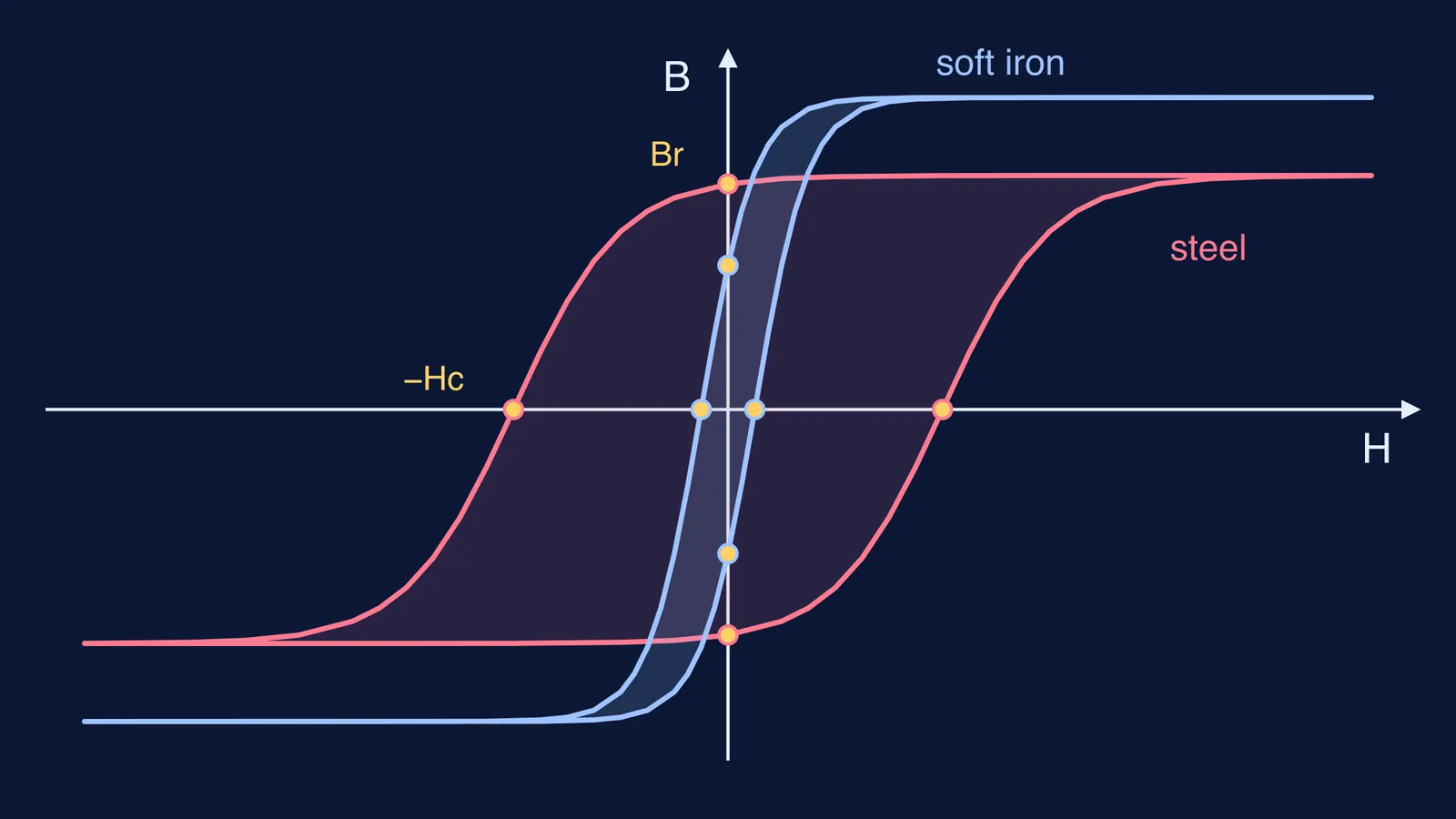
Put soft iron and steel in the same coil, push the current up, down and back, and plot B inside each against the magnetising field H. You get two closed loops, and their shapes tell you which metal belongs in an electromagnet. Here is how to read the two numbers that matter, retentivity and coercivity.
What does a B–H hysteresis loop show?
A ferromagnet magnetised in one direction does not relax back to zero magnetisation when the magnetising field is removed, as HyperPhysics at Georgia State University explains. So B depends on the sample's history: going up, the curve follows one path; coming down, it follows another.
The current NCERT Class 12 chapter Magnetism and Matter (section 5.5.3) sorts ferromagnets into two groups. In hard ferromagnets such as Alnico, an alloy of iron, aluminium, nickel, cobalt and copper, the magnetisation persists after the field is removed. In soft ferromagnets such as soft iron, it disappears. HyperPhysics adds that the hard group includes various steel alloys, and that soft iron is used for transformer and motor cores.
The area inside the loop matters too. In a 2025 review of hysteresis in magnets, Deepak Dhar of ICTS-TIFR and Sanjib Sabhapandit of the Raman Research Institute, both in Bengaluru, write that the energy dissipated per cycle is equal to the area of the hysteresis loop. A wide loop turns more energy into heat each time the field reverses. For the wider picture of dia-, para- and ferromagnets, see our explainer on magnetic materials and their hysteresis loops.
How do you read retentivity and coercivity off a hysteresis loop?
Retentivity (also called remanence) is the offset left at zero field, where the loop cuts the B axis, as described in Wikipedia's article on magnetic hysteresis. Coercivity is the reverse H needed to bring B back to zero, where the loop cuts the H axis; the same article notes that the width of the loop's middle section along the H axis is twice the coercivity.
Worked example: the diagram at the top comes from a simple model, B = Bs tanh((H − Hc)/a) rising and B = Bs tanh((H + Hc)/a) falling, with made-up teaching values in model units (soft iron Bs = 1.6, Hc = 0.125, a = 0.25; steel Bs = 1.2, Hc = 1.0, a = 0.5). They are not measured data.
Find where each loop cuts the vertical B axis. Soft iron: 1.6 × tanh(0.5) ≈ 0.74. Steel: 1.2 × tanh(2) ≈ 1.16. That is retentivity, and in this model steel keeps more.
Find where each loop cuts the horizontal H axis on the left. Soft iron crosses at H = −0.125, steel at H = −1.0. That is coercivity: in this model steel needs 8 times the reverse field to wipe out its magnetism.
Compare the areas. For this model the loop area works out to 4 × Bs × Hc: 0.8 for soft iron and 4.8 for steel, so model steel turns 6 times as much energy into heat per cycle.
Decide. Low coercivity and a small area mean the core lets go quickly and stays cool.
Soft iron vs steel: which suits an electromagnet?
An electromagnet must be strong while current flows and weak the moment it stops. In an electric bell that switches its electromagnet on and off, a core that stayed magnetised would hold the hammer down. Checklist for any loop:
Narrow loop, low coercivity: soft iron. Suits electromagnets and transformer cores; Wikipedia notes that soft, low-coercivity magnets are used as cores in transformers and electromagnets.
Wide loop, high coercivity: steel and Alnico. Suits permanent magnets, and NCERT lists the compass needle among their uses.
Steep rise near the origin: high permeability, so a modest current gives a large B.
Small loop area: less heating when the current keeps reversing, as in AC devices.
So soft iron wins for the electromagnet and steel wins for the permanent magnet. Our post on electromagnets vs permanent magnets sets out the Class 10 version of the same choice.
How can you run a hysteresis loop simulation yourself?
A ten-minute plan:
Predict first: sketch both loops and mark where each should cross the axes.
Sweep H from zero to a large positive value, through zero to a large negative value, and back up.
Pause at H = 0 on the way down and note B: your retentivity.
Keep reversing H until B reaches zero and note H: your coercivity.
Switch material, repeat, and compare both pairs of numbers with your sketch.
Explain aloud, in two sentences, why soft iron suits the electromagnet. If you cannot, run it again.
If the loop still feels abstract, the Fermi Simulation Lab has interactive simulations for ideas that are easier to see than to read. Fermi's AI tutor can run the simulation with you and check your understanding as it goes.
Next time you see a B–H loop in a question, go to the H-axis crossings first: the narrow loop is the electromagnet.