

On this page
You press the button, the bell rings, and it keeps ringing for as long as your finger stays down. That steady ringing comes from one clever detail: the bell keeps switching its own electromagnet off and on again. Once you see that loop, the diagram becomes a story you can retell in an exam.
How does an electric bell work using an electromagnet?
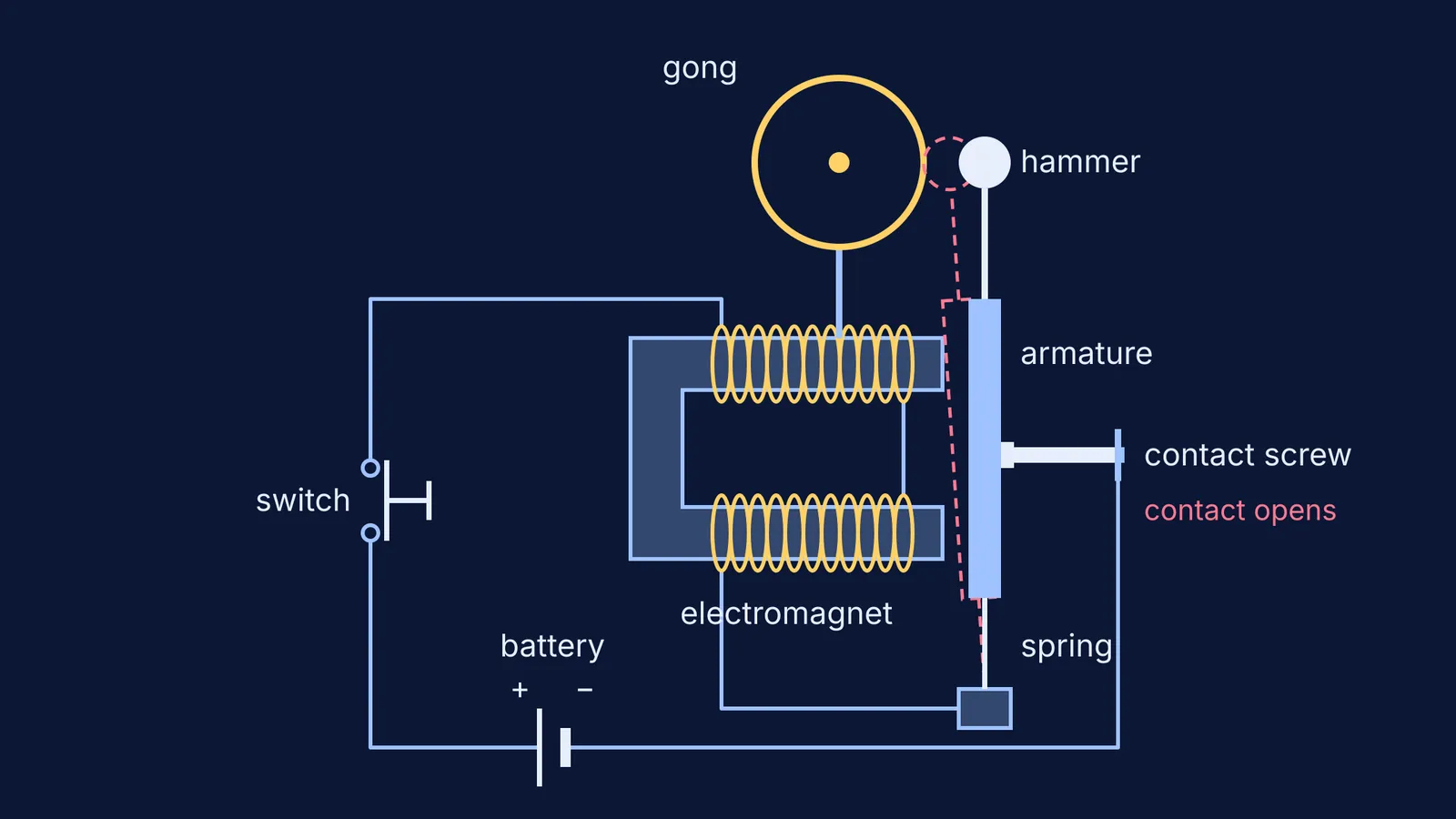
An electromagnet is a magnet whose field is produced by an electric current, and the field disappears when the current is turned off (Wikipedia: Electromagnet). The UK teaching site schoolphysics traces the current's path in a bell: from the battery, through the electromagnet, along the spring, through the contacts and the adjusting screw, and back to the battery.
Here is one full cycle:
You press the switch. The circuit is complete, current flows through the coil, and the electromagnet switches on.
The electromagnet pulls the soft iron armature towards it. The hammer fixed to the armature hits the gong once.
As the armature moves, it pulls away from the contact screw. The circuit opens and the current stops.
With no current, the electromagnet switches off and the spring pulls the armature back.
The armature touches the contact screw again, the circuit closes, and the cycle starts over.
The cycle repeats many times per second, which is why you hear continuous ringing rather than separate taps (Wikipedia: Electric bell).
Why does an electric bell keep ringing instead of striking once?
The answer is the make-and-break contact, also called the interrupter. Without it, the electromagnet would stay on and hold the armature in, so the hammer would strike once and stay there. The contact turns the battery's steady current into a rapid on-off current in the coil.
According to the Wikipedia article on the electric bell, Johann Philipp Wagner invented a vibrating "hammer" interrupter in 1839, and John Mirand added a clapper and gong around 1850 to make the standard electric bell. The electromagnet itself dates from the 1820s, and you can read how it came about in how William Sturgeon built the first electromagnet.
Why is the armature made of soft iron and not steel?
The armature has to let go the moment the current stops. Soft (annealed) iron has low coercivity, so it does not stay magnetised once the field is removed, which matters in any device where the field is switched on and off repeatedly (Wikipedia: Magnetic core). Hard magnetic materials, such as hardened steel, keep some magnetism, so a steel armature could stay stuck to the poles.
The iron core also adds strength. A ferromagnetic core can make the field thousands of times stronger than the coil alone (Wikipedia: Electromagnet). That is why the coil is wound on iron, not in air. For the full comparison, see electromagnets versus permanent magnets.
What happens if one part of the bell fails?
A good way to test your understanding is to break one part of the loop. Work each one out by asking two questions: is the current on or off, and what is pulling the armature?
Contact screw unscrewed too far: the circuit never closes, so the electromagnet never switches on. No sound.
Contacts bypassed with a wire: the circuit can never open. The magnet stays on, so the hammer strikes once and is held there.
Spring broken: the magnet pulls the armature once and nothing pulls it back. One strike, then silence.
Steel armature instead of soft iron: it may stay partly magnetised and cling to the poles, so the ringing stutters or stops.
Battery connected the other way round: the bell still rings. The electromagnet's poles swap, but soft iron is attracted to either pole.
How do you write the electric bell answer in an exam?
A good short answer covers the principle, the cycle and the reason it repeats. Use this frame:
Principle: An electric bell works on the magnetic effect of current: a coil carrying current becomes an electromagnet.
Make: When the switch is pressed, current flows, the electromagnet attracts the soft iron armature, and the hammer strikes the gong.
Break: The armature's movement separates it from the contact screw, the circuit breaks, the electromagnet loses its magnetism, and the spring pulls the armature back.
Repeat: Contact is restored, current flows again, and the cycle repeats rapidly, so the bell rings continuously.
Draw the labelled diagram beside it: battery, switch, coil on an iron core, armature, spring, contact screw, hammer and gong. Mark the contact point clearly, because the whole answer depends on it.
If you want to see the effect with your own hands, start by making an electromagnet at home and switching it on and off near a paper clip. If the on-off cycle is still hard to picture, the Fermi Simulation Lab has interactive simulations for ideas that are easier to see than to read. The Fermi Concept Library gives each physics concept its own lesson, so you can go back to the magnetic effect of current before your next problem set.


