On this page
Gravitation is the chapter where four ideas blur into one: g, G, field and potential. Ask an AI tutor to "explain gravitation" and you often get a smooth summary that hides the blur. The prompts below force the tutor to keep the four apart. The quick checks after them catch many wrong satellite answers.
What is the difference between g, G, field and potential?
G is the universal gravitational constant, the same everywhere: 6.674 30 × 10⁻¹¹ m³ kg⁻¹ s⁻² in the 2022 CODATA values published by NIST.
g is the gravitational field strength at a place, in N/kg (the same as m/s²). It changes with height, depth and planet. The conventional standard value is exactly 9.806 65 m/s² (NIST), and NASA lists Earth's mean surface gravity as 9.820 m/s² (NASA Earth fact sheet).
Field is a vector. Outside a sphere of mass M it has size GM/r² and points towards the centre.
Potential is a scalar: energy per kilogram, in J/kg. Outside the sphere V = −GM/r, which is zero at infinity and negative everywhere else.
The NCERT Class 11 gravitation chapter covers all four, from g above and below the surface to the energy of an orbiting satellite (NCERT Physics Part I, Chapter 7). If the minus sign in V bothers you, read why gravitational potential energy is negative.
Which questions should you ask an AI tutor about gravitation?
Use these one at a time; each makes the tutor commit to something checkable.
"Before solving, list every symbol you will use, its unit, and whether it is a constant, a vector or a scalar." If G and g get the same unit, the tutor has failed.
"In three sentences, explain why G is the same on the Moon but g is not, without using the word gravity."
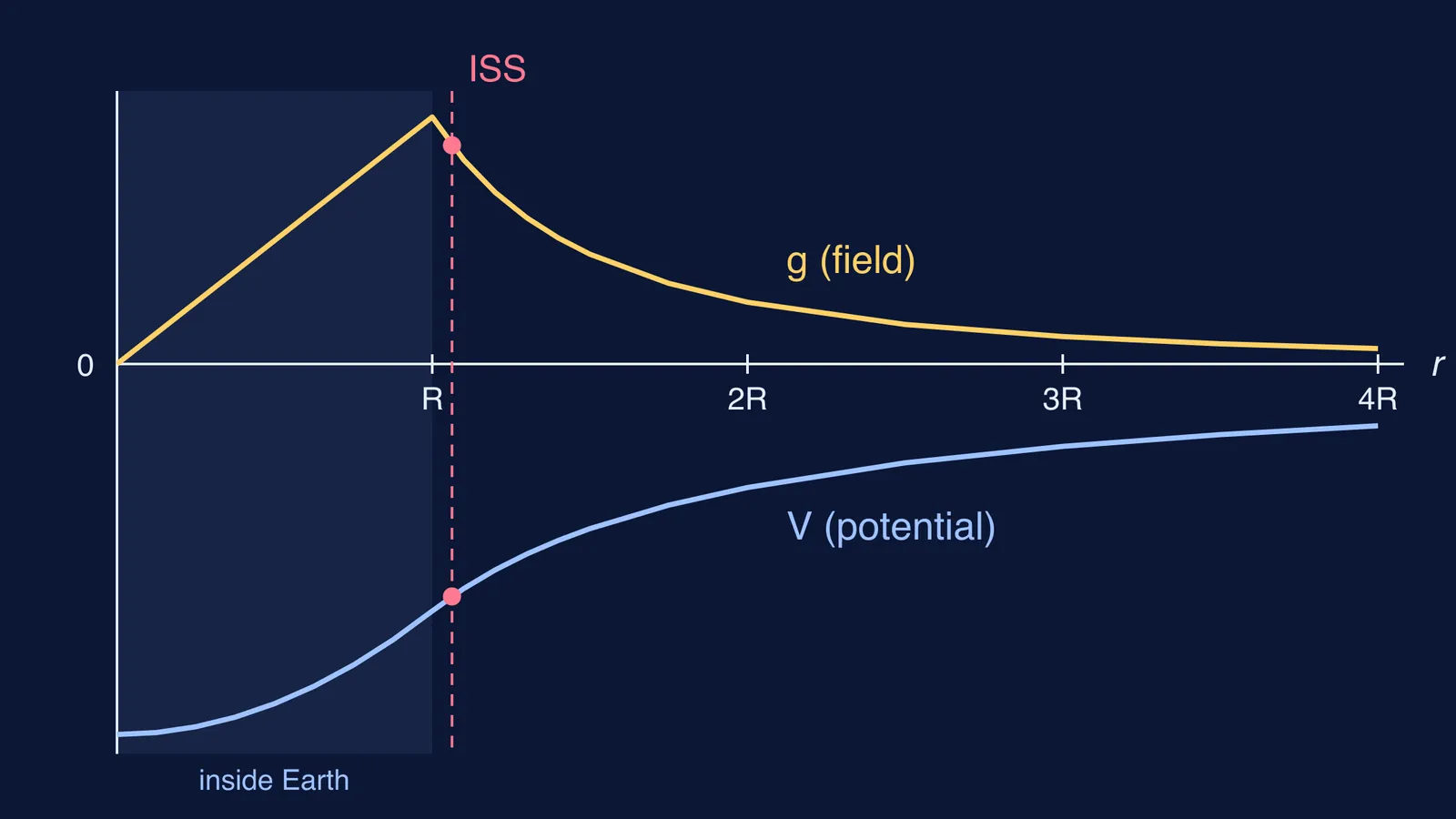
"Assuming a uniform-density Earth, describe how g changes from Earth's centre out to infinity, then do the same for V. Where is each largest in size?" The answer to look for: in this textbook model g peaks at the surface, but V is most negative at the centre. You can see both curves in our graph of gravity inside Earth.
"A satellite orbits at height h. Derive its speed, period and total energy, then show what each becomes as h → 0 and as h → ∞."
"I think astronauts float because g is zero up there. Correct me if I am wrong." A tutor that agrees with a planted mistake is not checking you.
How do you check an AI's satellite answer with limiting cases?
Run these four tests on any orbit formula the tutor gives you. The Earth values come from the NASA Earth fact sheet.
Mass test. Orbital speed v = √(GM/r) must not contain the satellite's own mass. If m survives in the answer, stop and ask why.
Ground test. Put r = R. The speed should become √(gR), about 7.9 km/s for Earth.
Far-away test. Let r → ∞. Field, potential and speed should all go to zero, and total energy should rise towards zero from below, never above it for a bound orbit.
Escape test. Escape speed √(2GM/R) is √2 times the ground orbital speed, about 11.2 km/s. NASA lists 11.186 km/s (NASA Earth fact sheet).
Is g zero on the International Space Station?
No. NASA says the International Space Station orbits between 370 and 460 km up (NASA ISS reference). Take h = 400 km, with GM = 3.986 × 10¹⁴ m³/s² and a mean radius of 6371 km from the NASA Earth fact sheet.
r = 6371 + 400 = 6771 km.
g = GM/r² ≈ 8.69 m/s², about 89% of the surface value.
v = √(GM/r) ≈ 7.67 km/s.
T = 2πr/v ≈ 5545 s, about 92 minutes.
The shortcut g(1 − 2h/R) gives about 87%, roughly one percentage point low, because it assumes h is much smaller than R.
So astronauts float because they and the station are falling together, not because g has vanished. Why astronauts feel weightless in orbit explains the free-fall picture.
Now give the tutor the same problem. If it says g is 0 or 9.8 m/s² at 400 km, it has mixed up the field with what you feel.
What should you do when the AI gets it wrong?
Name the check that failed instead of saying "that's wrong". For example: "Your v depends on m, but the mass should cancel. Redo the step where you equated forces."
If you don't know where to start in the chapter, Fermi's AI tutor works out what you already know and builds a plan for the session. Orbits are easier to see than to read, so the Fermi Simulation Lab has interactive simulations to explore before you predict an answer by hand.
Tonight, pick one orbit question from your textbook exercises and run all four limiting-case tests on the tutor's answer.