On this page
Flick one carrom coin into another that is sitting still, slightly off-centre, and watch where they go. One slides off to the left, the other to the right, and the gap between their paths often looks close to a right angle. That is no accident. It falls out of two conservation laws in three lines of algebra.
Why do equal mass balls move at 90 degrees after a collision?
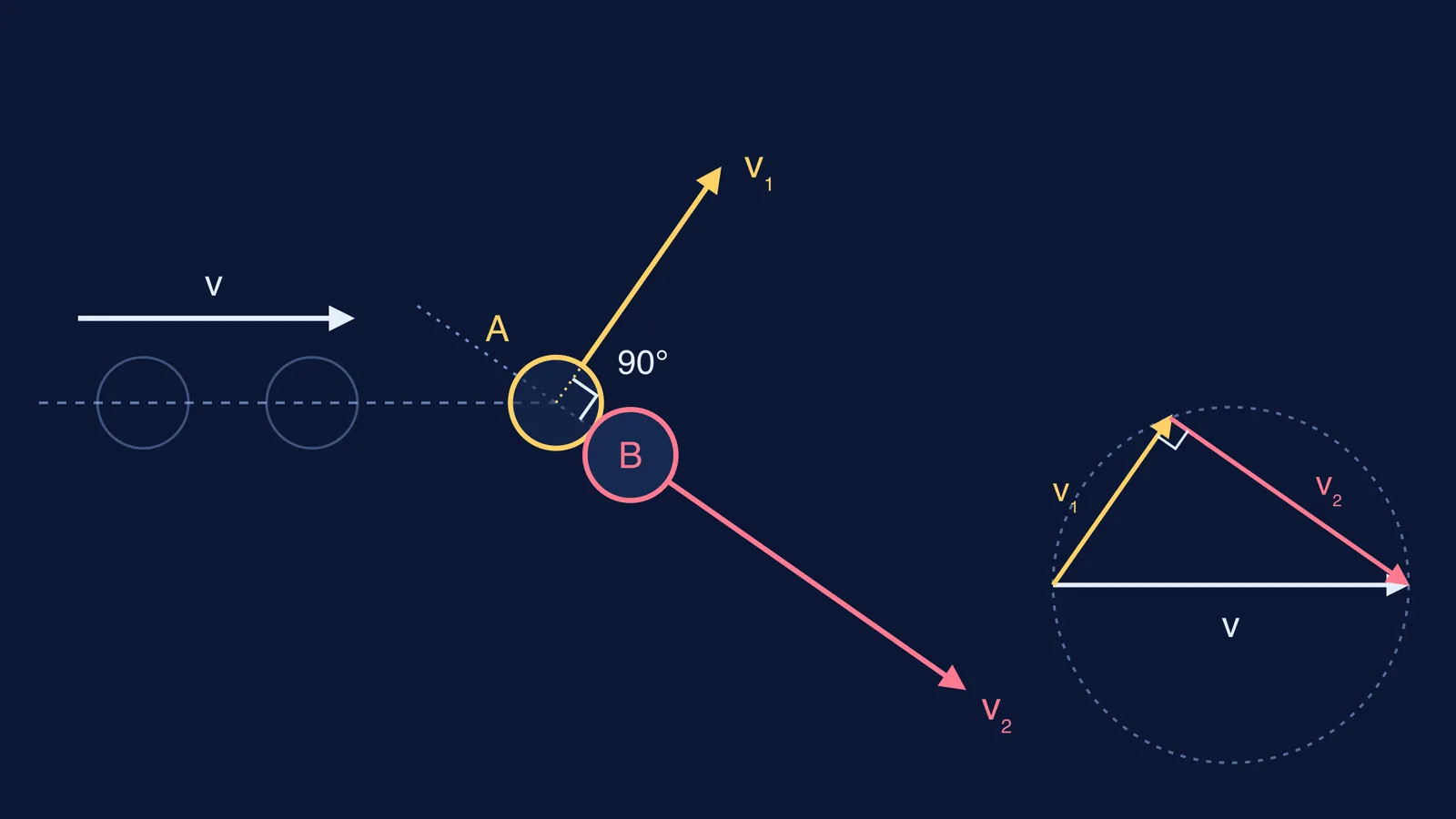
Take ball A of mass m moving with velocity v, and an identical ball B at rest. After the collision A has velocity v₁ and B has v₂. The derivation follows OpenStax College Physics 2e, section 8.6.
Momentum is conserved: mv = mv₁ + mv₂. Cancel m, and v = v₁ + v₂. The three velocity vectors close into a triangle.
Kinetic energy is conserved, because the collision is elastic: ½mv² = ½mv₁² + ½mv₂². Cancel ½m, and v² = v₁² + v₂².
Square the momentum equation instead (take its dot product with itself): v² = v₁² + v₂² + 2v₁·v₂. Compare with step 2, and the last term must be zero: v₁·v₂ = 0.
A zero dot product between two non-zero vectors means they are perpendicular. In OpenStax's words, the angle of separation "is 90º after the collision" (OpenStax). Geometrically, step 2 says the velocity triangle from step 1 obeys Pythagoras, so it is a right triangle with v as the hypotenuse.
The one exception is a dead-centre hit: A stops, B leaves with A's full speed, and there is no angle to measure.
How fast does each coin move after a glancing hit?
For smooth coins, the push between them acts along the line joining their centres at the moment of contact. So B always leaves along that line, and A leaves at right angles to it. If the line of centres makes an angle θ with A's original path, B gets speed v cos θ and A gets v sin θ.
A worked example: A moves at 2.0 m/s and the line of centres is at θ = 30°.
B leaves at 30° to one side with 2.0 × cos 30° ≈ 1.73 m/s.
A leaves at 60° to the other side with 2.0 × sin 30° = 1.00 m/s.
Energy check: 1.73² + 1.00² ≈ 3.0 + 1.0 = 4.0 = 2.0².
Sideways momentum check: 1.73 × sin 30° − 1.00 × sin 60° ≈ 0.87 − 0.87 = 0.
A thin graze leaves B creeping away; a near head-on hit hands B almost all the speed. The 90° split holds for every θ.
Does the 90° rule work for the carrom striker?
Not exactly, and the reason is in the rulebook. The Laws of Carrom published by the All India Carrom Federation allow a striker weighing up to 15.00 g, while each carrom man must weigh between 5.25 g and 5.50 g. Two coins are close to equal masses. A full-weight striker is nearly three times as heavy as a coin.
Run the same algebra with masses m₁ (moving) and m₂ (at rest) and you get v₁·v₂ = (m₁ − m₂)v₂² / 2m₁. So:
m₁ = m₂: the dot product is zero, so the paths are at 90°.
m₁ > m₂ (heavy striker on a light coin): the dot product is positive, so the angle is less than 90°. The striker follows the coin forward.
m₁ < m₂ (light ball on a heavy one): the dot product is negative, so the angle is more than 90°, and a near head-on hit sends the light ball backward.
The heavy-on-light and light-on-heavy cases along a straight line are worked through in our post on what happens when a heavy ball hits a light ball.
How can you test the 90° split in a simulation?
Write each prediction down before you press play in any two-dimensional collision simulation.
Equal masses, elastic, hit dead-centre. Predict: A stops, B takes all the speed.
Equal masses, elastic, change the offset three times. Predict: the angle between the paths stays 90° while the two speeds change.
Make A three times heavier, like a striker. Predict: the angle drops below 90°.
Make A lighter than B. Predict: the angle opens past 90°.
Equal masses, but let the collision lose some energy. Predict: then v² is more than v₁² + v₂², the dot product turns positive, and the angle shrinks below 90°.
If a result surprises you, find the step of the proof that changed. For more ideas that are easier to see than to read, the Fermi Simulation Lab has interactive simulations. The same collision looks even simpler in the centre-of-mass frame, where elastic velocities just reverse, and it helps to know why momentum is conserved in collisions despite gravity.
When a JEE problem gives two equal masses, one at rest, colliding elastically, write 90° in the margin first. It often removes an unknown.