On this page
A fish's gill is a thin sheet where water on one side passes blood on the other, and oxygen diffuses from the water into the blood. Does it matter which way the blood flows? Guess first, then check.
Predict first: same way or opposite ways?
Take the simplest version. Water arrives at the gill carrying 100 units of oxygen. Blood arrives carrying 0. Both stream past each other at the same rate, and oxygen only ever moves from where there is more to where there is less.
Write two numbers on paper before you scroll:
If water and blood flow the same way, how much oxygen does the blood carry when it leaves?
If they flow in opposite directions, how much?
A common guess is the same answer for both, since only the direction changes.
What happens when water and blood flow the same way?
At the entrance, fresh water meets oxygen-poor blood, so the gap is large (100 against 0) and oxygen rushes across. As the two travel together, the water loses oxygen and the blood gains it. The gap shrinks and transfer slows.
You can prove the limit yourself. With equal flows, every unit the water loses, the blood gains, so the two always add up to 100. Oxygen stops moving when they are equal. Two numbers that add to 100 and are equal must both be 50. However long the gill, the blood cannot leave with more than 50.
That matches the figure in lecture notes from Millersville University's animal physiology course: with same-direction flow, oxygen is exchanged until the concentrations are equal, so at most 50% of it can be transferred.
How does countercurrent exchange in fish gills get more oxygen?
Countercurrent exchange means two fluids flow past each other in opposite directions, so each stretch of blood meets water that is a little richer in oxygen than itself. In a fish, blood moves through the gill in the opposite direction to the water passing over it.
Follow the blood. It enters at the far end, where the water has given up most of its oxygen but still has more than the empty blood. As the blood moves on, it meets fresher and fresher water. The gap never closes, so oxygen keeps crossing along the whole length.
With opposite flow, more than 80% of the oxygen can be transferred, the same Millersville course notes say. A 2023 paper in Royal Society Open Science by Jin-Bo Hou and colleagues states that the countercurrent mechanism can absorb up to 90% of dissolved oxygen in fish and crustaceans, while noting that its efficiency varies between organisms with several physiological factors (Hou et al., 2023).
Can you check the answer by hand?
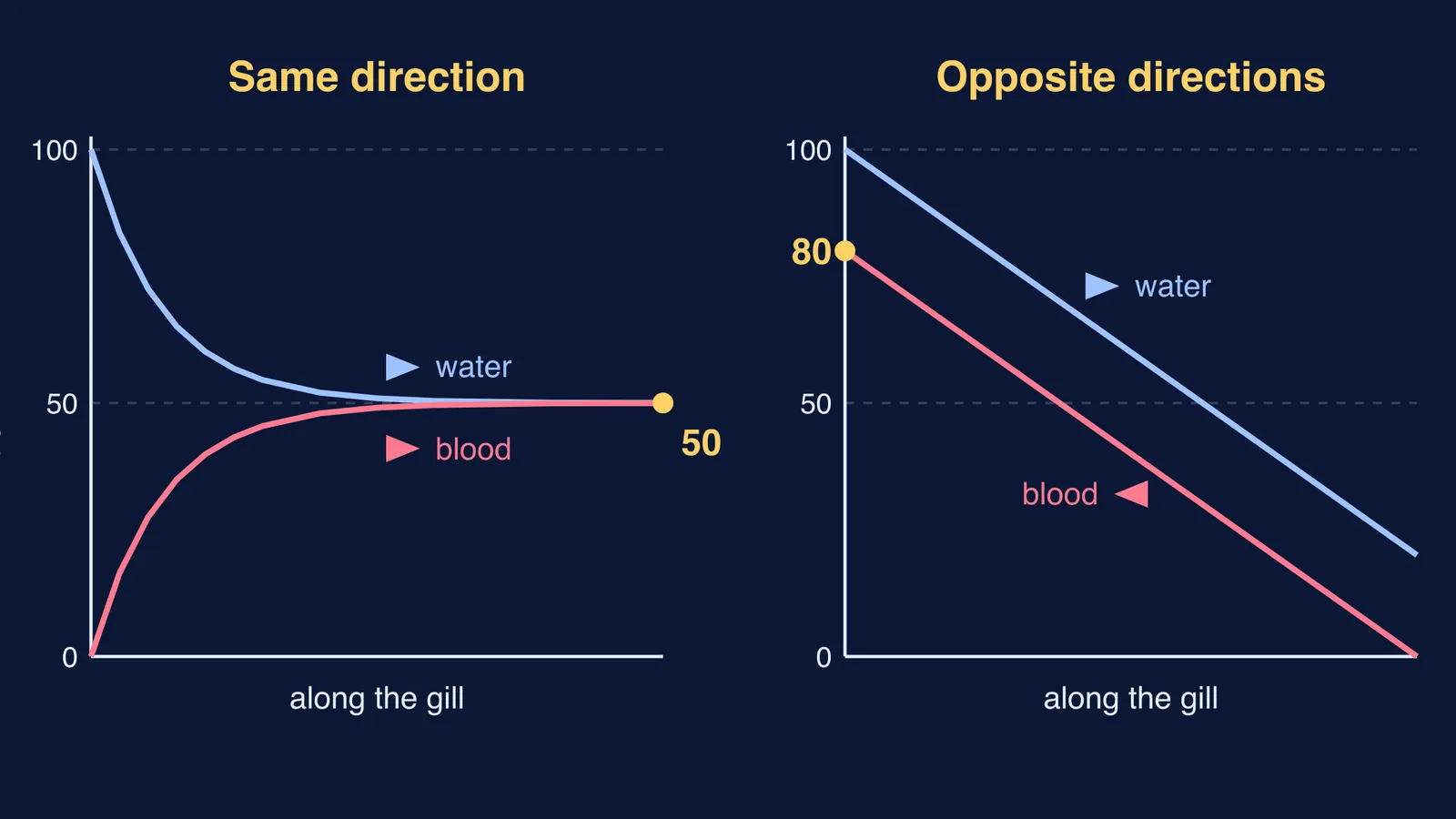
Yes. The diagram at the top of this post comes from a simple model of the setup above: equal flows, with oxygen crossing at a rate proportional to the gap between water and blood. We chose an exchange strength at which the opposite-flow gill reaches 80, at the low end of the range the sources give.
Same direction: the gap starts at 100 and falls towards zero. Blood leaves at 50 and so does the water.
Opposite directions: the gap is 20 everywhere. Water enters at 100 and leaves at 20. Blood enters at 0 and leaves at 80.
Check the second case with conservation: the water lost 100 minus 20, or 80 units, and the blood gained 80. They match, as they must. At one end, used water at 20 meets fresh blood at 0; at the other, fresh water at 100 meets blood already at 80.
Same gill, same water, same blood: the blood leaves with 80 instead of 50, only because one flow was reversed. Now compare with your two numbers.
How do you turn this into a habit for biology answers?
Use this four-step check whenever a question involves two things exchanging heat, gas or salt:
Predict with a number, not just "more" or "less".
Name the gap at the entrance, the middle and the exit.
Apply conservation: what one side loses, the other gains.
Write one sentence on why your guess was right or wrong.
For a written answer, one clear sentence captures the idea: blood and water flow in opposite directions, so a concentration gradient is kept along the whole gill surface and more oxygen diffuses into the blood than with same-direction flow. For the structures around it, read our explainer on how fish breathe through their gills. A related opposite-flow idea in the kidney is told in Werner Kuhn and the countercurrent multiplier.
Flow direction is a good example. The Fermi Simulation Lab has interactive simulations for ideas that are easier to see than to read, and the predict-first habit works with any of them. If a result does not match your guess, try our four-step method for asking AI why a simulation surprised you. And if you are stuck on why the gap stays constant, Fermi's AI tutor notices where you are stuck and decides whether to explain, ask or show.