

On this page
In 1881 a Russian student working in Gustav von Bunge's laboratory in Basel ran a simple test. Nikolai Lunin fed one group of mice whole milk and another a mixture made from the separate parts of milk that chemists knew about: protein, fat, sugar and salts. The milk-fed mice developed normally; the others died (Hektoen International). That result, tucked inside a paper about mineral salts, is now seen as the first experimental hint that foods carry tiny amounts of the substances we call vitamins.
What did Nikolai Lunin do with mice and milk in 1881?
Lunin's paper, "Ueber die Bedeutung der anorganischen Salze für die Ernährung des Thieres" (on the importance of inorganic salts for the nutrition of animals), appeared in 1881 in the Zeitschrift für physiologische Chemie (DOI record).
Frederick Gowland Hopkins described the work in his 1929 Nobel lecture: Lunin "fed mice upon an artificial mixture of the separate constituents of milk", meaning the proteins, fats, carbohydrates and salts then known, and "the animals failed to survive". Lunin concluded, in Hopkins's English rendering, that "a natural food such as milk must therefore contain besides these known principal ingredients small quantities of unknown substances essential to life".
A history of vitamin research in the International Journal for Vitamin and Nutrition Research gives a longer translation: mice "can live quite well" on suitable food such as milk, but "they are unable to live on proteins, fats, carbohydrates, salts, and water", so "other substances indispensable for nutrition" must be present in milk (Semba, 2012).
Why did the mice on purified milk die?
Today we would say the mixture lacked vitamins. Purified protein, fat, sugar and salts carry almost none of the tiny amounts of vitamins found in real milk. Whole milk still had them, which is why the milk-fed mice lived.
Purity cut both ways. In the same Nobel lecture, Hopkins said that researchers who doubted the idea had used ingredients that "were not pure and not free from adherent vitamins", which explains why their results seemed to contradict it. In his own 1906-1907 mouse tests, casein washed with water and alcohol lost its power to support growth.
For more on this, see our explainer on why biology experiments need a control group.
Why was Lunin's discovery ignored for 30 years?
Hopkins offered several reasons in his Nobel lecture. The paper's title was about salts, which hid the striking remark inside it. Bunge himself was "inclined to disbelieve" in unknown factors and blamed the way the minerals had been separated from milk. And the evidence was thin: in Hopkins's words, "the fate of six mice only" really suggested unknown factors, Lunin gave no data on how much they ate, and he never added parts of milk back to see which one rescued them.
Semba's review describes the late nineteenth-century dogma that nutrition needed only four things: proteins, carbohydrates, fats and minerals. Hopkins said no widespread belief in other essential constituents existed until 1911-1912.
How did Lunin's idea turn into vitamins?
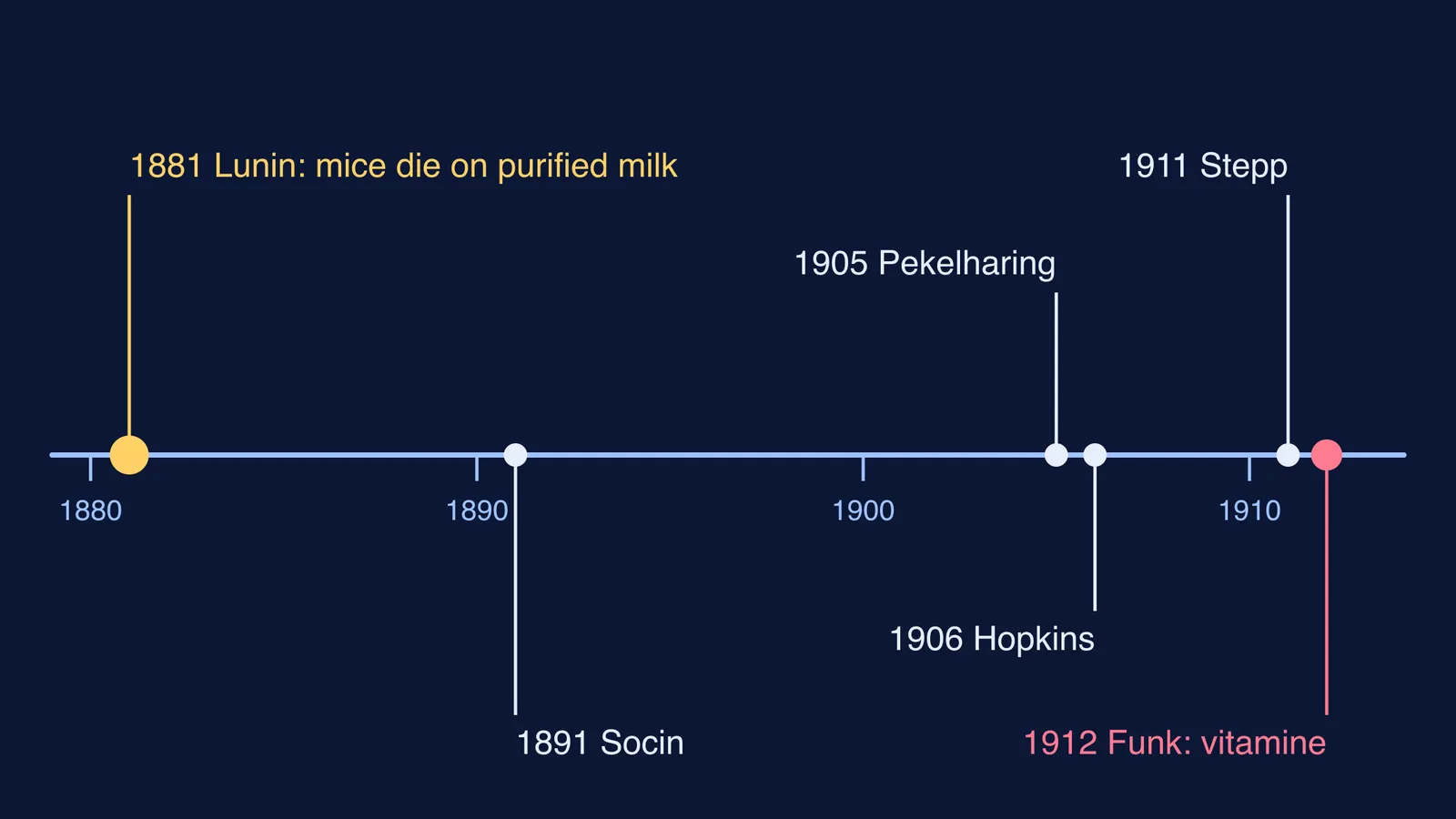
The idea kept returning (Semba, 2012; Hopkins, 1929):
1891: Carl Socin, another of Bunge's students, concluded that unknown substances essential to life were present in egg yolk and whole milk.
1905: Professor Pekelharing in the Netherlands wrote of "a still unknown substance in milk" of "paramount importance to nutrition", in a paper published only in Dutch that stayed unknown to most researchers for years.
1911: Wilhelm Stepp found that mice could not survive beyond three weeks on milk-bread extracted with alcohol and ether, and survived normally when the extract was added back.
1912: Hopkins showed that young rats on a purified diet grew normally once a small amount of milk was added, and Casimir Funk proposed the word "vitamine".
You can follow the next chapters in our stories on Frederick Gowland Hopkins and accessory food factors and Casimir Funk and the idea of vitamines.
What can you learn from Lunin's experiment today?
Lunin's paper is a good template for reading any experiment in your textbook. Answer these five questions in one line each before you read the conclusion:
What was changed? Whole milk versus milk rebuilt from purified parts.
What was kept the same? The species, the lab and the named nutrients.
Where is the control? The whole-milk group.
How strong is the evidence? According to Hopkins's Nobel lecture, only six mice really mattered, with no food-intake records.
What test would settle it? Add back one part of milk at a time and see which one keeps the mice alive. Hopkins notes that neither Lunin nor Socin did this.
Question 5 turns a hint into a discovery: if you cannot name the single test that would prove a claim, you have found its weak spot. If a term such as "fat-soluble vitamin" trips you up, the Fermi Concept Library has a lesson for every concept in biology and chemistry, with its place in the map.
Next time you read "milk is a complete food", remember Lunin's mice in Basel: a food can be more than the sum of its known parts.


