On this page
Before you read on, make a prediction. You have a two-pan balance and a box of weights, and you want to balance any whole load from 1 kg to 40 kg, with weights allowed in either pan. What is the smallest set, and which weights are in it? Write your guess down.
What is the fewest number of weights to weigh 1 to 40 kg?
The answer is four weights: 1, 3, 9 and 27 kg. Edwin O'Shea's paper Bachet's Problem: as few weights to weigh them all gives this answer and traces the puzzle to Fibonacci's Liber Abaci of 1202, which has a section on four weights weighing forty pounds. ProofWiki's entry on the smallest set of weights for a two-pan balance credits the two-pan solution to Claude Gaspard Bachet de Méziriac, in his 1612 book Problèmes plaisans et délectables.
Notice the pattern: 1 + 3 + 9 + 27 = 40, and each weight is three times the one before it.
Why do powers of 3 work on a two-pan balance?
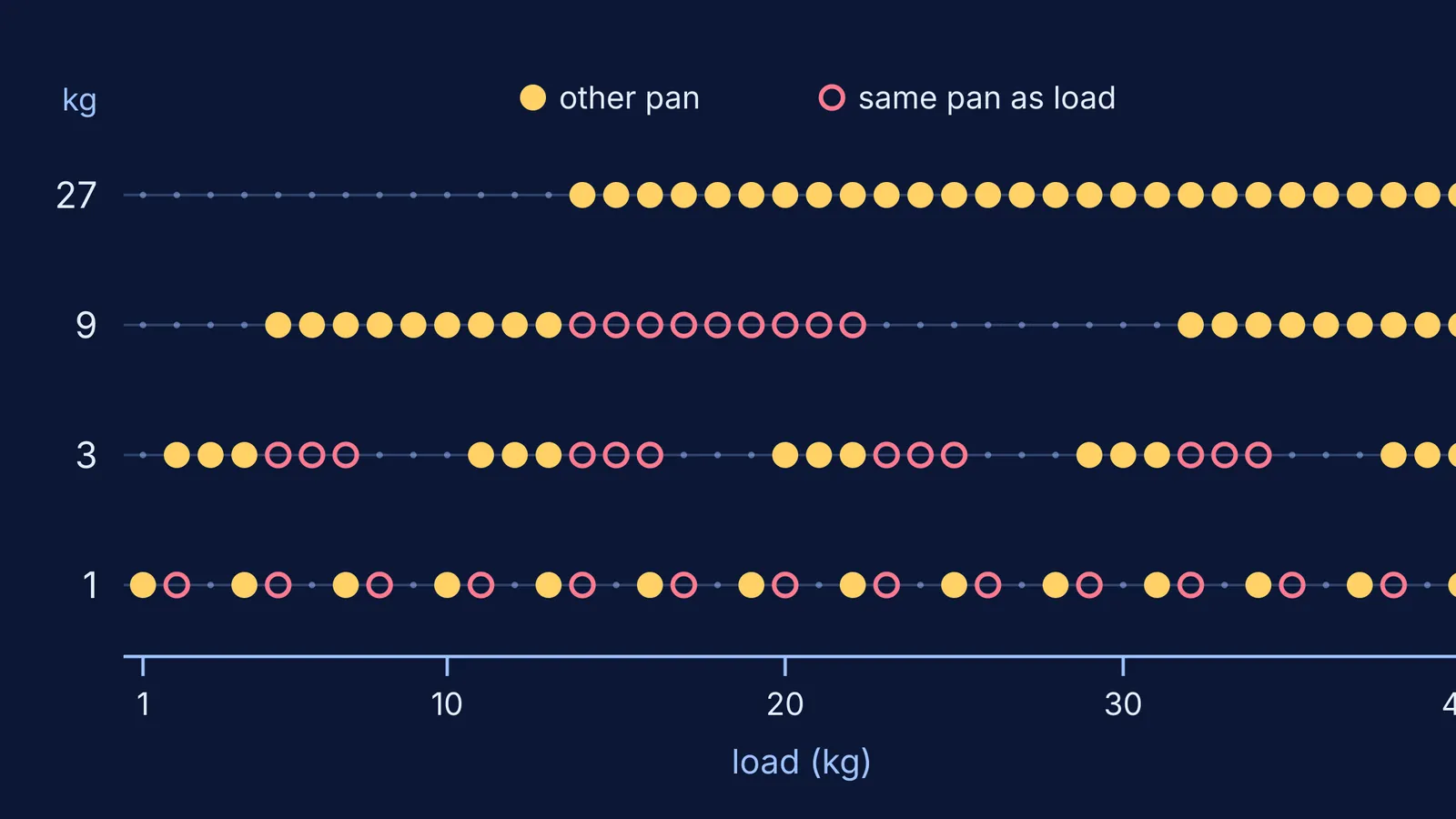
The key is that every weight has three places to go, not two:
in the other pan, where it adds to that side
in the same pan as the load, where it effectively subtracts
on the table, where it does nothing
Those three choices match the digits 1, −1 and 0 of balanced ternary, which writes numbers in base 3 using −1, 0 and 1 instead of 0, 1 and 2. A load's balanced-ternary digits tell you exactly where each weight goes.
To find them, divide the load by 3, starting with the 1 kg weight and moving up to 3, 9 and 27. Remainder 0: the weight stays on the table. Remainder 1: it goes in the other pan; subtract 1 before dividing again. Remainder 2: it goes in the load's pan; add 1 before dividing again.
Worked example, a 20 kg load:
20 ÷ 3 leaves 2, so the 1 kg weight goes with the load. (20 + 1) ÷ 3 = 7.
7 ÷ 3 leaves 1, so the 3 kg weight goes in the other pan. (7 − 1) ÷ 3 = 2.
2 ÷ 3 leaves 2, so the 9 kg weight goes with the load. (2 + 1) ÷ 3 = 1.
1 ÷ 3 leaves 1, so the 27 kg weight goes in the other pan.
Check: the load's pan holds 20 + 1 + 9 = 30 kg, and the other pan holds 27 + 3 = 30 kg. Balanced.
Try these, then check:
5 kg: 9 in the other pan, 3 and 1 with the load
14 kg: 27 in the other pan, 9, 3 and 1 with the load
25 kg: 27 and 1 in the other pan, 3 with the load
Why can't three weights do it?
Count the arrangements. With three weights, each in one of three places, there are 3 × 3 × 3 = 27. One is every weight on the table, which balances nothing. The other 26 come in mirror pairs, because swapping the pans gives the same load, so three weights can balance at most 13 loads.
With four weights there are 81 arrangements, and (81 − 1) ÷ 2 = 40: four weights just reach 40, with no arrangement wasted. O'Shea's paper gives the least number of weights for every load up to m as ⌊log₃(2m)⌋ + 1, which is 4 for m = 40 (arXiv).
The pattern keeps going. Weights 1, 3, 9 and so on up to 3^m weigh every whole load up to (3^(m+1) − 1) ÷ 2 (ProofWiki), so adding an 81 kg weight reaches 121 kg.
What if the weights can only go in one pan?
Then each weight has two places, in or out, and the answer becomes powers of 2. O'Shea notes that for loads up to 15, the one-pan answer is 1, 2, 4 and 8 (arXiv). Five powers of 2 reach only 1 + 2 + 4 + 8 + 16 = 31, so a one-pan scale needs six weights (1 to 32 kg) to cover 40. If your first guess was powers of 2, you solved the one-pan puzzle; the second pan is what saves two weights. Our guide to binary, octal and hexadecimal for CBSE computer science covers the base-2 side.
How do you turn this into a predict-then-test session?
A quick plan for a study break or the dinner table:
Predict a weight set and write one sentence on why.
With only 1 and 3, list every load you can balance. You should get 1 to 4.
Add 9 and fill in 1 to 13 by hand.
Explain why 13 is the ceiling for three weights.
Predict the next weight and the new maximum, then check with the formula.
For parents, one question does most of the teaching: "Where could the 1 kg weight go when the load is 2 kg?" Ask it, then wait.
The same habit works in physics. Our lever balance simulation guide applies predict-then-test to moments, and using an AI tutor alongside a simulation shows how to check your reasoning as you go. The Fermi Simulation Lab has interactive simulations for ideas that are easier to see than to read. If a method like the remainder rule trips you up, the Fermi Problem Library has a step-by-step solver that explains the reasoning rather than printing an answer.
Now check your first guess against the four weights. What did you assume?