On this page
Most students can recite the ten percent law. Fewer can say how little energy reaches an eagle at the top of a grassland food chain. Here you guess first, work it out, then keep adding levels until the chain runs out.
What is the ten percent law in an energy pyramid?
A trophic level is a feeding step: producers (plants and algae) are level 1, herbivores level 2, and so on up to the top predator.
The ten percent law says that roughly 10% of the energy stored at one trophic level ends up stored in the next level. The idea is credited to Raymond Lindeman's 1942 paper, The Trophic-Dynamic Aspect of Ecology, as summarised in his Wikipedia biography. You can read more about him in our profile of Raymond Lindeman and trophic efficiency.
Ten percent is an average, not a constant. When Daniel Pauly and Villy Christensen estimated the primary production needed to sustain the world's fish catch, they used a mean energy transfer efficiency of 10% between trophic levels, a value they derived from estimates in 48 published trophic models (Nature, 1995; abstract on FishBase). In the Silver Springs ecosystem described in OpenStax Biology 2e, the efficiency between the first two trophic levels was about 14.48%.
How much energy reaches the top predator?
Take a simple chain: grass, grasshopper, frog, snake, eagle. Suppose the grass stores 10,000 kJ. Before you read on, write down your guess for the eagle.
Now apply the ten percent law one step at a time:
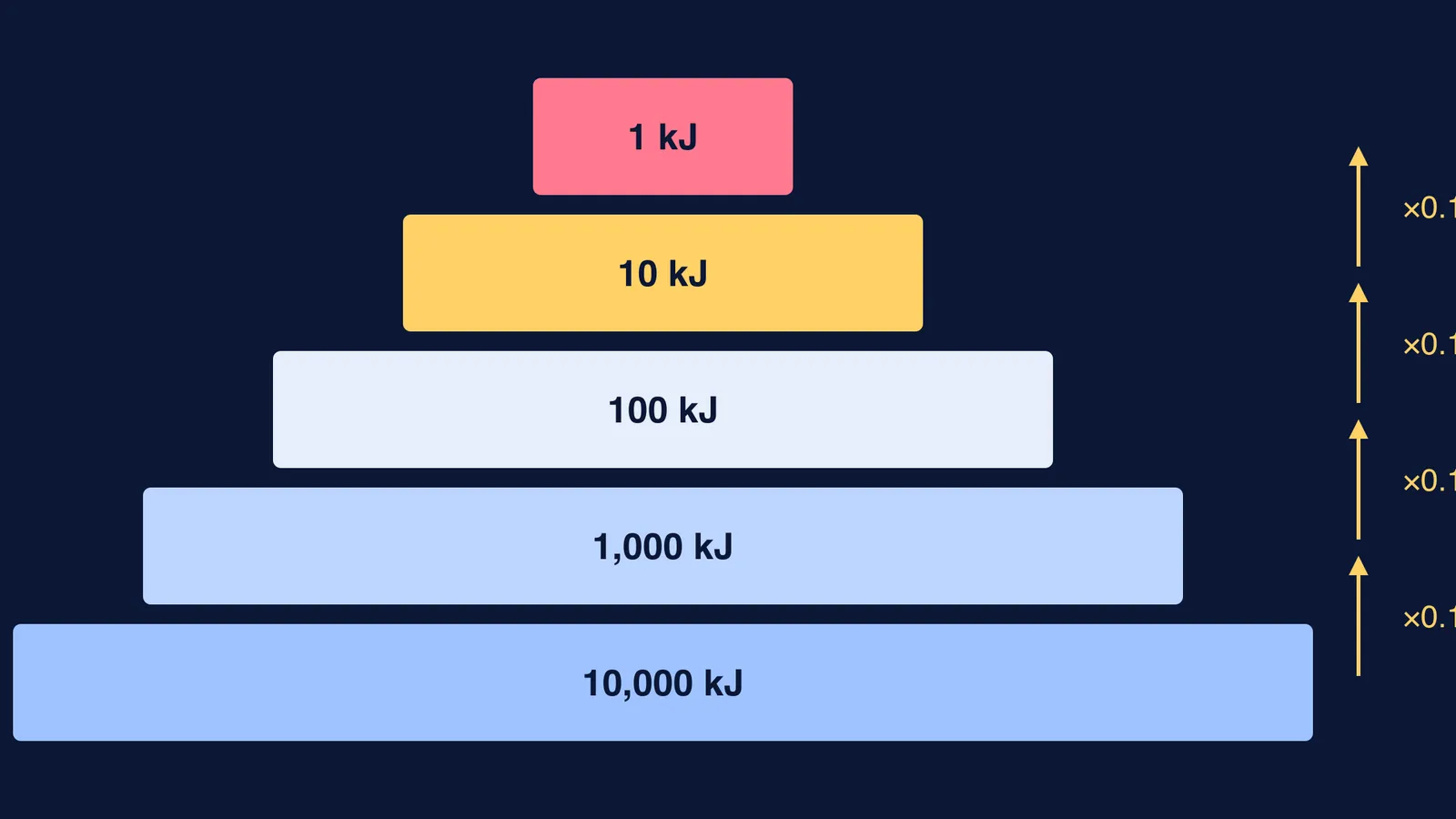
Grass (level 1): 10,000 kJ
Grasshopper (level 2): 10,000 x 0.1 = 1,000 kJ
Frog (level 3): 1,000 x 0.1 = 100 kJ
Snake (level 4): 100 x 0.1 = 10 kJ
Eagle (level 5): 10 x 0.1 = 1 kJ
The general rule is energy at level n = energy at level 1 x (0.1)^(n-1). The eagle gets one ten-thousandth of what the grass stored. That is why an energy pyramid is drawn wide at the base and narrow at the top, and why the OpenStax chapter on energy flow notes that pyramids of energy are always upright.
What happens when you add more levels?
Add a sixth level and it gets 0.1 kJ. A seventh gets 0.01 kJ. The ceiling arrives fast.
Now change the efficiency, since real values differ from 10% (Pauly and Christensen; OpenStax). From the same 10,000 kJ:
At 20% per step, level 5 gets 10,000 x 0.2^4 = 16 kJ.
At 10% per step, level 5 gets 1 kJ.
At 5% per step, level 5 gets about 0.06 kJ.
A factor of four in efficiency becomes a factor of 256 by the fifth level. Warm-blooded animals push efficiency down: OpenStax gives a net production efficiency of 18% for a caterpillar and as low as 1.6% for a squirrel, because endotherms use much of their energy to generate heat.
Why are food chains so short?
The energy losses are usually the main limit. OpenStax puts it plainly: after four to six energy transfers, there is not enough energy left to support another trophic level (OpenStax Biology 2e). Energy leaves each level largely as metabolic heat, a loss OpenStax ties to the second law of thermodynamics.
Energy is not the whole story, though. A 2013 meta-analysis by Gaku Takimoto and David Post, summarised on Post's lab page at Yale, found a strong but variable effect of ecosystem size on food-chain length and only a weak but consistent effect of resource availability. Post's review, The long and short of food-chain length02455-2), frames chain length as the result of several interacting constraints. To see what happens when one link disappears, try our walk-through on removing a species from a food web.
How do you solve ten percent law questions in exams?
The same few moves cover most board-exam and NEET-UG questions on this topic:
Number the levels from the producer, which is always level 1.
Going up, multiply by 0.1 for each step. Going down, multiply by 10.
For "how much must the producer fix to give the predator X kJ", count the steps and multiply X by 10 for each.
If the question gives a different efficiency, use it instead of 10%.
Check the units (kJ, kcal or J) and that the answer shrinks as you go up.
For more practice, work through our set of ten percent law energy flow calculations. If the multiplying-by-0.1 steps keep slipping, the Fermi Problem Library has worked problems with a step-by-step solver that explains the reasoning rather than printing an answer.
Some ideas are easier to see than to read. The Fermi Simulation Lab has interactive simulations for the ideas that are easier to see than to read. On paper, you can run the same experiment yourself: change one number and watch the top of the pyramid disappear.