On this page
You can watch water move into and out of a model cell on your kitchen counter. Soak a raw egg in vinegar until the shell is gone, then put the bare egg in water or in syrup. Before you do, write down a prediction: will it get bigger, smaller or stay the same, and by how much? Then weigh it and find out.
What happens to a shell-less egg in water and in syrup?
In water, the egg swells. In syrup, it shrinks and wrinkles. Scientific American's version of this activity explains that in water, “water moves from the outside solution, across the membrane and into the egg”, while the egg in corn syrup may end up looking “like a deflated balloon”.
Osmosis is the movement of water across a selectively permeable membrane, from where water is more concentrated to where it is less concentrated (Carolina Biological Supply).
The rule to hold on to: water moves towards the side with more dissolved stuff in it. Pure water outside the egg has a higher water concentration than the inside of the egg, so water goes in. Syrup is the opposite. As Carolina puts it, “because corn syrup contains a high amount of sugar, water molecules moved from the inside of the egg” to the syrup outside.
If the words hypotonic and hypertonic keep swapping places in your head, our explainer on isotonic, hypotonic and hypertonic solutions sorts them out with examples.
How does vinegar remove an eggshell?
The shell is almost entirely mineral. A 2021 review in Frontiers in Genetics describes the bird eggshell as “made of 95% calcite and 3.5% organic matrix” (Le Roy and colleagues, 2021). Calcite is a form of calcium carbonate.
Vinegar contains acetic acid, which reacts with the calcium carbonate in the shell (Carolina Biological Supply). The tiny bubbles that collect on the egg are carbon dioxide from that reaction (Scientific American).
Scientific American's method swaps in fresh vinegar after 24 hours and says the shell should be gone by the third day. What remains is a white membrane that is “actually two membranes” held tightly together. It stands in for a cell membrane: water can cross it, so the egg behaves like a very large model cell.
How do you test it and track the water?
Soak two raw eggs in vinegar, in separate jars, until no shell is left. Pour liquids off slowly: Carolina's procedure warns against rupturing the membranes.
Rinse each egg gently, pat it dry and weigh it on a kitchen scale.
Write a prediction for each egg: bigger, smaller or the same, and roughly how many grams.
Put one egg in water (distilled if you can get it) and the other in syrup. Leave both for 24 hours.
Lift each egg out, rinse, pat dry, then weigh again.
Work out the change in grams and the percentage change.
Extra round: move the syrup egg into water for another day. Predict first, then check.
A scale beats your eye. Carolina's activity uses a balance and records mass in grams, which turns “it looks a bit bigger” into a number you can compare.
How much water does a shell-less egg gain or lose?
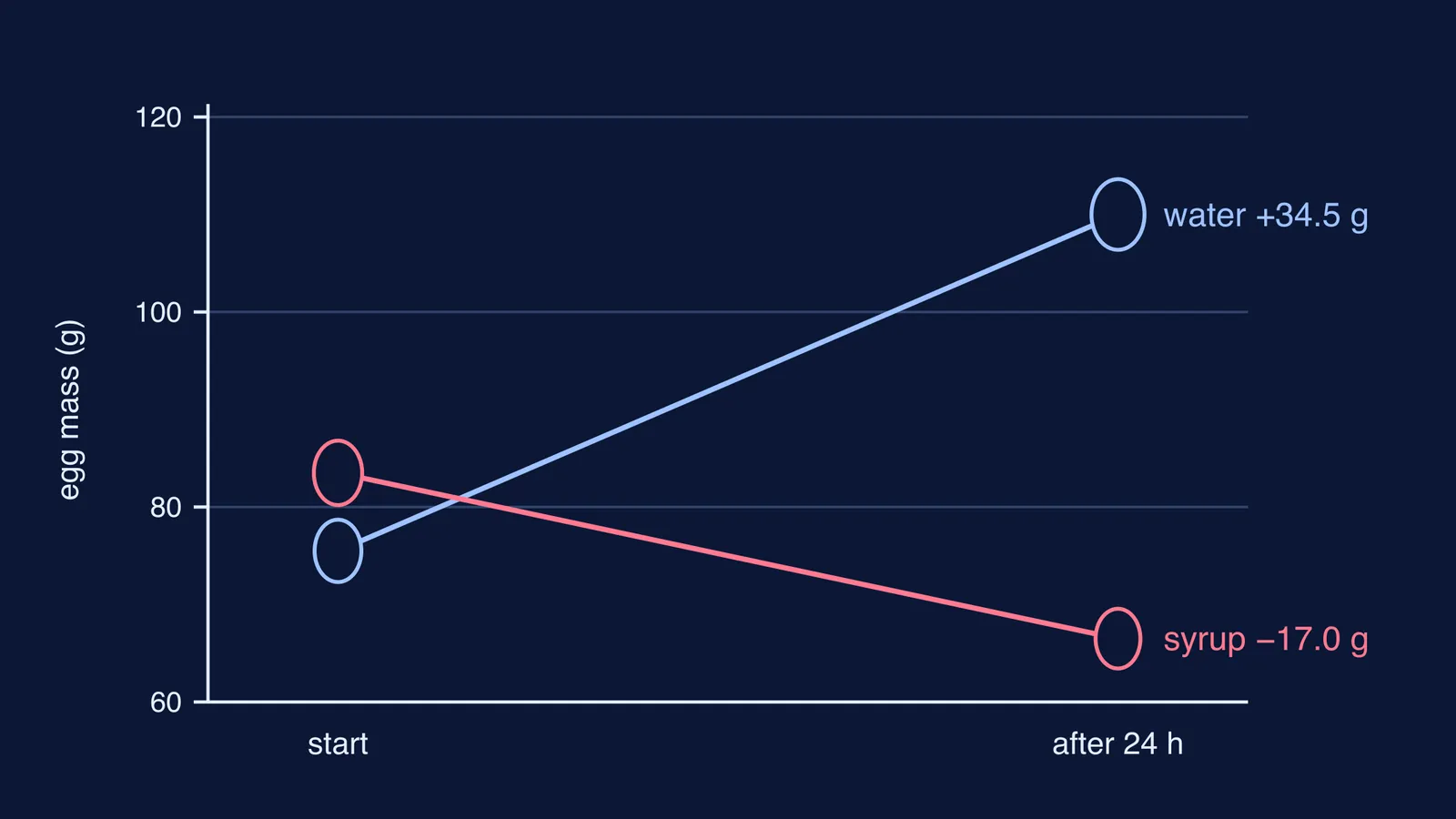
In Carolina's sample data, egg 1 weighed 75.5 g after the vinegar and 110.0 g after 24 hours in distilled water, a gain of 34.5 g. Egg 2 went from 83.5 g to 66.5 g in corn syrup, a loss of 17.0 g.
Percentage change = change in mass ÷ starting mass × 100.
Water egg: 34.5 ÷ 75.5 × 100 ≈ +45.7%
Syrup egg: −17.0 ÷ 83.5 × 100 ≈ −20.4%
Percentages let you compare eggs that started at different sizes, or your result with a friend's. Since water is what crosses the membrane, the change in mass is your estimate of how much water moved.
Why didn't my egg change the way I predicted?
Syrup still on the egg. A sticky coat adds mass. Rinse and blot before weighing.
A torn membrane. If egg leaks out, the mass change is no longer just water. Start again.
Bits of shell left. Rub them off gently under running water before the first weighing.
Only one weighing. Weigh each egg twice and take the average.
No starting mass. Without the after-vinegar weight there is nothing to compare. Write it down straight away.
Wash your hands after handling raw egg, and keep the eggs away from food you plan to eat.
What does the egg tell you about real cells?
The same rule explains why raisins plump up in water and why potato strips go floppy in salt water. You can try both at home with our guides to the raisin water absorption experiment and the potato osmosis experiment.
The hard part of osmosis is that you never see the water molecules, only the result on a scale. The Fermi Simulation Lab has interactive simulations for ideas that are easier to see than to read. And if your egg surprises you, Fermi's AI tutor can ask you questions about your prediction rather than simply handing over an answer.
Start tonight: put two eggs in vinegar, and write your prediction on the jar.