On this page
Expanding a 3×3 determinant straight away means six products and a lot of chances to drop a minus sign. Simplifying first, so that a column fills with zeros, usually leaves one small 2×2 to finish. An AI tutor is quick at spotting which row to subtract from which. It is less reliable at saying what that step does to the value, so the job splits neatly: the AI suggests, you check.
Which row operations keep a determinant's value?
The three rules are stated in MIT's 18.06 lecture summary on properties of determinants, from Gilbert Strang's linear algebra course.
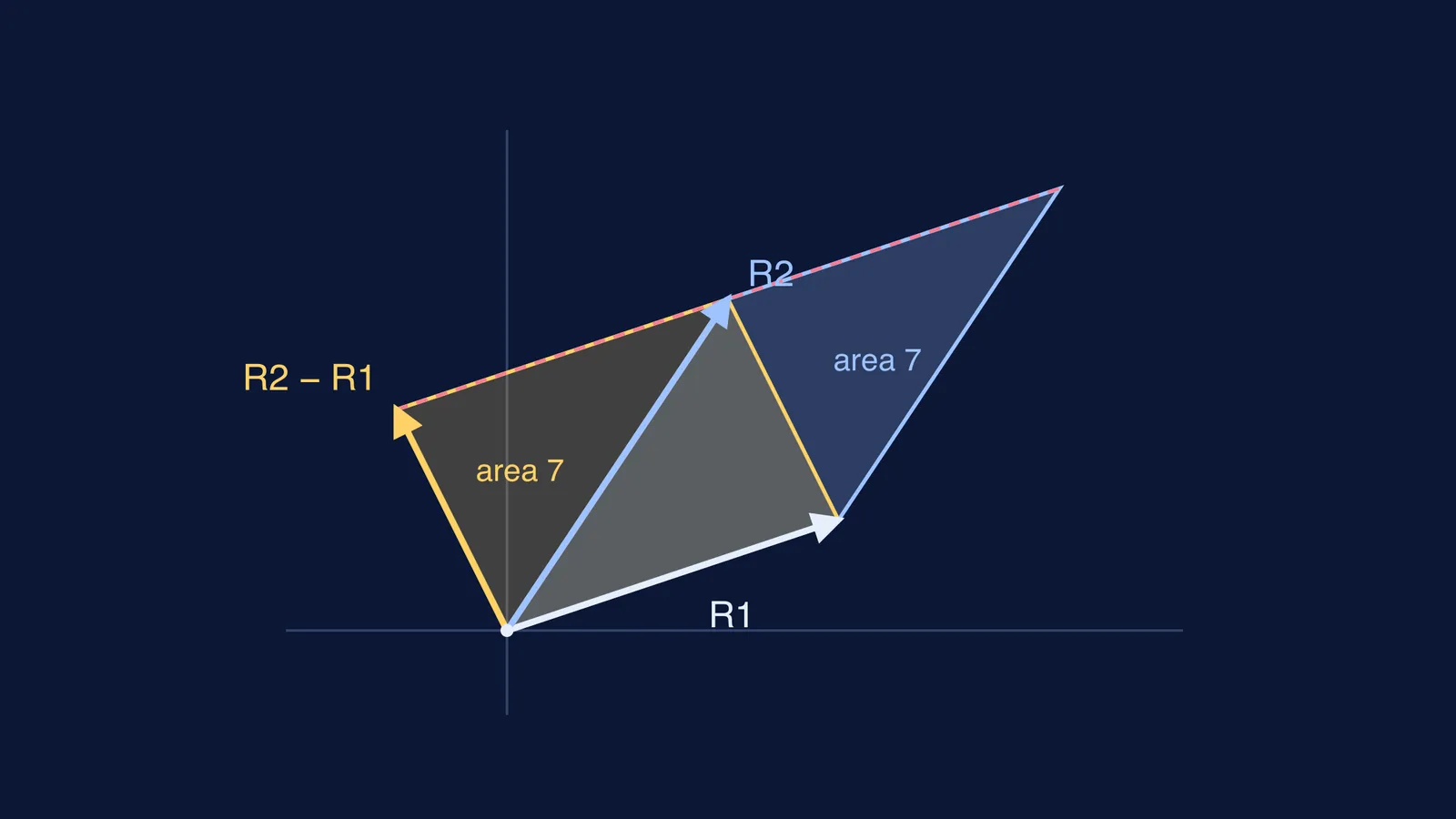
Keeps the value: subtracting t times row i from a different row j. In notation, R2 → R2 − tR1.
Flips the sign: exchanging two rows.
Multiplies the value by t: multiplying one row by t. Taking a common factor out of a row is the same rule run backwards.
The same notes add that det Aᵀ = det A, so every row rule also works for columns.
One detail is easy to miss. In R2 → R2 − tR1, the row being replaced must keep a coefficient of exactly 1. Write R2 → 3R2 − R1 and you have quietly multiplied the determinant by 3.
Can you trust an AI's steps on a determinant?
Not without checking. In the GSM-Symbolic study by Mirzadeh and colleagues, the performance of all the models tested declined when only the numbers in a maths question were changed. Adding one clause that seemed relevant but played no part in the solution caused drops of up to 65%. It tested 2024 models on grade-school word problems, not determinants, but the lesson carries over: treat each suggested step as a claim to test, not a fact. Our earlier post on asking AI to defend a wrong answer uses the same habit.
What should you ask the AI, and what should you check?
Take D with rows (2, 4, 6), (3, 7, 10) and (1, 3, 5). Expanded along the first row it gives 2(35 − 30) − 4(15 − 10) + 6(9 − 7) = 10 − 20 + 12 = 2. Keep that aside.
A prompt that works: "Suggest row operations that make zeros in the first column of this determinant. Do not evaluate it. After each step, tell me whether the value stays the same, changes sign, or is multiplied by a number."
Suppose the AI replies with three steps.
Take 2 out of R1. This is the scaling rule backwards, so D = 2 × the determinant with rows (1, 2, 3), (3, 7, 10), (1, 3, 5). Correct, as long as the 2 stays outside.
R2 → R2 − 3R1. The replaced row has coefficient 1, so the value is unchanged. R2 becomes (0, 1, 1).
R3 → R3 − R1. Same rule, value unchanged. R3 becomes (0, 1, 2).
Now expand down the first column: D = 2 × 1 × (1 × 2 − 1 × 1) = 2. It matches.
Here are two suggestions an AI may give that fail the check.
R2 → 3R1 − R2. It clears the 3 just as well, but the 2×2 test gives a determinant of −1, so this step flips the sign. Fine only if you write the minus sign down.
R1 → R1 − R2 and R2 → R2 − R1 done at the same time. The second step uses the old R1, which no longer exists. On the identity matrix this turns both rows into multiples of each other and the determinant becomes 0. Do one step, rewrite the determinant, then do the next.
If the AI says a step "doesn't change the value" and your 2×2 test disagrees, say so and ask it to recheck that step alone. For more practice with these properties, see how to evaluate determinants quickly using properties and why the determinant of kA is kⁿ det A.
A five-line checklist for each step
Which row is being replaced, and is its coefficient exactly 1?
Is the row being subtracted a different row, taken from the current determinant?
Was a row swapped? Write a minus sign.
Was a factor taken out or put in? Write it outside.
Before expanding, does the 2×2 test agree with every factor you wrote?
If your mistakes are less about arithmetic and more about choosing the wrong method, the Fermi Problem Library has worked problems with a step-by-step solver that explains the reasoning rather than printing an answer. Fermi's AI tutor works out what you already know and builds a plan for the session, and it checks understanding as it goes, so a rule you skipped gets noticed. Next time you meet a 3×3, ask for the steps, run the 2×2 test, and expand last.