

On this page
It is one of the most common mistakes in high school matrices: you are asked to find the determinant of a scaled matrix, let us say 3A, and you write 3 det A. But the correct answer is 3ⁿ det A, where n is the dimension of the square matrix.
Understanding why det(kA) = kⁿ det A instead of k det A saves you marks in exams like JEE Main and board exams. It is not just a formula to memorise, but a natural result of how determinants are calculated row by row.
What is the determinant of k times a matrix?
The rule is that for an n × n matrix A, multiplying the entire matrix by a scalar k results in a determinant that is kⁿ times the original determinant. In mathematical terms, det(kA) = kⁿ det A.
To see why the power of n appears, we must look at the difference between matrix scaling and determinant scaling.
When you multiply an entire matrix A by a scalar k, you multiply every single element inside that matrix by k. If A is a 2 × 2 matrix, you are scaling four numbers. If it is a 3 × 3 matrix, you are scaling nine numbers.
However, the determinant is calculated differently. According to the properties of determinants, you can only factor out a common multiplier from one row or one column at a time.
If you have scaled every element in an n × n matrix by k, then every one of its n rows has a common factor of k. When you pull that k out of the first row, you get one k outside the determinant. When you pull it out of the second row, you get another k, making it k². By the time you pull k out of all n rows, you have factored it out n times.
This gives us the standard rule: det(kA) = kⁿ det A.
Why does det(kA) equal kⁿ det A?
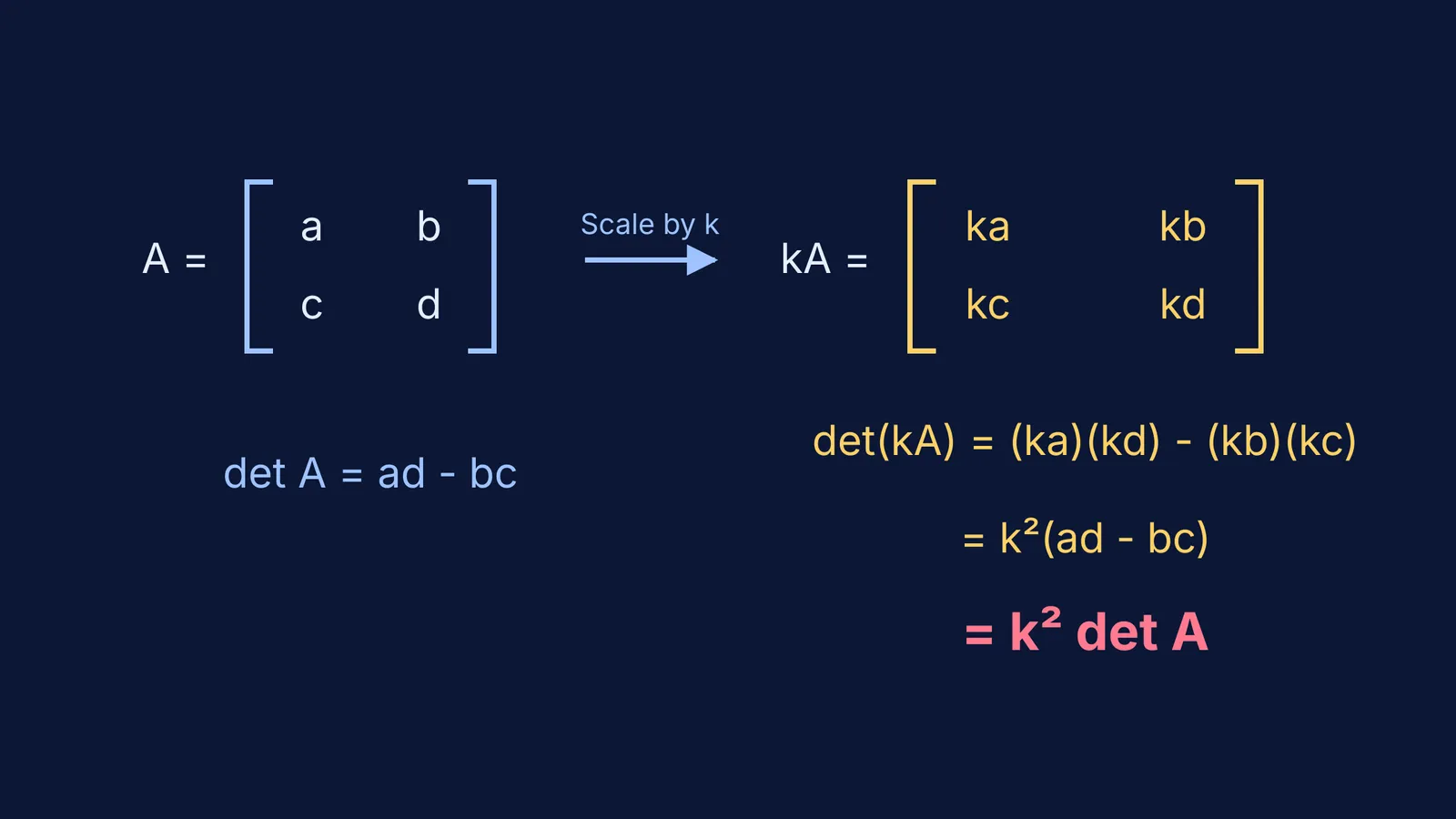
Let us prove this with a simple 2 × 2 matrix. Suppose A is a matrix with elements a, b in the first row and c, d in the second.
The determinant of A is: det A = ad - bc
Now, let us multiply the entire matrix by k to get kA. The elements become ka, kb in the first row and kc, kd in the second.
The determinant of this new matrix is: det(kA) = (ka)(kd) - (kb)(kc) det(kA) = k²ad - k²bc det(kA) = k²(ad - bc)
Since (ad - bc) is just the original det A, we are left with: det(kA) = k² det A
For a 3 × 3 matrix, you would be multiplying three rows, so the k would appear three times in each term of the expansion, resulting in k³. In a 2018 study published in Springer by researchers Cathrine Kazunga and Sarah Bansilal, confusing matrix scaling with determinant scaling was identified as a major misconception among students. It is easy to see kA and instinctively pull the k straight out, forgetting that a matrix is a grid of numbers, not a single value.
How to avoid the k det A trap in exams?
This error usually happens when you are rushing through a multi-step problem. Here is a framework to keep your matrix operations clear:
Check the brackets: Are you scaling the matrix (using square brackets) or the determinant (using vertical bars)?
Count the dimension: What is the order of the matrix? If it is a 3 × 3 matrix, n = 3. Write this down.
Apply the power: Before you start substituting numbers, rewrite det(kA) as k³ det A immediately.
If you find yourself guessing which rule to apply, you might need to strengthen your foundation in matrix properties. This is where Fermi's AI tutor can help. Rather than just giving you the final answer to a matrix problem, Fermi notices where you are stuck, decides whether to explain or show, and works through the steps alongside you.
For a deeper dive into determinants, you can explore the Fermi Concept Library, which maps out every concept in mathematics so you can trace matrix properties back to their roots.


