On this page
When you ask an AI chatbot a question, the answer is usually not worked out on your phone. Your words travel to a data centre, where large computers do the work and send the reply back.
What is a data centre?
The International Energy Agency (IEA) defines data centres as facilities that house servers, storage systems, networking equipment and associated components, installed in racks and organised into rows (IEA, Energy and AI). Servers are computers that process and store data, and they can carry specialised chips called accelerators, such as graphics processing units (GPUs), which do most AI work, according to the same report.
Think of it in four parts, each with the IEA's estimate of its share of electricity (IEA):
Servers: the computers that run the AI model, around 60% on average.
Storage: drives for data and backups, around 5%.
Networking: equipment that moves data in and out, up to 5%.
Cooling and power equipment: fans, chillers and pumps, plus backup batteries and generators. Cooling alone ranges from about 7% in efficient hyperscale data centres to over 30% in less efficient enterprise ones.
Your question reaches the servers as tokens, small chunks of text the model works with, which we explained in why AI gets letter counting wrong.
Why does a data centre need so much cooling?
A chip does not store the electrical energy it draws. Current flowing through its circuits does work against resistance, and that energy ends up as heat, the same Joule heating that warms your laptop. If the heat is not carried away, chips slow down or fail. So data centres push air or liquid past finned metal heat sinks, which you can test at home in our heat sink fins experiment. The heat is then pumped outdoors, much as a room AC does (see whether 24 °C on the AC saves power).
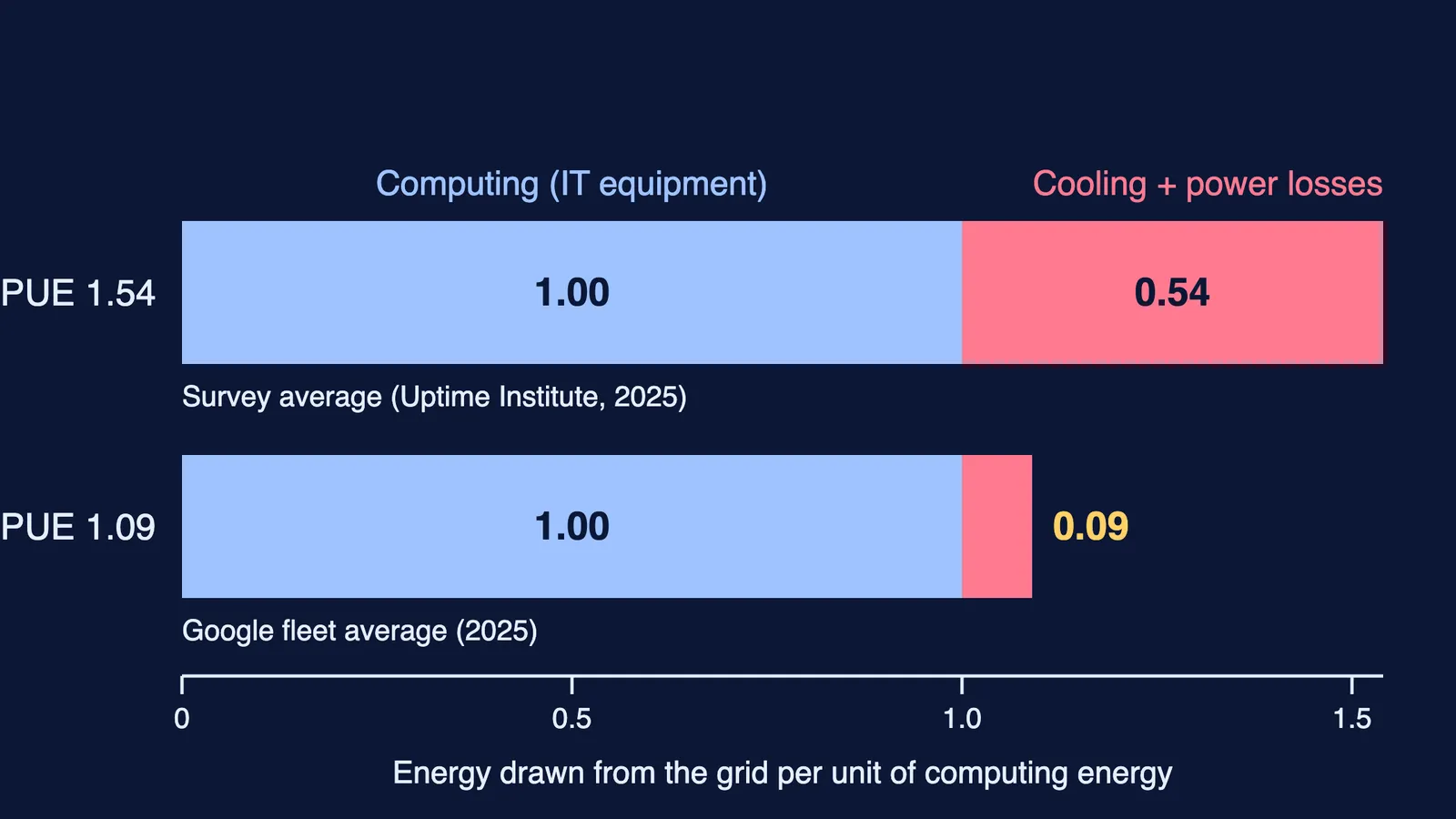
Power usage effectiveness (PUE) compares a data centre's total energy with the energy used by its computing equipment: a PUE of 2.0 means one extra watt for cooling and power delivery for every watt of computing (Google, data centre efficiency). Google reports a 2025 fleet-wide average PUE of 1.09, and cites the Uptime Institute's 2025 survey, whose respondents averaged 1.54 (same page).
How much electricity do data centres use?
Data centres used around 415 terawatt-hours (TWh) of electricity in 2024, about 1.5% of the world's total, according to the IEA (IEA, Energy and AI: executive summary). The IEA expects that to more than double to around 945 TWh by 2030. A typical AI-focused data centre consumes as much electricity as 100,000 households, and the largest ones under construction will consume 20 times as much (same report).
The IEA calls AI the most important driver of that growth. In its base case, electricity used by accelerated servers grows about 30% a year, against 9% for conventional servers (IEA). For perspective, data centres account for around one-tenth of global electricity demand growth to 2030, less than air conditioning or electric vehicles (IEA executive summary).
How much energy does one AI answer use?
Google estimated in 2025 that the median Gemini Apps text prompt used 0.24 watt-hours (Wh) of energy and 0.26 millilitres of water, a figure that includes cooling and other data centre overhead (Google Cloud blog). Google compares that to watching TV for less than nine seconds. It is one company's figure for one model, and a median hides long requests.
Worked example: a study session of questions
Using Google's 0.24 Wh per prompt (Google Cloud blog):
Suppose you ask 30 questions in an evening: 30 × 0.24 Wh = 7.2 Wh.
A 10 W LED bulb uses 10 Wh in an hour, so 7.2 Wh runs it for 0.72 hours, about 43 minutes.
Scale up: if 10 crore people did the same daily, that is 7.2 × 10⁸ Wh, or 720 megawatt-hours a day.
Add the building: if a hall's servers draw 10 MW, a PUE of 1.54 means 15.4 MW from the grid, and a PUE of 1.09 means 10.9 MW. The 4.5 MW gap is cooling and power losses.
One answer is tiny. Multiplied across many millions of users, plus the energy to train new models, it adds up, which is why the IEA's totals keep climbing.
If watts, watt-hours and Joule heating feel fuzzy, the Fermi Concept Library has a lesson for every concept in physics. For estimation practice, the Fermi Problem Library has worked problems with a step-by-step solver that explains the reasoning.
How do you judge a headline about AI's energy use?
Before you share one, check five things:
Was it measured by the operator, or estimated from outside?
Which model, and what kind of request: short text, an image or a video?
Does it include cooling and overhead, or only the chips?
Is it per answer, per day or per year? Convert it to Wh and compare it with a bulb.
Who published it, and do they gain from a high or low number?
Pick one AI energy headline this week and run it through these checks with your family; converting it to bulb-minutes often shows whether it is alarming or ordinary.