On this page
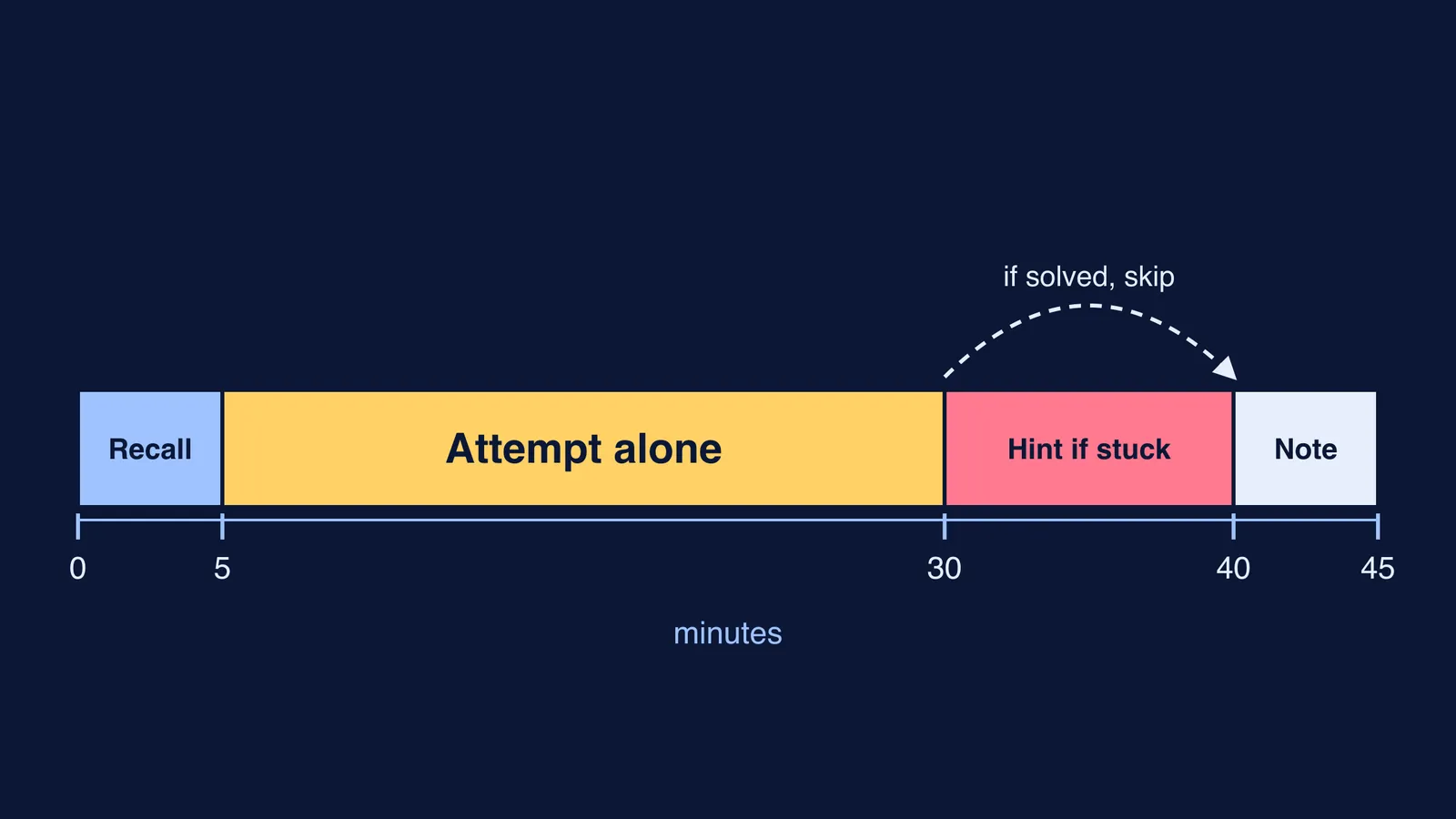
A single hard problem, done properly, can teach you more than ten easy ones done on autopilot. The routine below takes 45 minutes and has four steps: recall, attempt, hint, note. The AI comes in only at step three, and only if you are truly stuck.
Why attempt a hard problem before asking AI?
A 2021 meta-analysis of 53 studies found that students who tried problems before being taught learned more than students who were taught first, with a moderate effect size of 0.36 (Sinha and Kapur, Review of Educational Research, 2021). The same review found the opposite trend for children in classes 2 to 5, so this routine is meant for teenagers and older students.
The risk with AI is that it removes the struggle. In a field experiment with nearly a thousand high school maths students, those given a standard GPT-4 chat interface scored 48% higher during practice. Once access was taken away, they scored 17% lower than students who never had it (Bastani et al., PNAS, 2025). A second version, prompted to safeguard learning, largely avoided that harm. How you use the AI matters as much as whether you use it.
What does a one-problem-a-day routine look like?
Recall (5 minutes). Close your notebook and write yesterday's problem and its key idea from memory. Then check yesterday's note.
Attempt (25 minutes). Set a timer. Work alone, on paper. Keep failed attempts.
Hint only if stuck (up to 10 minutes). If you solved it, skip to step four. If not, ask the AI for one hint, not the solution, and try again before asking for another.
Note (5 minutes). Write three lines: what the problem was really testing, where you got stuck, and the move that got you unstuck.
The recall step uses the testing effect. In Roediger and Karpicke's experiments, students who practised recalling a passage remembered more of it 2 days and 1 week later than students who re-read it, even though re-reading made them feel more confident (Roediger and Karpicke, Psychological Science, 2006).
Twenty-five minutes is a starting point, not a rule; see how long to try a problem before asking AI for help.
How do you ask AI for a hint without getting the answer?
Tell the AI exactly what you tried and ask for the smallest nudge.
Problem: A ball is thrown at 20 m/s, 30° above the horizontal, from the top of a 15 m cliff. How long until it hits the ground below? Take g = 10 m/s².
You find the vertical velocity, 20 sin 30° = 10 m/s, and write 15 = 10t − 5t². That rearranges to 5t² − 10t + 15 = 0, which has no real roots. You are stuck.
What to type: “I'm solving a projectile problem and I don't want the answer. I wrote 15 = 10t − 5t² and got no real solutions. Give me one hint about where my setup might be wrong.”
A good hint sounds like: “If up is positive, which way does the ball move from the cliff top to the ground?” The displacement is −15 m, so −15 = 10t − 5t², which gives t² − 2t − 3 = 0 and t = 3 s.
If one hint is not enough, climb one rung at a time, as set out in our AI hint ladder for hard maths and physics problems. Fermi's AI tutor is built to teach rather than answer: it notices where you are stuck and decides whether to explain, ask or show, so the solving stays in your hands.
Where do you find one hard problem each day?
Pick from the chapter you studied this week, one level above what feels comfortable: a JEE Main numerical if NCERT exercises feel easy, a JEE Advanced one if Main problems feel routine. The Fermi Problem Library has worked problems with a step-by-step solver that explains the reasoning rather than printing an answer; open it after your timed attempt, not before.
Once a week, read your seven notes together and look for the stuck point that repeats. That is your next topic. For full exam-style sets, use timed practice followed by AI review.
How long until the routine becomes a habit?
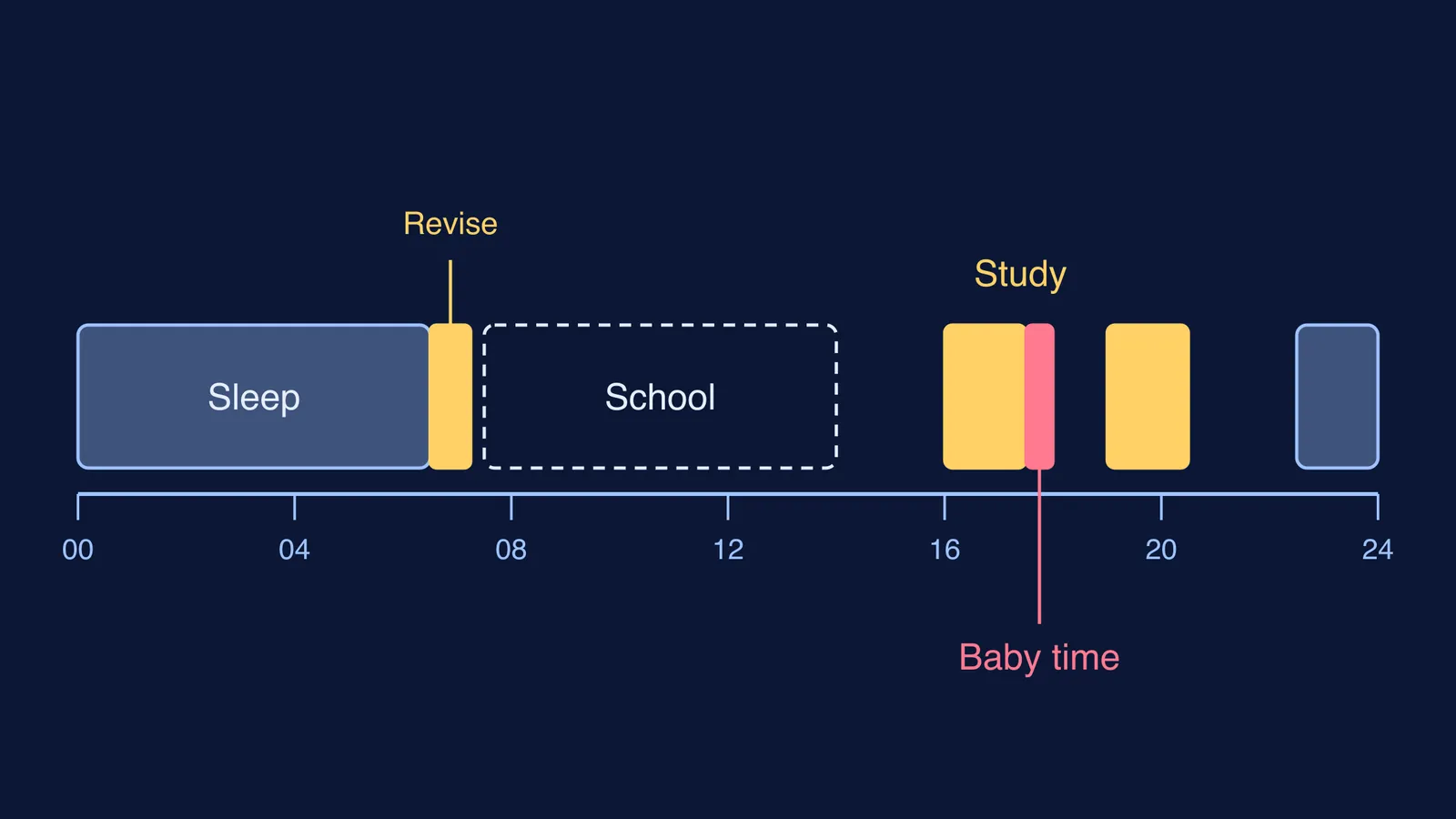
Longer than a week. In a study that asked 96 volunteers to repeat a chosen behaviour daily in the same context, the time to reach near-automatic habit ranged from 18 to 254 days among those whose progress could be modelled (Lally et al., European Journal of Social Psychology, 2010). Missing one day did not materially affect habit formation, so a skipped evening is no reason to quit. Tie the routine to a fixed cue, such as straight after dinner.
If the daily problem brings dread rather than challenge, shrink it. If stress feels heavier than that, talk to someone you trust, or call Tele MANAS, the government's free 24/7 mental health helpline, on 14416 (PIB, Ministry of Health and Family Welfare, 2025).
Start tonight: one problem, one timer, one note.