On this page
Cut a sector out of paper, bring its two straight edges together, and you get a cone. Mensuration asks what that cone will look like before you tape it, and you need just two numbers: the sector angle and the radius of the paper circle.
How does a sector become a cone?
Two things carry over from the flat paper to the cone.
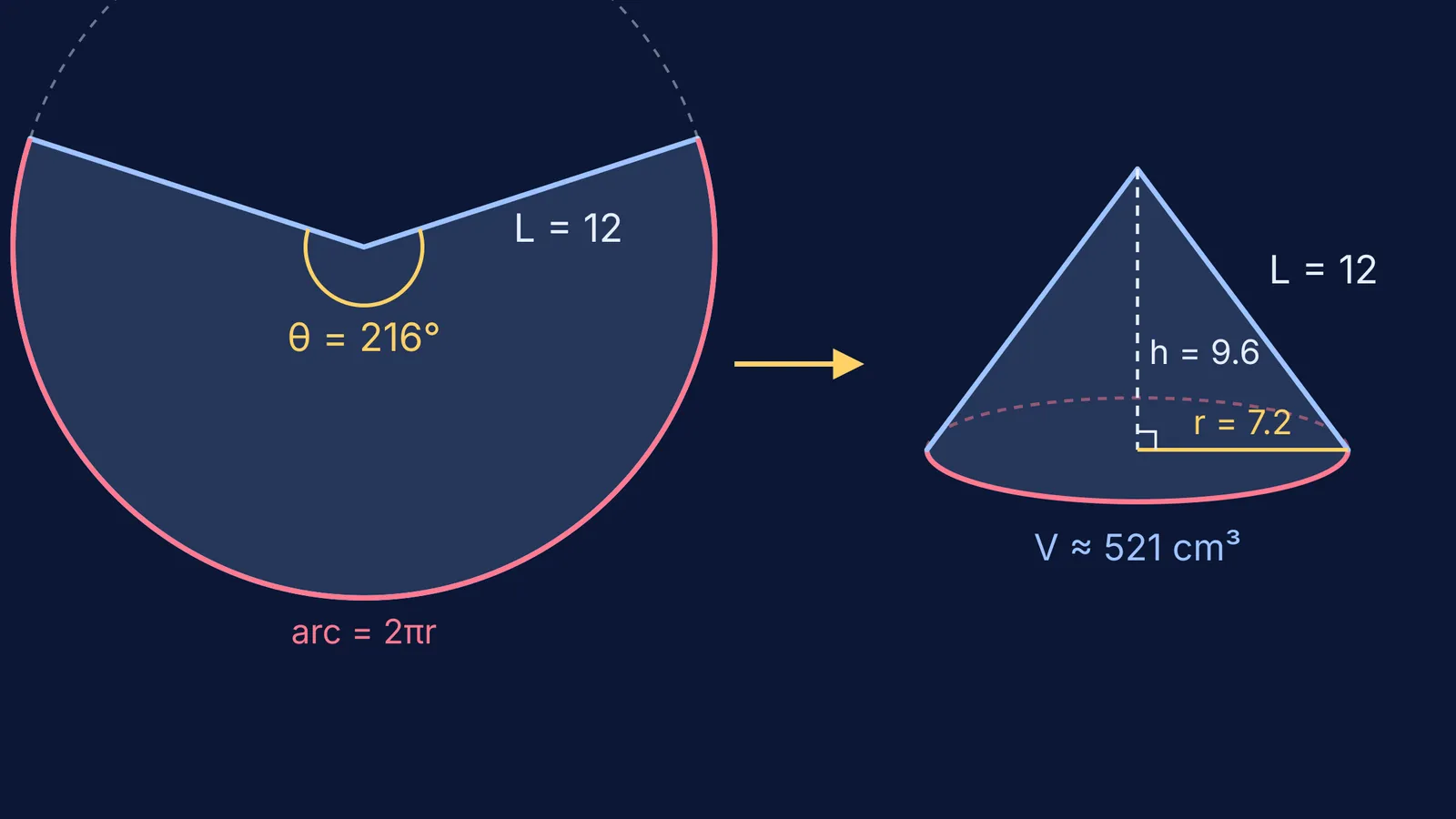
The sector's radius becomes the cone's slant height, L: every point on the curved edge ends up L away from the tip.
The sector's curved edge, the arc, wraps around to become the circumference of the base, 2πr.
The arc length of a sector is its radius times its angle in radians, s = Rθ, as Wolfram MathWorld's circular sector entry gives it. In degrees, that is (θ/360) × 2πL. Setting this equal to 2πr gives the one equation that matters:
r = L × θ / 360
Once you have r, the height comes from the right triangle formed by the height, the base radius and the slant edge. The NCERT Class 10 chapter on surface areas and volumes uses slant height l = √(r² + h²), so h = √(L² − r²). Volume is one-third of the base area times the height, V = ⅓πr²h, as MathWorld's cone entry states.
If arc length feels shaky, our post on sector area and arc length with clock and wiper sums goes over it first.
How do you find the cone's radius, height and volume?
Here is a worked example you can also make with a compass and a sheet of chart paper, using the NCERT and MathWorld formulas above. Take a circle of radius 12 cm and cut out a 216° sector.
Slant height: L = 12 cm, the radius of the paper circle.
Base radius: r = 12 × 216 / 360 = 7.2 cm.
Height: h = √(12² − 7.2²) = √(144 − 51.84) = √92.16 = 9.6 cm.
Volume: V = ⅓ × π × 7.2² × 9.6 = 165.888π ≈ 521 cm³.
The numbers come out clean because 7.2, 9.6 and 12 are 3, 4 and 5 scaled by 2.4, so a 216° or 288° sector is a hint to look for a 3-4-5 triangle.
The curved surface area formula πrL is in the same NCERT chapter. For the full surface area picture, see finding the surface area of a cone from its net.
What happens when you change the sector angle?
Before you read on, make a prediction. Keep L = 12 cm. If you use a bigger sector, does the cone hold more or less?
Here is what r = Lθ/360, the NCERT slant-height relation and V = ⅓πr²h give for the same paper circle:
180° sector: r = 6 cm, h ≈ 10.39 cm, V ≈ 392 cm³
216° sector: r = 7.2 cm, h = 9.6 cm, V ≈ 521 cm³
240° sector: r = 8 cm, h ≈ 8.94 cm, V ≈ 599 cm³
288° sector: r = 9.6 cm, h = 7.2 cm, V ≈ 695 cm³
324° sector: r = 10.8 cm, h ≈ 5.23 cm, V ≈ 639 cm³
360° sector: r = 12 cm, h = 0, V = 0, a flat disc
A bigger angle gives a wider base but a shorter cone. Volume rises, peaks, then falls to zero. Setting the derivative of V = ⅓πr²√(L² − r²) to zero gives r = L√(2/3), which means a sector angle of about 294° and a maximum volume of about 697 cm³ for L = 12 cm. If you have done Class 12 maxima and minima, try deriving that yourself.
Why predict before you roll it?
In a study in the American Journal of Physics, Crouch, Fagen, Callan and Mazur (2004) found that students who only watched classroom demonstrations understood the ideas no better than students who did not see them at all. Students who predicted the outcome first showed significantly greater understanding.
The same habit works for a paper cone. Here is a short plan, alone or with a parent:
Draw a 12 cm radius circle on chart paper and mark two sectors: 180° and 288°.
Write down a guess: which cone will be taller, and which will hold more?
Work out r, h and V for each with the steps above.
Cut, roll and tape both cones. Measure the height with a ruler held upright inside.
Fill each with rice or dal and pour it into a measuring cup to compare volumes.
Write one line on where your guess went wrong, if it did. Tape and overlap add a little error.
The Fermi Simulation Lab has interactive simulations for ideas that are easier to see than to read; predict before you change anything there too. For why the ⅓ appears in V at all, read why a cone's volume is one-third of a cylinder's.