On this page
You can turn an AI chatbot into a concept cartoon maker. Ask it for a short scene in which four friends argue about one science idea, decide yourself who is right, and only then let the AI explain. It works for physics, chemistry, biology or maths.
What is a concept cartoon?
A concept cartoon is a picture of an everyday situation in which several characters give different ideas about what is happening, and learners decide which idea holds up. Brenda Keogh and Stuart Naylor created the first ones in 1991, and their 2013 review, Concept Cartoons: What Have We Learnt?, lists their main features:
They use everyday situations that do not look like "science", so less confident students join in.
They give alternative viewpoints, always including the scientifically acceptable one.
The speech bubbles include common misconceptions, so these can be faced directly.
All the ideas have equal status, with no clues from facial expressions or wording about who is right.
A blank speech bubble invites ideas the cartoon has not listed.
The review notes that learners become the judge of other people's ideas instead of having their own judged, which makes it easier to risk being wrong.
Why does arguing with friends help you learn science?
Harvard physicist Eric Mazur developed a method called Peer Instruction that runs on exactly this kind of argument: students answer a concept question alone, then spend two to four minutes trying to convince the classmates sitting around them, then answer again (Crouch and Mazur, American Journal of Physics, 2001). In their calculus-based course, the average normalised gain on the Force Concept Inventory, a standard test of physics ideas, doubled from 0.25 in 1990 to 0.49 in 1991 when the course switched from traditional lectures to Peer Instruction (same paper). That is one course at one university, not a controlled trial.
That was a classroom with an instructor, not an AI. An AI-written scene stands in for the friend who disagrees with you when you study alone.
How do you ask AI to write a concept cartoon?
Copy this prompt and fill in the brackets:
"Write a short concept cartoon scene. Setting: [an everyday situation]. Four friends each give a different idea about [concept] in one or two sentences. Include the scientifically accepted idea and the most common misconceptions students my age have. Make every friend sound equally confident. Leave a fifth empty speech bubble for me. Do not say who is right until I give my verdict."
Then send your verdict: "I think [name] is right because [reason]. Tell me whether I am right, where each other idea breaks, and one experiment or prediction that would tell the ideas apart."
Questions without numbers work best here, the kind covered in using AI for conceptual physics questions.
Worked example: is there a force on a ball at the top of its throw?
Kabir throws a cricket ball straight up in the school ground. At the top, it stops for an instant.
Aarav: "At the top there is no force on it. It has stopped, so nothing is acting."
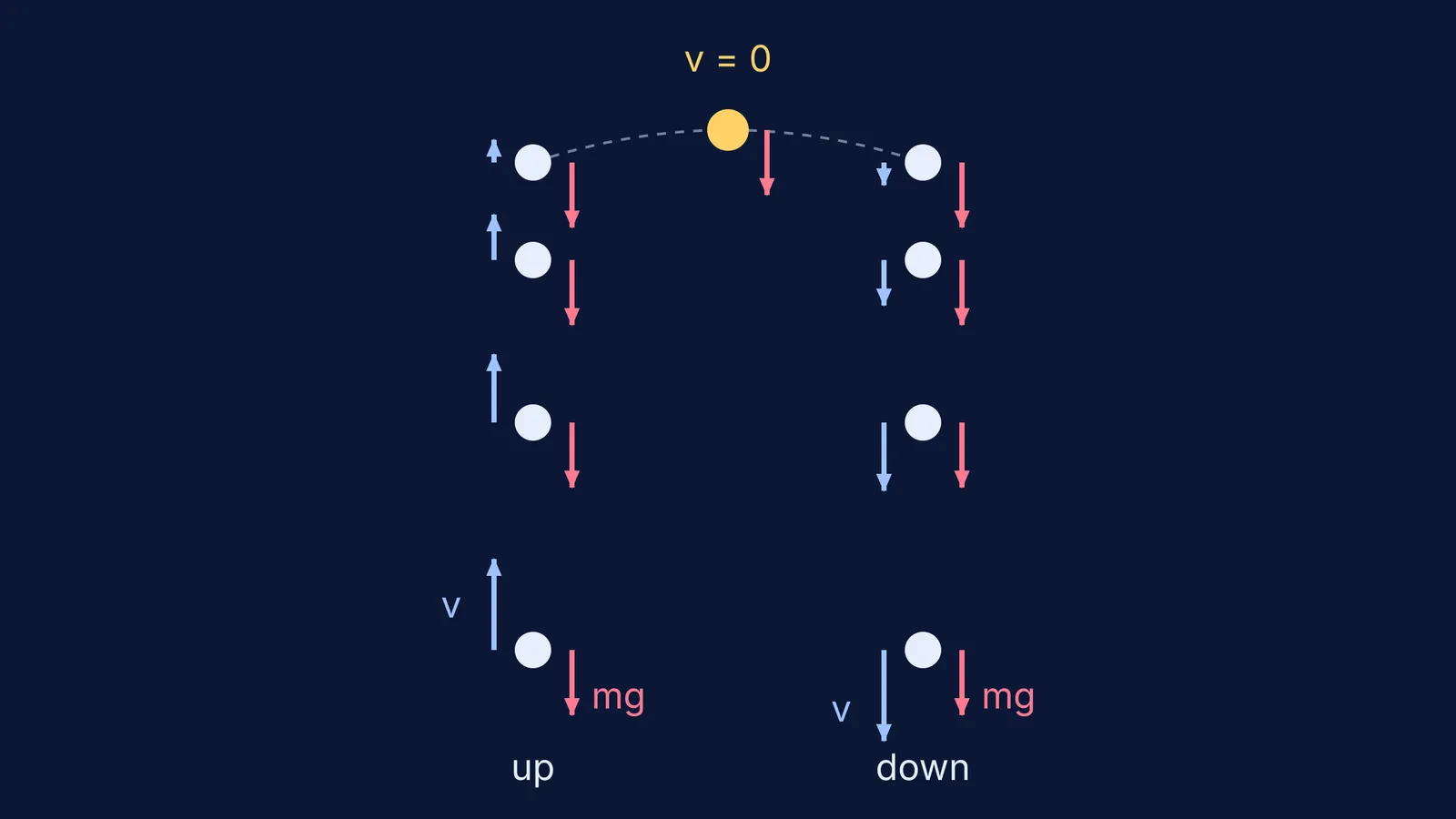
Meera: "Gravity is still pulling it down, the same as all the way up. Its speed is zero, but its acceleration is still g."
Kabir: "My throw gave it an upward force. At the top that force has just run out."
Zoya: "Velocity is zero at the top, so acceleration must be zero too."
You: ...
Meera is right, if you ignore air resistance. Gravity acts on the ball the whole time, so the force on it is mg, downward, everywhere along the path, including the top. Acceleration is how fast velocity changes, not how big it is: just before the top the ball moves up, just after it moves down, so velocity is still changing. Kabir's "force of the throw" acts only while the ball is in his hand. Aarav mixes up "not moving" with "no force", and Zoya mixes up zero velocity with zero acceleration.
Naming why each wrong idea sounded sensible is what makes the lesson stick; our post on asking AI why your wrong idea seemed right shows how to do it.
How do you check the AI's verdict?
AI chatbots can state a wrong idea confidently, so treat the verdict as one more friend in the argument.
Ask for a prediction that separates the ideas. Here: if the force at the top were zero, the ball would hang in the air. It does not.
Check the verdict against your NCERT textbook or class notes.
If the AI and your book disagree, the book wins until a teacher says otherwise. Our guide on what to do when an AI tutor gives a wrong answer has a short script.
For ideas easier to see than to read, the Fermi Simulation Lab has interactive simulations. And Fermi's AI tutor notices where you are stuck and decides whether to explain, ask or show, which suits this kind of argue-then-judge practice.
Pick one concept you got wrong in your last test and run the prompt on it tonight.