On this page
You have just checked your answers on a practice test, and you got a difficult question wrong. The standard response is to read the correct solution, try to memorise it, and move on. But cognitive psychology suggests a more powerful approach: dissecting the mistake itself. When you learn to ask AI why your wrong idea seemed right, you transform a simple error into a durable lesson.
Why do we remember our worst mistakes?
Most of us assume that practising the wrong method will burn it into our memory. However, a 2017 review of error-based learning found that making an error and then correcting it leads to better long-term retention than simply studying the right answer from the start (Annual Review of Psychology, 2017).
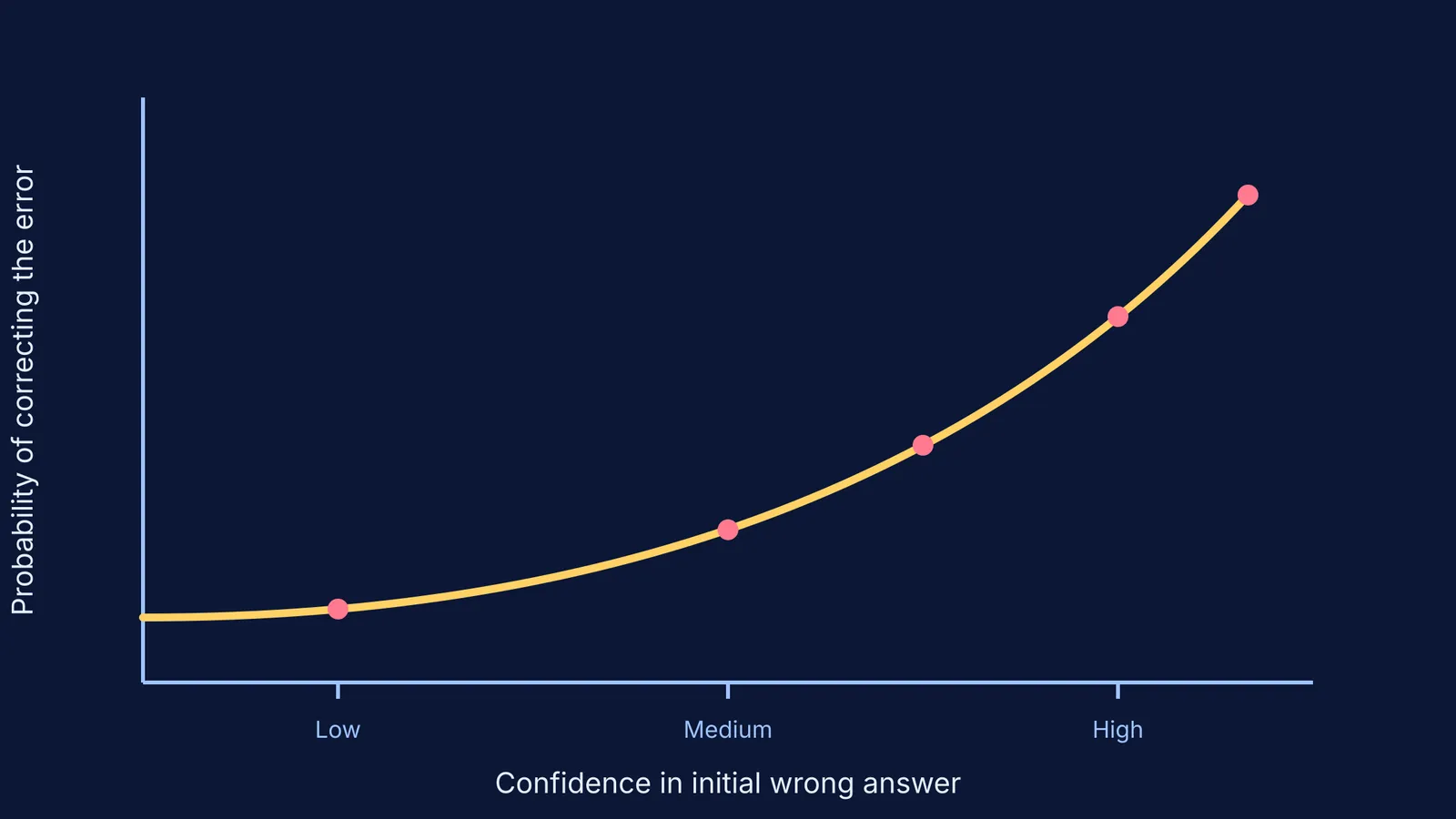
Psychologist Janet Metcalfe showed that this is driven by the "hypercorrection effect." Her research indicates that when you make an error with high confidence—meaning you were certain you were right—you are actually much more likely to remember the correction. The surprise of being wrong creates a prediction error in the brain, capturing your attention and making the new information stick.
However, this effect is completely dependent on receiving corrective feedback. If you just make a mistake and never learn the right answer, the learning does not happen.
How productive failure builds deeper understanding
This concept extends to how we first approach new topics. A 2008 study found that 11th-grade physics students who struggled with unstructured problems before receiving instruction significantly outperformed those who received step-by-step guidance from the start (Cognition and Instruction, 2008).
In the study, researcher Manu Kapur tested an idea called productive failure. The students without instruction struggled and frequently failed to find the right answer. Yet, on subsequent individual tests, they showed superior conceptual understanding. The struggle itself helped the students notice the deep features of the problem, preparing them to deeply understand the formal instruction when it was finally given.
In the traditional direct instruction model, teachers try to prevent students from making mistakes by breaking everything down into small, safe steps. Kapur's work showed that while this makes students good at following procedures, it fails to build conceptual understanding. If you want to replicate this challenging but effective approach, the Fermi Problem Library offers worked problems with a step-by-step solver that explains the reasoning rather than just printing an answer.
Should I ask AI why my wrong idea seemed right?
The challenge of self-study is that it is hard to correct your own misconceptions. You know your answer is wrong, but you might not understand *why* the wrong logic felt so convincing. This is where an AI tutor excels, offering a more nuanced approach than just looking up the right answer. Can AI tutors teach better than chatbots that give answers? The evidence suggests they can, particularly when you guide the interaction.
When you hit a wall, do not just ask the AI to solve the problem. Instead, explain your thought process. A script like this can completely change the value of a study session:
*"I tried to solve this projectile motion problem by using the vertical velocity, but my answer is wrong. Here is my working. Why did my logic seem right, and where exactly did it break down?"*
A framework for learning from errors
To turn errors into expertise, make this three-step process part of your daily study routine:
Commit to an answer: Force yourself to solve the problem completely, even if you are unsure. This triggers the generation effect, priming your brain for the correction.
Explain your trap: When you get it wrong, articulate exactly why your incorrect method felt intuitive. Was it a rule you misapplied? A formula you memorised without context?
Ask for the breakdown: Ask your tutor to explain the specific flaw in your mental model. Fermi's AI tutor can work out what you already know and build a plan for the session, teaching you through the exact gap in your knowledge rather than just repeating a generic textbook definition.