

On this page
Physics students often fall into the "plug and chug" trap: finding a formula that matches the variables given in a question, plugging in the numbers, and calculating an answer without ever understanding the physical laws at play. While this strategy might secure a passing grade on a standard test, it completely breaks down when the questions shift from mathematics to logic.
Harvard physicist Eric Mazur noticed this pattern in his classrooms. He discovered that his students could solve complex mathematical problems by rote, but they "floundered on the simple word problems, which demanded a real understanding of the concepts behind the formulas" (Source). Traditional problem-solving often masked a severe lack of understanding; students had a toolbox of equations but reverted to basic misconceptions when asked to reason qualitatively about forces or motion.
The difference in learning outcomes when you shift focus is stark. A 1998 study of 6,542 students by Richard Hake found that courses using interactive engagement — methods that force students to confront these conceptual hurdles — produced an average learning gain of 0.48, compared to just 0.23 for traditional lecture courses (Source). This research demonstrated that true problem-solving skill requires conceptual clarity as a prerequisite, rather than assuming it will naturally follow from completing mathematical exercises.
To build this kind of deep intuition, you need to practise reasoning. This is where Fermi's AI tutor becomes relevant: instead of answering questions for you, Fermi's AI tutor holds a line of reasoning across a session, noticing where you are stuck and deciding whether to explain, ask or show.
Why are conceptual physics questions without numbers so hard?
When you remove the numbers, you can no longer rely on your calculator. You have to explain the why and how. An AI tutor is particularly good at this because it can act as a sounding board, challenging your logic just as a peer or teacher would.
Instead of typing in a homework problem and asking for the final number, you can bring a concept to the AI and ask it to test your understanding. If you struggle with a specific idea, you can use the Fermi Concept Library to find its place in the physics map, and then ask the tutor to walk you through a scenario.
For more on why guiding reasoning is more effective than giving the final number, you can read our guide on Can AI tutors teach better than chatbots that give answers?.
How do you use AI for conceptual physics questions without numbers?
To get the most out of an AI tutor for conceptual physics, you need to set the right constraints so it doesn't default to acting like a calculator. Try using this four-step script in your next study session:
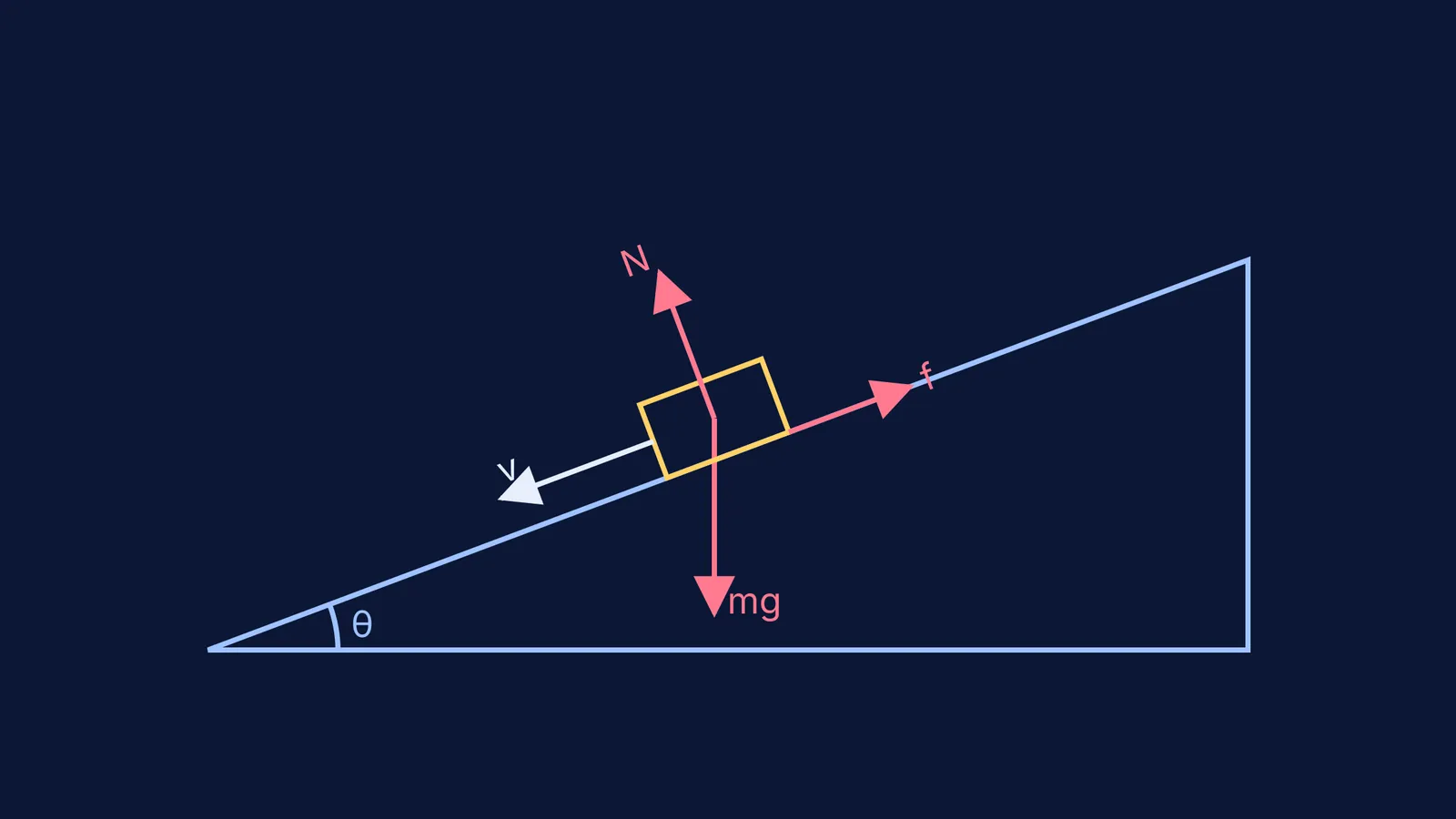
Request a scenario: Ask the tutor to describe a physical situation without providing variables to plug into a formula. *Script: "Describe a scenario involving a block on an inclined plane. Do not give me any numbers, masses, or angles."*
Predict the outcome: Tell the AI what you think will happen when a condition changes. *Script: "If the angle of the incline increases, I think the normal force will stay the same because the block's mass hasn't changed. Is my reasoning correct?"*
Ask for a critique: Set a strict rule for how the AI should respond to mistakes. *Script: "If I am wrong, do not give me the correct answer. Instead, ask me one question about the forces involved that points out the flaw in my logic."*
Iterate: Adjust your reasoning based on the tutor's hints until you arrive at the correct physical principle.
This back-and-forth approach forces you to confront misconceptions directly. It mirrors the active learning methods that require you to make sense of the physics rather than passively taking notes. You can read more about this in Hints or answers? What tutoring research says about the right help.
What happens when you stop calculating and start explaining?
When you regularly practise conceptual physics questions, the mathematical problems become much easier. You start to see the equations as a way to describe what you already intuitively know will happen, rather than as an arbitrary set of rules.
Sometimes, an idea is simply easier to see than to read. If a text-based explanation is not clicking, you can open the Fermi Simulation Lab to watch how the forces, velocities and fields interact in real time.
By using an AI tutor to focus on reasoning rather than arithmetic, you train yourself to think like a physicist, ensuring that your understanding is built on a solid foundation rather than a fragile house of cards.


