

On this page
You read the first law of thermodynamics in NCERT, then in your reference book, and the equation looks different. Usually neither is wrong. An AI chat can lay the two side by side in a minute, if you ask the right questions and check its answer against the pages.
Why do NCERT and reference book explanations differ?
Most differences are one of three kinds:
Depth: one book stops at the result; the other derives it, adds special cases or goes beyond your syllabus.
Method: both reach the same answer by different routes, such as forces in one and energy conservation in the other.
Notation: the same quantity gets a different symbol or the opposite sign.
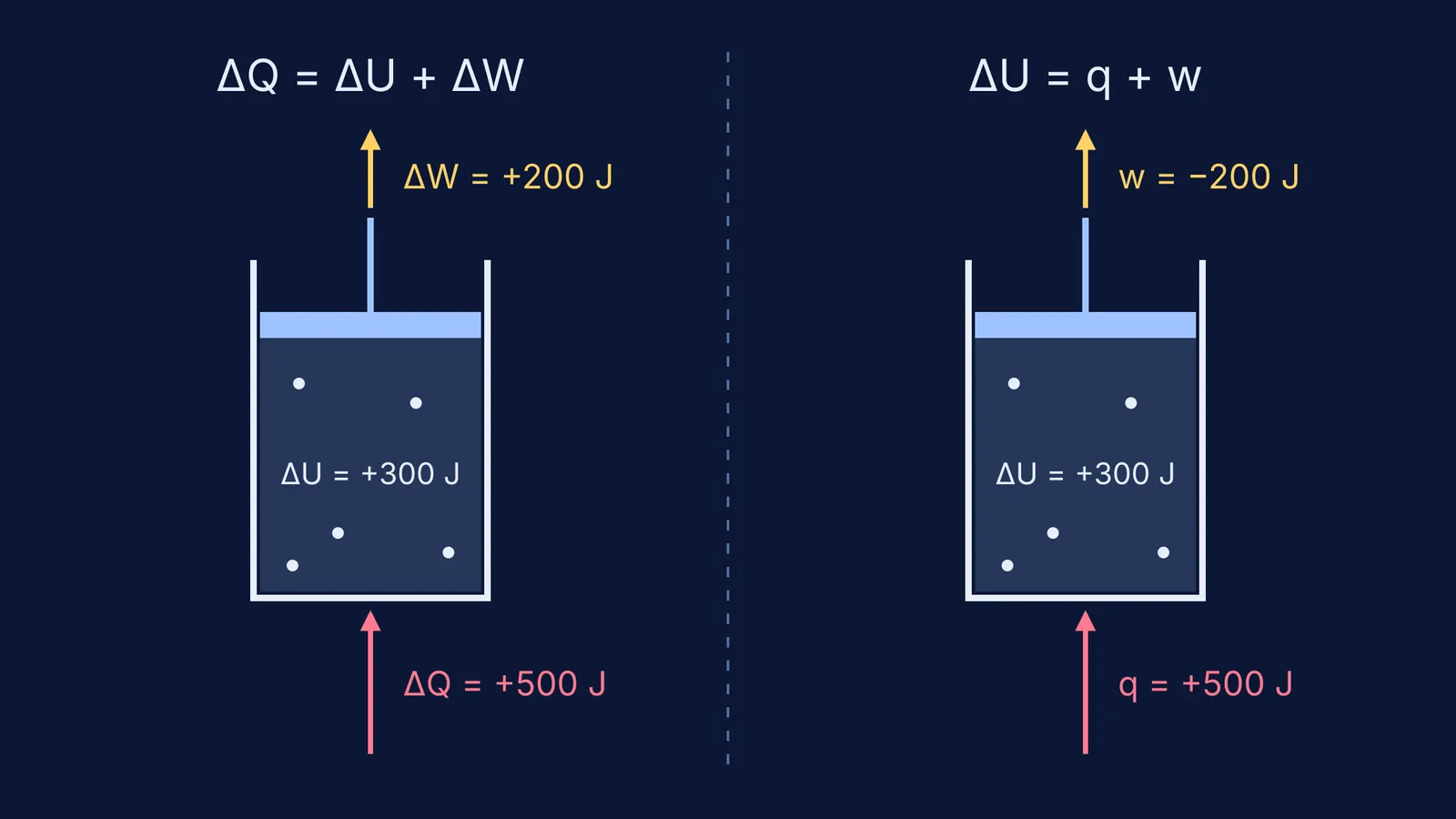
Notation is the easiest to trip on, because two correct books can give opposite signs for the same quantity. NCERT's own Class 11 books show this. The physics chapter writes the first law as ΔQ = ΔU + ΔW, where ΔW is the work done by the system (NCERT Physics Part 2, Chapter 11). The chemistry chapter writes ΔU = q + w, where w is positive when work is done on the system, following IUPAC (NCERT Chemistry Part 1, Unit 5). A footnote there says the older sign "is still followed in physics books, although IUPAC has recommended the use of new sign convention."
Does comparing two explanations help you learn?
The research says yes. In a 2007 experiment, students who studied two ways of solving the same equations side by side gained more procedural knowledge and flexibility than students who studied the same methods one after another, with similar gains in conceptual knowledge (Rittle-Johnson and Star, Journal of Educational Psychology; summary by Harvard Graduate School of Education).
A 2013 meta-analysis of 57 experiments found that comparing cases usually led to more learning than other forms of case study or standard instruction, with a moderate average effect size of d = 0.50 (Alfieri, Nokes-Malach and Schunn, Educational Psychologist). It also found that looking for similarities, and getting the principle after the comparison, went with more learning. That is why the prompt below asks for agreement first.
How do you ask AI to compare NCERT and a reference book?
Paste or photograph both passages, a page or less each. Label them A (NCERT) and B (reference book), tell the AI not to solve anything yet, and ask:
What do A and B agree on? One line each.
Where do they differ in depth? Name anything in B that is not in A.
Where do they use a different method? Show both routes on one small example.
Where do they use different symbols or signs? Give me a translation line between them.
Quote the exact line from A and from B that supports each difference.
The fifth question matters most: an AI can misread a scanned equation or invent a difference. If it cannot quote the line, check the book yourself. The same habit helps when you ask AI why one formula applies and not another.
Worked example: the first law in both notations
A gas absorbs 500 J of heat and does 200 J of work pushing a piston out.
NCERT Physics: ΔQ = +500 J and ΔW = +200 J (work done by the gas), so ΔU = 500 − 200 = +300 J.
NCERT Chemistry: q = +500 J and w = −200 J (work done by the gas counts as negative), so ΔU = 500 + (−200) = +300 J.
Same gas, same answer. The trap is mixing the two: put w = +200 J into ΔU = q + w and you get 700 J, which is wrong.
Which explanation should you follow for which exam?
Sort each difference the AI found:
Notation: in a school exam, write in the textbook notation for that subject. In JEE Main or NEET-UG, read how the question defines work before you pick a sign. ΔU comes out the same in either convention as long as you stay consistent.
Depth: check whether the extra material is in this year's official syllabus, published by NTA on its JEE Main site and NEET-UG site. If a topic is outside it, park it for later. To see the same idea at two depths, try asking AI to explain at Class 10 and Class 12 level.
Method: learn the textbook method first so you can write the full working. Keep the reference book's faster route for MCQs once you can explain why it works.
If you can't follow the idea in either book, the gap is the concept, not the book. Fermi's AI tutor works out what you already know and builds a plan for the session. For a whole weak chapter, see how to use AI to revise a chapter you never understood.
This week, pick one topic where your two books disagree, ask the five questions, and write the translation line in your notes.


