

On this page
Two formulas both look right, and you wonder "which one do I use?" A better question is "what conditions does each formula need, and does my problem meet them?" Ask an AI tutor that, and you get a reason you can reuse on the next problem.
Why does choosing a formula feel like guessing?
Usually because formulas are learned as a list, not as rules with conditions. Chi, Feltovich and Glaser (1981) found that physics experts start from the principle a problem rests on, while novices base their approach on the problem's literal features.
A follow-up by Chi and colleagues (1989) analysed what students said aloud while studying worked mechanics examples. The stronger students generated many explanations that "refine and expand the conditions" for each step. The weaker students did not explain enough and later relied heavily on the examples.
Self-explanation was rated a technique of moderate utility in a 2013 review of ten study techniques by Dunlosky and colleagues. Asking "under what conditions?" is one way to practise it.
How do you ask AI why one formula and not another?
Turn "which formula?" into three questions. Paste this into an AI tutor with the problem:
"Before solving, list what is fixed or constant in this problem and what is changing."
"For each formula I'm considering, what must be true for it to hold?"
"Which of those conditions does this problem meet, and which one rules out the other formula? Don't solve it yet."
Then solve it yourself. The same habit works step by step when you ask AI why a step in a solution is allowed.
Which kinematics equation should you use, and when?
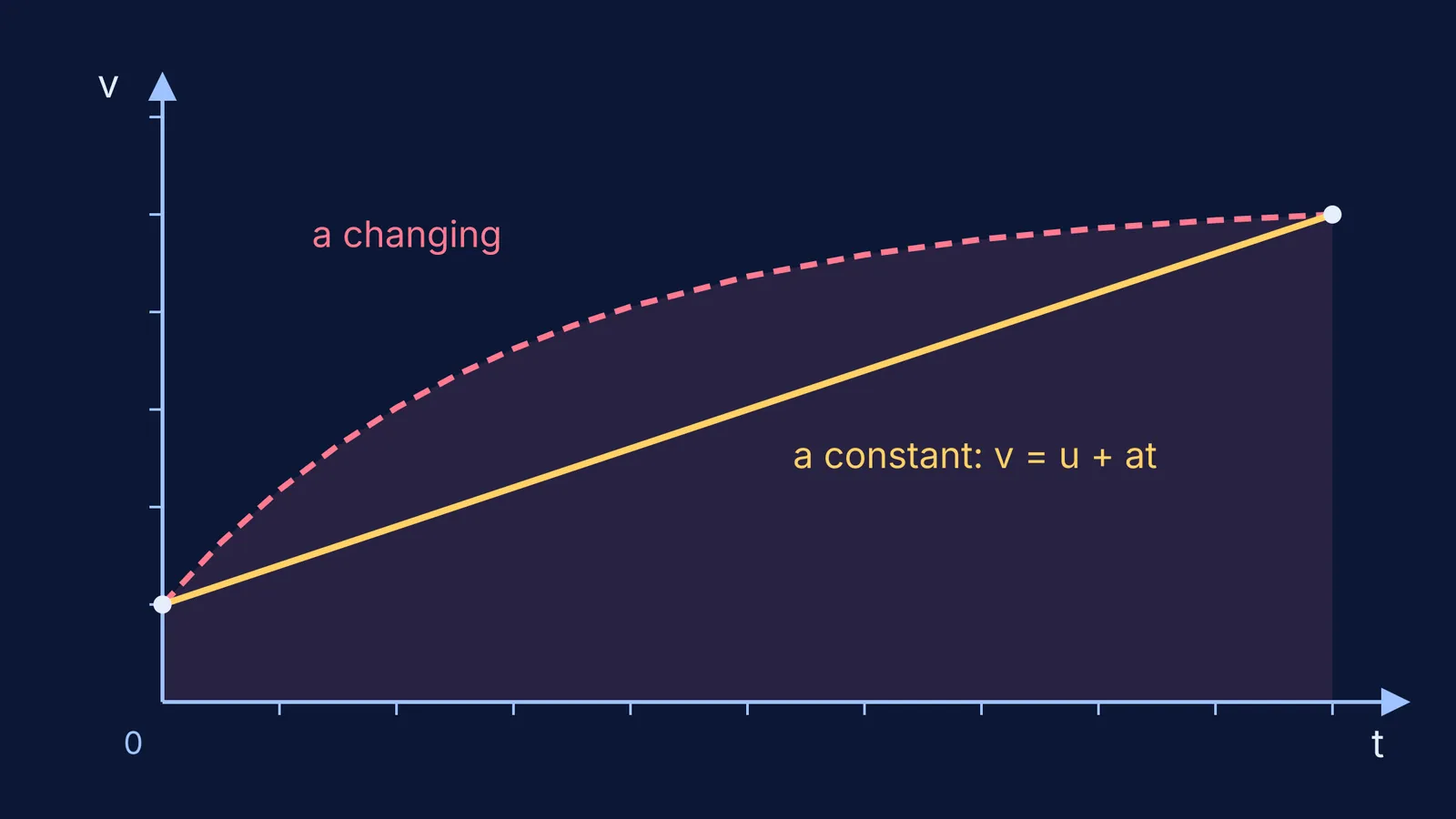
The kinematic equations are true only for motion in which the magnitude and direction of acceleration stay constant, as the NCERT Class 11 Physics chapter on motion in a straight line points out. So the first check is not which variable is missing; it is whether acceleration is constant.
Worked example: a scooter moving at 20 m/s brakes uniformly and stops in 50 m. Find the deceleration and the time taken.
Condition: "brakes uniformly" means constant acceleration, so the kinematic equations apply.
Which equation: you know u = 20 m/s, v = 0 and s = 50 m, and time is unknown. v² = u² + 2as is the one without t, so 0 = 400 + 2a(50) and a = −4 m/s².
Now the time: v = u + at gives 0 = 20 − 4t, so t = 5 s.
If the rider pressed the brakes harder and harder, acceleration would change and none of these equations would hold; you would go back to a = dv/dt.
When can you use PV = nRT, Boyle's law or Charles' law?
Real gases approach ideal gas behaviour at low pressures and high temperatures, according to the NCERT Class 11 Physics chapter on kinetic theory. The same chapter gets Boyle's law from the ideal gas equation by fixing the amount of gas and the temperature, and Charles' law (V proportional to T) for a given sample by fixing the pressure.
So "Boyle or Charles?" is really "what is held constant?" Slowly pressing the plunger of a sealed syringe at room temperature fixes amount and temperature: Boyle. Heating gas under a freely moving piston fixes pressure: Charles. A gas at very high pressure, near liquefying, is a warning that neither law will be exact.
Why does t½ = 0.693/k work for some reactions and not others?
For a first order reaction, t½ = 0.693/k, and this half-life does not depend on the starting concentration, as derived in the NCERT Class 12 Chemistry chapter on chemical kinetics. For a zero order reaction, the same chapter shows t½ = [R]₀/2k, which is directly proportional to the starting concentration.
NCERT's Example 3.5 finds k = 0.0304 min⁻¹ for the first order decomposition of N₂O₅ at 318 K, so its half-life is about 22.8 minutes whatever amount you start with. On a zero order reaction, 0.693/k gives a wrong answer. The condition is the order, which NCERT notes is found by experiment, not read off the balanced equation.
How do you check the AI's answer about conditions?
AI can state a condition confidently and still be wrong, so test it:
Can you find the same condition in your textbook?
Change one detail (non-uniform braking, high pressure, zero order). Does the AI's formula change too?
Can you say in one sentence why the other formula fails?
Keep picking the wrong method? Seeing the reasoning step by step can help. The Fermi Problem Library has worked problems with a step-by-step solver that explains the reasoning rather than printing an answer. Fermi's AI tutor notices where you are stuck and decides whether to explain, ask or show, so you can practise the "which condition?" question with it.
Next, learn to ask AI for the assumptions behind a formula, or check your choice by comparing your method with a model solution.


