On this page
When you finish a tough physics or maths problem and check the back of the book, you usually find just the final answer or one model solution. If your answer matches but your steps look completely different, you might wonder if you found a clever shortcut or just got lucky. If your answer is wrong, the book rarely explains *why* your specific logic failed.
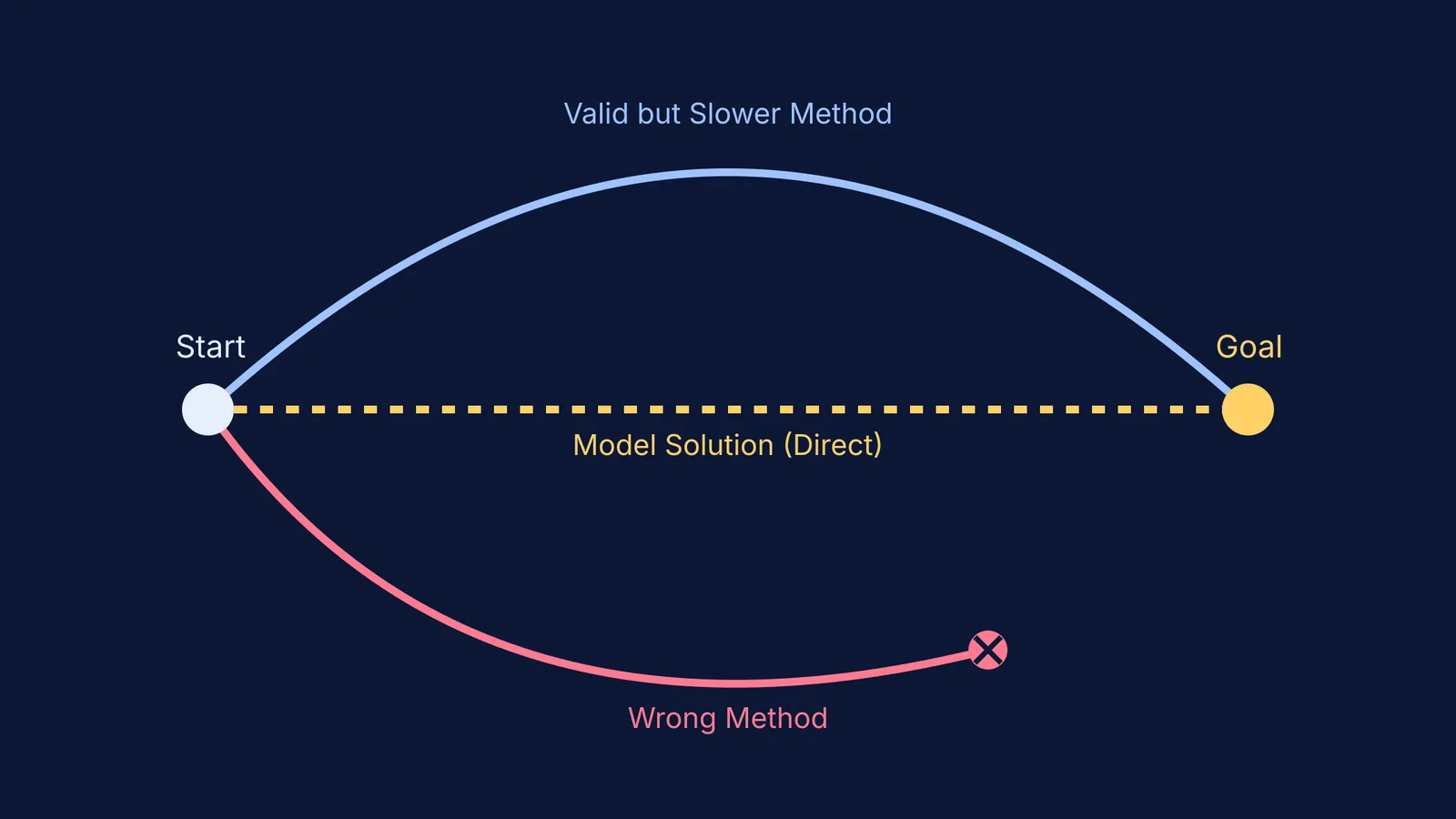
This is where AI excels. Instead of just seeking the final step—a debate explored in our guide on hints or answers? What tutoring research says about the right help—you can paste your exact working and ask if your method is valid, slower, or wrong.
Why compare your solution to the model one?
Evaluating multiple paths to a single answer builds deeper understanding than memorising one formula. It is a form of active learning. A 1991 paper by Bonwell and Eison defined active learning as any method where students participate by "doing something besides passively listening."
Looking at your own method next to an expert's forces you to trace the logic. A 2014 study of 145 students by Schukajlow and Krug published in the *Journal for Research in Mathematics Education* found that prompting students to construct multiple solutions for a single problem had a positive effect on their interest, competence and autonomy. It proves that maths is not just a rigid set of rules, but a logical space where different valid paths exist.
How to ask AI to compare your method with the model solution?
To get the most out of an AI tutor, you need to prompt it to act like a teacher, following the Socratic method. The Socratic method is a form of argumentative dialogue where questions are used to press someone to come to a conclusion on their own.
Use this simple script when you finish a problem:
"I solved this problem using the following steps: [insert your steps]. The official solution uses [insert official steps]. Please compare them. Tell me if my method is valid. If it is valid, is it slower or faster? If it is wrong, do not just give me the right answer—ask me a question to help me find the flaw in my logic."
This approach forces you to do the cognitive work. Fermi's AI tutor is built around this exact principle. It holds a line of reasoning across a session, works out what you already know, and decides whether to explain, ask, or show. It teaches rather than simply answering.
What if your method is valid but slower?
Sometimes, you rely on first principles to derive an answer, while the model solution uses a specific shortcut or theorem. For example, deriving the time of flight for a projectile using basic kinematics equations works perfectly, but using the standard formula T = 2u sin(θ) / g is faster.
If the AI tells you your method is valid but slower, it means your fundamental understanding is solid. In competitive exams like JEE or NEET, however, speed matters. Use the AI's feedback to map your longer path to the standard shortcut. For more on structuring your practice and review times, you can read our breakdown of immediate or delayed feedback: when should you check your answers?
If you want to practise problems where multiple approaches are encouraged, the Fermi Problem Library has a step-by-step solver that explains the reasoning for different methods.
What if your method is wrong?
A wrong answer is the best place to learn, provided you find out exactly where you slipped. Often, students erase their work and blindly copy the textbook's solution. This guarantees they will make the same mistake again.
When the AI compares your wrong method to the right one, it isolates the exact step where your logic broke down. Did you misapply a sign convention? Did you forget that friction acts opposite to the direction of relative motion? Identifying these specific gaps helps you update your mental model.
If you struggle with the core ideas behind the solution, rather than just the math, check the Fermi Concept Library to patch the theoretical gap before trying the next problem.
By taking the time to compare methods, you stop treating model solutions as unquestionable truths, and start treating them as one of many possible routes to the right answer.