

On this page
When solving equations in mathematics or physics, it is tempting to treat algebraic rules as mechanical shortcuts. You spot a matching term on both sides, strike a diagonal line through it, and move on to the next line of working. In classroom problem sets, this shortcut often produces the textbook answer. In exam problems—such as those in JEE Main, CBSE boards, or advanced physics—the identical move can silently erase a valid physical solution or introduce an impossible ghost value.
The issue is that algebra is not a set of typographical tricks. Every legitimate operation on an equation is a logical deduction that transforms one equality into another. When you ask an AI assistant to check your working, asking "Is this step right?" usually returns a superficial confirmation. To build real competence, you need to ask a sharper question: why is this specific step allowed, and under what conditions does it break?
Why can you not simply cancel a term from both sides?
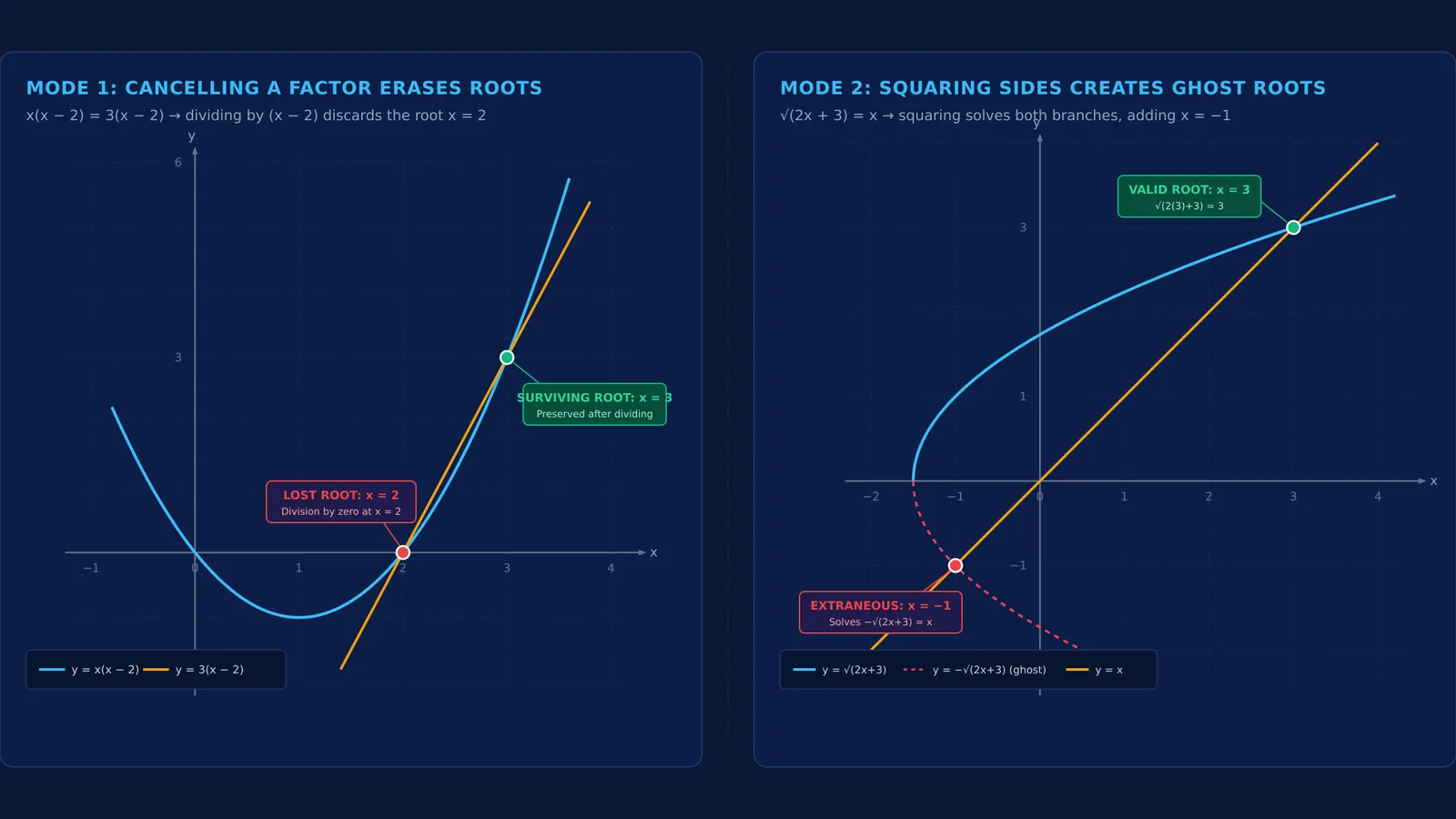
Consider a standard quadratic equation: x(x − 2) = 3(x − 2). A common instinct is to cancel the factor (x − 2) from both sides, leaving x = 3. But substituting x = 2 into the original equation gives 2(0) = 3(0), which is true (0 = 0). The value x = 2 is a genuine solution, yet cancelling made it disappear.
Cancelling is not an eraser; it is division. When you divide both sides by (x − 2), you are making an implicit assumption that x − 2 ≠ 0. If x − 2 = 0, dividing by it is mathematically undefined. By dividing without splitting the problem into cases, you throw away an entire branch of solutions. The safe approach is to collect all terms on one side: x(x − 2) − 3(x − 2) = 0, which factors into (x − 3)(x − 2) = 0, preserving both x = 3 and x = 2.
A similar danger arises with rational expressions. In the equation (x² − 9) / (x − 3) = 6, factoring the numerator into (x − 3)(x + 3) and cancelling (x − 3) yields x + 3 = 6, suggesting x = 3. However, plugging x = 3 back into the original expression produces 0/0, which is undefined. The original equation has an empty solution set. As Carolyn Kieran (2004) explained in *The Future of the Teaching and Learning of Algebra*, algebra requires understanding "transformational activities" as operations that must strictly preserve algebraic equivalence. Two equations are equivalent if and only if they share identical solution sets. Striking out terms without checking domain restrictions breaks that equivalence, a failure mode students also notice when analyzing why AI chatbots make maths mistakes.
When does squaring both sides create extraneous roots?
The opposite problem occurs when an operation manufactures roots that never existed in the original problem. Suppose you need to solve √(2x + 3) = x. To eliminate the radical, you square both sides to obtain 2x + 3 = x². Rearranging terms produces x² − 2x − 3 = 0, which factors into (x − 3)(x + 1) = 0. This quadratic yields two solutions: x = 3 and x = −1. Checking x = 3 in the original equation gives √(9) = 3, which is valid. But testing x = −1 yields √(1) = −1. Because the principal square root is non-negative by definition, 1 ≠ −1, making x = −1 an extraneous root.
Squaring both sides is irreversible because it destroys sign information. When you square √(2x + 3) = x, you simultaneously solve the twin equation −√(2x + 3) = x. The extraneous root x = −1 is the genuine intersection of that lower reflected branch, not your original curve.
What does cognitive research say about explaining steps?
Why should you spend time interrogating why steps work rather than simply doing more practice problems? Cognitive science provides a clear answer. In a 2013 study published in *Learning and Instruction*, Julie L. Booth, Karin E. Lange, Kenneth R. Koedinger, and Kristie J. Newton demonstrated that prompting students to self-explain *incorrect* worked examples significantly boosted their conceptual understanding of equations compared to solving problems alone. Confronting where a rule fails forces learners to notice algebraic features they previously ignored.
This finding reinforces earlier research by Vincent Aleven and Kenneth Koedinger (2002) in *Cognitive Science*00061-7), which showed that students required to justify problem-solving steps with explicit principles developed more robust knowledge and transferred their skills far better to unfamiliar tasks. In an earlier 1989 investigation in *Cognitive Science*, Michelene Chi and colleagues found that high-performing students naturally generate explanations that clarify the exact conditions under which an action is permitted.
This is where Fermi's AI tutor teaches rather than merely answering questions: it holds a line of reasoning across a session, notices where a student is stuck, and decides whether to explain, ask or show. For worked problems, the Fermi Problem Library provides worked problems with a step-by-step solver that explains the reasoning rather than printing an answer.
How should you prompt an AI tutor to audit your steps?
If you use an AI tool while studying, avoid prompts like "Solve this for me" or "Is step 3 correct?" General language models often gloss over invalid cancellations if the final number looks plausible. Instead, use targeted prompts that force the AI to test mathematical conditions:
"Under what domain restrictions is this transformation reversible?"
"If I divide both sides by this term, what roots am I discarding if the term equals zero?"
"Does squaring or cross-multiplying here introduce extraneous solutions on the original domain?"
"Show me an example where applying this identical operation produces a false statement like 1 = 2."
Learning how to query an AI about step validity helps you use step-by-step solvers without just copying. Combined with the habit of asking why while studying, auditing your steps transforms mechanical algebra into deep mathematical reasoning.


