On this page
You push the same bar magnet into three coils of 50, 100 and 200 turns, at the same speed, each wired to the same galvanometer. The needle swings further each time. But the swing does not keep pace with the number of turns. Two laws you already know explain both facts.
Does more turns in a coil give more induced emf?
Yes. For a coil of N turns, Faraday's law gives ε = −N dΦ/dt, where Φ is the magnetic flux through one turn (OpenStax University Physics Volume 2, Faraday's law). In this ideal picture each turn sees the same change of flux, so the emfs of the turns add in series, like cells placed end to end.
If the magnet and its speed stay the same, dΦ/dt stays the same, and the emf is proportional to N. Double the turns, double the emf. To revise how flux depends on area and angle first, see magnetic flux through a coil at an angle.
Why doesn't the galvanometer current double too?
A galvanometer's needle deflection is proportional to the current through it (OpenStax College Physics 2e, galvanometers). That current is I = ε / (R_coil + R_G), where R_G is the galvanometer's own resistance.
Here is the catch. A uniform wire's resistance is R = ρL/A, so it grows in proportion to the wire's length (OpenStax, resistivity and resistance). Wind more turns from the same wire on the same former and you use more wire. Twice the turns means about twice the coil resistance.
So the top of the fraction doubles, and the bottom grows too. The current rises, but by less than double.
A worked example with real numbers
Copper has a resistivity of 1.68 × 10⁻⁸ Ω·m at 20 °C (OpenStax, resistivity table). Take copper wire 0.1 mm thick, wound into turns of radius 2 cm. The OpenStax galvanometer example uses a 25 Ω meter (OpenStax College Physics 2e), so use that. Assume the moving magnet induces 10 μV in each turn; this is a value chosen for the example, and a real one depends on your magnet and your push.
Resistance per metre of wire: ρ/A = 1.68 × 10⁻⁸ ÷ (π × (0.05 × 10⁻³)²) ≈ 2.14 Ω/m.
Length of one turn: 2π × 0.02 ≈ 0.126 m, so each turn adds about 0.269 Ω.
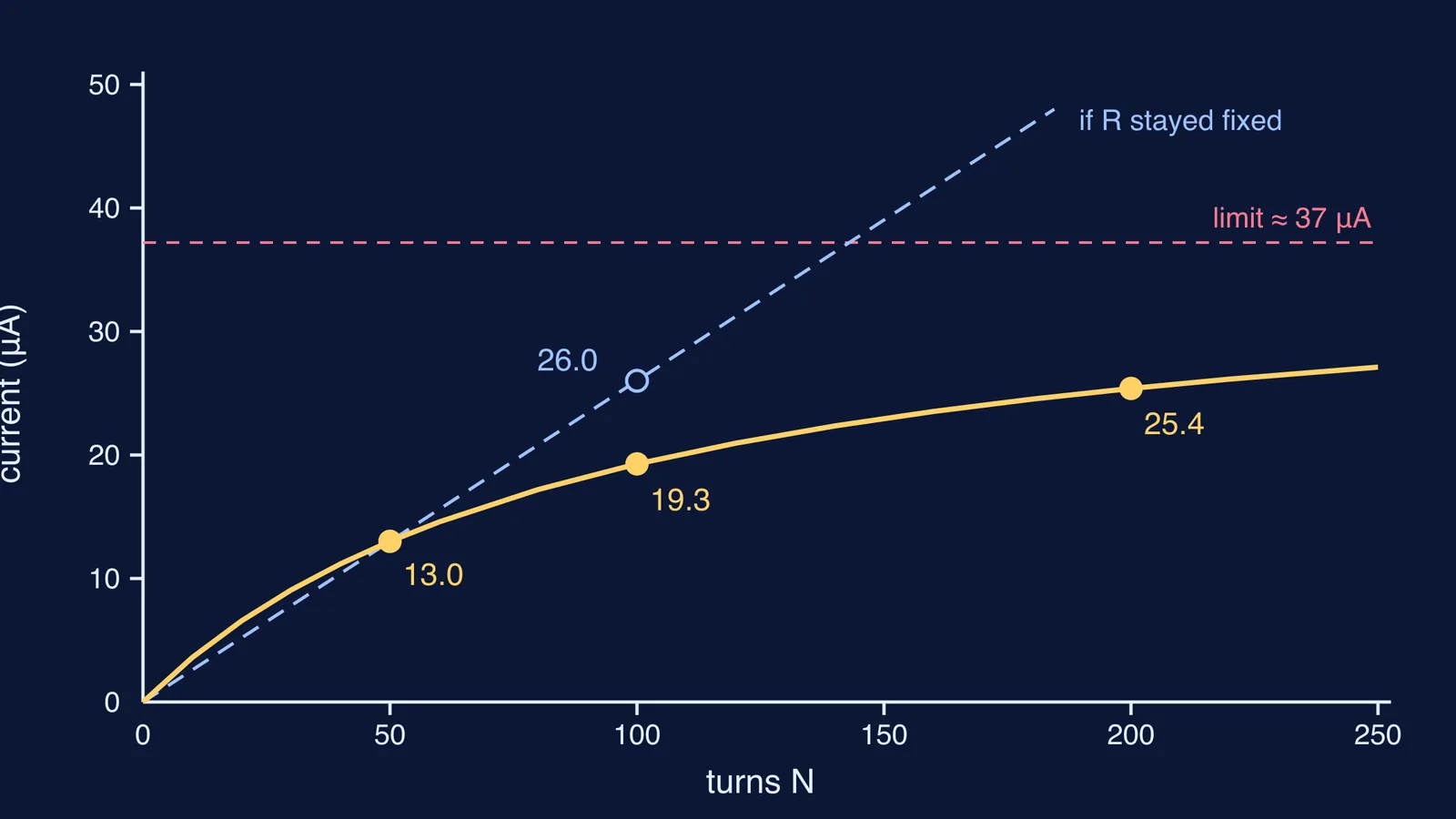
50 turns: emf 0.5 mV, coil 13.4 Ω, total 38.4 Ω, current 13.0 μA.
100 turns: emf 1.0 mV, coil 26.9 Ω, total 51.9 Ω, current 19.3 μA.
200 turns: emf 2.0 mV, coil 53.8 Ω, total 78.8 Ω, current 25.4 μA.
The emf doubles at every step. In this example the current goes up about 1.48 times from 50 to 100 turns and about 1.32 times from 100 to 200 turns. Four times the turns gives roughly twice the deflection.
Notice the trend. As N grows, both the emf and the coil resistance become proportional to N, so the current approaches emf per turn ÷ resistance per turn = 10 μV ÷ 0.269 Ω ≈ 37 μA. With this wire, no number of turns pushes past that limit.
What else changes when you add turns?
A coil with more turns is usually longer or fatter. Turns far from the magnet's path see a smaller change of flux, so in a real lab the emf grows a little less than N times.
Speed matters as much as turns. Push twice as fast and dΦ/dt doubles for every coil, so the emf doubles too (OpenStax, Faraday's law). The shape of the emf over time is in induced emf vs time for a magnet falling through a coil.
The direction of the kick depends on the pole and the direction of motion, not on N. If your sign keeps coming out wrong, see three common mistakes in finding induced current direction.
How should you answer this in an exam?
Questions often say "the number of turns is doubled" without saying what happens to the resistance. Use this three-step check:
Write the emf: ε is proportional to N dΦ/dt.
Decide what happens to the resistance. Same wire, more turns: R grows with N. "Resistance unchanged" in the question: the current doubles.
Write I = ε / R_total for both cases and compare the ratio, instead of guessing.
Two effects pulling against each other are often easier to see than to read, which is what the Fermi Simulation Lab and its interactive simulations are for. For practice, the Fermi Problem Library has worked problems with a step-by-step solver that explains the reasoning rather than printing an answer, so you can see exactly where a ratio went wrong.
Next time you see "turns doubled", ask one question before you write anything: what happened to the resistance?