On this page
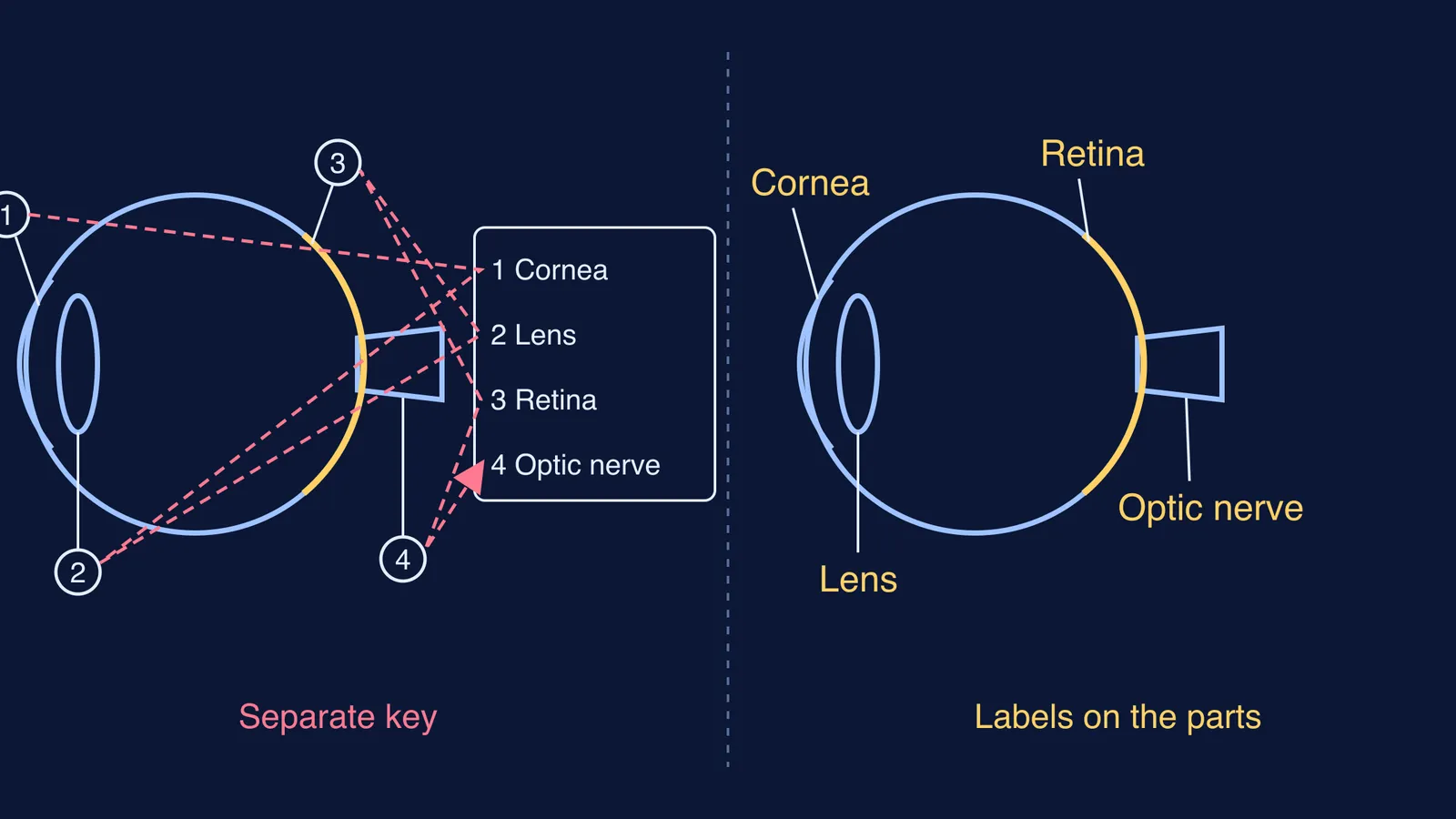
You open a textbook figure. The parts are numbered 1 to 8 and the names sit in a key at the bottom, or what each part does is three paragraphs away. Your eyes go back and forth, and ten minutes later little has stuck. Often that is less a focus problem than a layout problem, and a pencil can fix it.
What is the split-attention effect?
The split-attention effect is the drop in learning that happens when you must mentally join two sources of information, such as a diagram and its key, that sit apart on the page (Chandler and Sweller, British Journal of Educational Psychology, 1992). While you hunt for ‘6’ in the key, you hold the spot on the figure in mind, and that leaves less working memory for understanding.
In that paper, Paul Chandler and John Sweller ran two experiments. Trainees learning to program machine tools did better when instructions were joined to the diagrams, and students reading psychology reports did better, in less time, when related parts of the text were joined together. The idea comes from cognitive load theory, explained in our post on John Sweller's cognitive load theory and why solved examples help.
Do labels on the diagram really help you learn?
On average, yes. A 2018 meta-analysis by Noah Schroeder and Ada Cenkci pooled 58 experimental comparisons from 1989 to 2017, with 2,426 learners (Educational Psychology Review, 2018; figures as reported in this Technical University of Munich summary). Learners given text and picture together outperformed those given them apart, with an average effect size of g = 0.63.
Three details matter for how you study:
Static figures and worksheets gained most. The effect was g = 0.68 for static pictures and g = 0.80 for worksheets, against g = 0.24 for interactive pictures.
It helps most when picture and text don't repeat each other. The effect was g = 0.74 when the picture and text did not duplicate content, and g = 0.26 (not statistically significant, only 4 comparisons) when the picture made sense alone.
Most evidence comes from adults. 35 of the 58 comparisons were in adult education and only 7 in Classes 9 to 12, though those 7 showed a large effect (g = 0.81).
How do you redraw an NCERT figure with labels on the parts?
You can't change the book, but you can change your copy. Do this for the figures you keep forgetting:
Pick the right figures: numbered parts with a key, or figures whose explanation lives in the paragraphs.
Redraw it big, on half a page, so there is room beside each part.
Put each name on its part, or just beside it with a short leader line. Keep the lines from crossing.
Add the job in five words or fewer, taken from the paragraph. Skip anything the picture already shows; the 2018 review found only a small, uncertain effect there.
Test the redraw, not the book. Close the textbook and explain the figure aloud from your page. Where you get stuck, a label or a job is missing.
What does a labelled redraw of the human eye look like?
The human eye in Class 10 science is a good first figure: the names are easy, and the jobs are where marks are lost. On your redraw, each part carries both:
Cornea: clear front window; bends incoming light most
Iris: coloured ring; sets the pupil's size
Pupil: the opening; lets light in
Eye lens: fine-tunes the focus
Ciliary muscles: change the lens's curvature for near or far
Retina: screen where the image forms
Optic nerve: carries signals to the brain
Now ‘how does the eye focus on a nearby object?’ is answered by tracing the figure: ciliary muscles, lens, retina. Nothing has to be pieced together from three paragraphs. For more ways to combine words and pictures, see our guide to dual coding in science notes.
If a figure still makes no sense after the redraw, the gap is usually the concept, not the layout. Fermi's AI tutor draws the figure as it teaches, decides whether to explain, ask or show, and checks your understanding as it goes.
When is a separate key fine?
The picture explains itself. If you already know the parts, extra text only repeats the figure.
You are testing yourself. Once a figure is learned, a numbered blank version is good revision: recall the names, then check. Our cover-and-check method for textbook diagrams shows how.
Start with one figure tonight: redraw it, label the parts in place, and explain it with the book closed.