On this page
Ask a chatbot for the solubility of silver chromate and the answer can come back neat, confident and wrong by more than an order of magnitude. A common cause: the AI treats Ag2CrO4 like AgCl and takes the square root of Ksp. One line of your own working catches it.
Why does AI get Ksp solubility answers wrong?
A chatbot writes text that looks like answers it has seen before, and a standard textbook Ksp example is a 1:1 salt such as AgCl, where Ksp = s². ChemBench, a 2025 Nature Chemistry benchmark of 2,788 chemistry question-answer pairs, found the best models beat the best human chemists on average, yet the models "struggle with some basic tasks and provide overconfident predictions" (Mirza et al., Nature Chemistry). On molecular-structure questions, performance did not track the molecules' complexity, which the authors read as reliance on closeness to training data rather than reasoning (full text on PMC).
Ksp problems are a neat trap for that kind of pattern-matching. Ag2CrO4 and CaF2 look routine, so a model can reach for the 1:1 template, drop the stoichiometric factor, then do flawless arithmetic on the wrong equation.
What is the one-line check?
Before you trust any number, write Ksp in terms of the molar solubility s yourself. For a salt MpXq that dissolves into p cations and q anions, Ksp = [M]^p × [X]^q (OpenStax Chemistry 2e, section 15.1). The ion concentrations are then ps and qs:
Ksp = (ps)^p × (qs)^q = p^p × q^q × s^(p+q)
The same OpenStax section works Ca(OH)2 this way, writing Ksp = (x)(2x)² = 4x³. Here is the line for four salts you will meet in practice problems:
AgCl: Ksp = s × s = s²
CaF2: Ksp = s × (2s)² = 4s³
Ag2CrO4: Ksp = (2s)² × s = 4s³
Ca3(PO4)2: Ksp = (3s)³ × (2s)² = 108s⁵
For where the expression comes from, see what the solubility product Ksp means.
Worked example: how wrong can an Ag2CrO4 answer be?
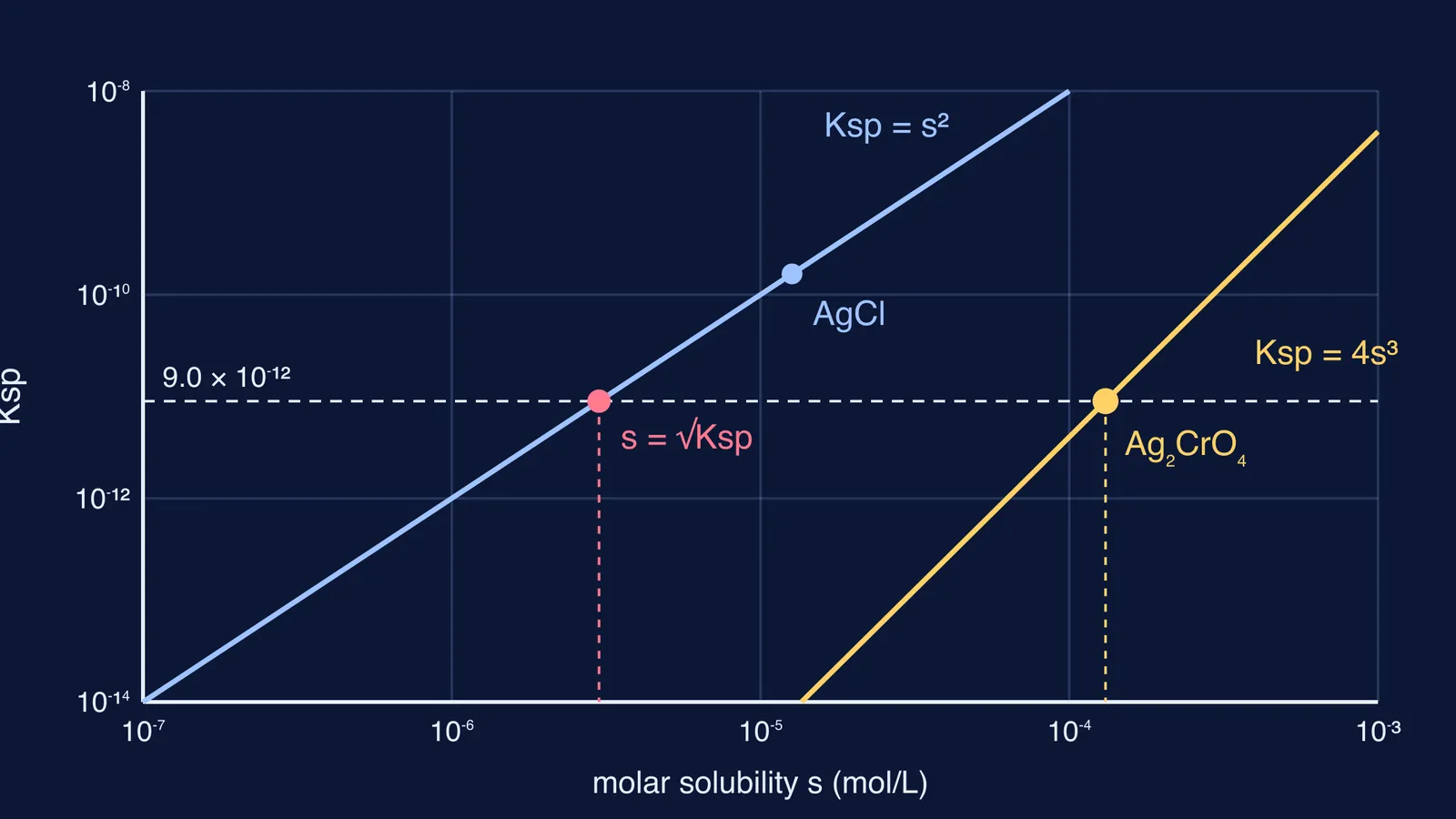
OpenStax lists the Ksp of Ag2CrO4 as 9.0 × 10⁻¹² at 25 °C (OpenStax Chemistry 2e, Appendix J). From that one value, the four ways of writing the Ksp line give four different answers:
Correct, 4s³ = 9.0 × 10⁻¹²: s³ = 2.25 × 10⁻¹², so s = 1.3 × 10⁻⁴ mol/L.
Treated like AgCl, s² = 9.0 × 10⁻¹²: s = 3.0 × 10⁻⁶ mol/L, about 44 times too small.
Forgot the 2 inside the bracket, s³ = 9.0 × 10⁻¹²: s = 2.1 × 10⁻⁴ mol/L, about 1.6 times too big.
Forgot to square the 2, 2s³ = 9.0 × 10⁻¹²: s = 1.7 × 10⁻⁴ mol/L, about 1.3 times too big.
Answers 3 and 4 are the dangerous ones: same order of magnitude as the right answer, so they look plausible. Only the factor of 4 in the Ksp line gives them away.
Then substitute back: 4 × (1.31 × 10⁻⁴)³ = 9.0 × 10⁻¹², which matches the table. CaF2 behaves the same way. With the Appendix J value of 4.0 × 10⁻¹¹, 4s³ gives s = 2.2 × 10⁻⁴ mol/L, while the square-root shortcut gives 6.3 × 10⁻⁶ mol/L, about 34 times too small.
Can you compare solubilities just by comparing Ksp values?
Only for salts with the same formula type. In the same OpenStax table, AgCl has a larger Ksp than Ag2CrO4: 1.6 × 10⁻¹⁰ against 9.0 × 10⁻¹² (OpenStax Chemistry 2e, Appendix J). Yet the molar solubility of AgCl, √(1.6 × 10⁻¹⁰) = 1.3 × 10⁻⁵ mol/L, is about ten times smaller than the 1.3 × 10⁻⁴ mol/L of silver chromate. An AI that ranks salts by Ksp alone gets this order backwards. We work through more pairs in comparing solubility from Ksp for salts with different formulas.
What should you do when the AI's answer fails the check?
Before you copy any Ksp answer into your notes:
Write your own line: Ksp in terms of s, with each ion's concentration shown.
Find the same line in the AI's working. If it is missing or different, stop.
Ask: "Write Ksp for this salt in terms of s, showing the concentration of each ion, then solve. Then put your s back into the Ksp expression."
Substitute the final s into your own line and check that you get the table value back.
Sanity check: for any salt that is not 1:1, the right s is larger than √Ksp whenever Ksp is small.
The same habit catches the Δn slip in checking an AI's Kc to Kp conversion.
When you want to see where the 4 enters rather than just be told, the Fermi Problem Library has worked problems with a step-by-step solver that explains the reasoning rather than printing an answer. If the gap is the idea of solubility equilibrium itself, the Fermi Concept Library gives each concept its own lesson and its place in the map.
Next time an AI hands you a Ksp answer, write one line first, then read its number.