

On this page
If you are asked to rank salts by how well they dissolve in water, your first instinct might be to just look at their solubility product constants (Ksp). It seems logical: a smaller Ksp should mean less dissolves. But this shortcut only works if the salts share the same formula type.
When comparing salts that break into a different number of ions—like silver chloride (AgCl) and silver chromate (Ag₂CrO₄)—a direct Ksp comparison will give you the wrong answer. You have to calculate the molar solubility (s) for each.
How do you find the solubility of AgCl?
Silver chloride is an AB-type salt. When it dissolves, it splits into two ions: one silver ion and one chloride ion.
AgCl (s) ⇌ Ag⁺ (aq) + Cl⁻ (aq)
The expression for its solubility product is simply the product of the two ion concentrations: Ksp = [Ag⁺][Cl⁻]. If the molar solubility is s, then [Ag⁺] is s and [Cl⁻] is s, making Ksp = s².
According to standard values published by EniG. Periodic Table of the Elements, the Ksp for AgCl is 1.77 × 10⁻¹⁰.
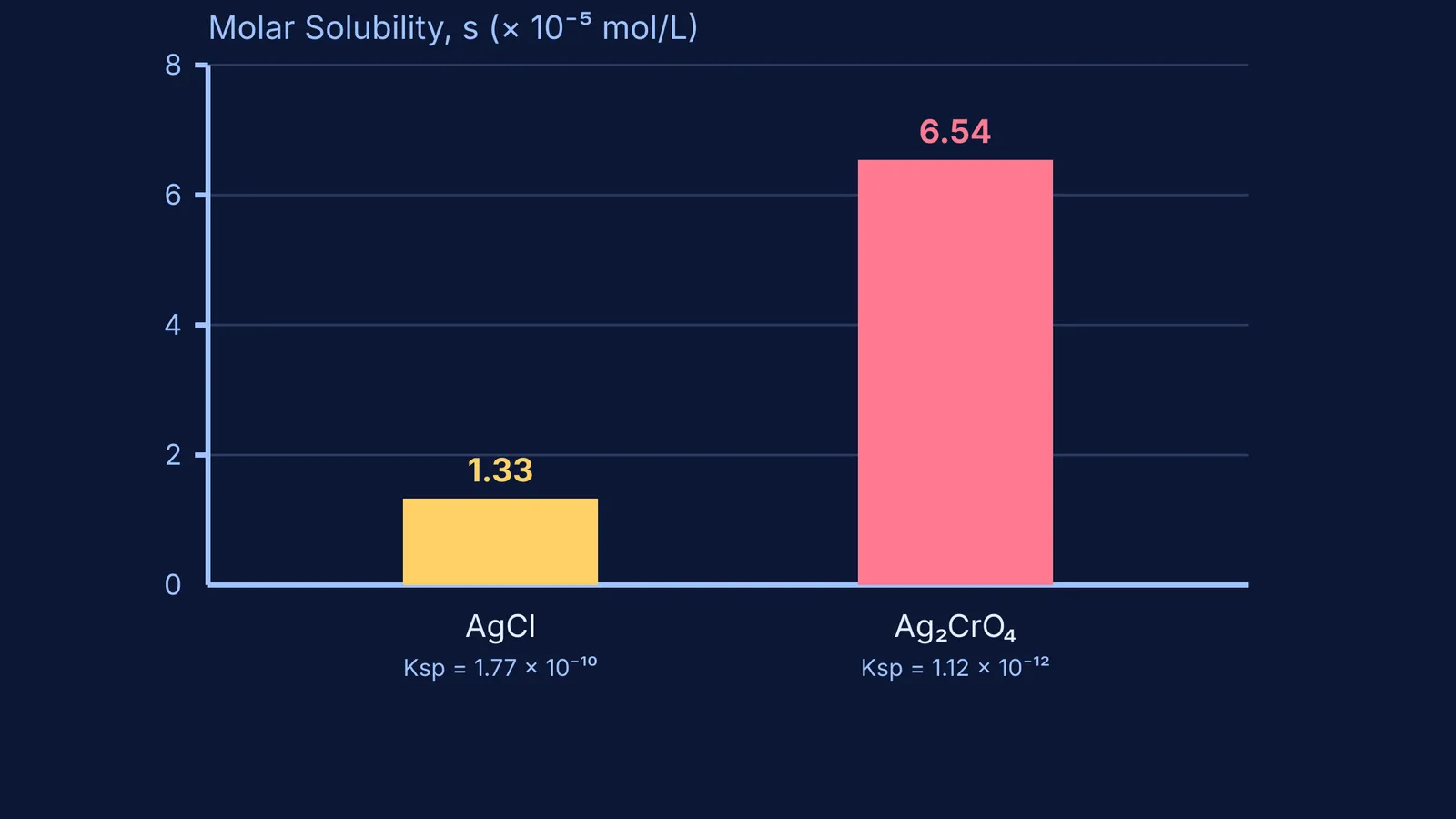
Solving for s means taking the square root: s = √(1.77 × 10⁻¹⁰) ≈ 1.33 × 10⁻⁵ mol/L.
How do you find the solubility of Ag₂CrO₄?
Silver chromate, however, is an A₂B-type salt. Each formula unit that dissolves yields three ions: two silver ions and one chromate ion.
Ag₂CrO₄ (s) ⇌ 2Ag⁺ (aq) + CrO₄²⁻ (aq)
The solubility product expression must account for this stoichiometry. The silver ion concentration is squared: Ksp = [Ag⁺]²[CrO₄²⁻]. If the molar solubility is s, then [Ag⁺] is 2s and [CrO₄²⁻] is s.
This makes the Ksp equation much different: Ksp = (2s)²(s) = 4s³.
The same table lists the Ksp of Ag₂CrO₄ as 1.12 × 10⁻¹². Notice that this value is roughly 160 times smaller than the Ksp of AgCl.
To find its molar solubility, we solve 4s³ = 1.12 × 10⁻¹²: s³ = 2.8 × 10⁻¹³ s = ∛(2.8 × 10⁻¹³) ≈ 6.54 × 10⁻⁵ mol/L.
Can we compare solubility using Ksp for AgCl and Ag2CrO4?
No, you cannot. If you only looked at the Ksp values, you would assume Ag₂CrO₄ (1.12 × 10⁻¹²) is much less soluble than AgCl (1.77 × 10⁻¹⁰).
However, looking at the calculated molar solubilities (s), Ag₂CrO₄ (6.54 × 10⁻⁵ mol/L) is actually nearly five times *more* soluble than AgCl (1.33 × 10⁻⁵ mol/L).
This happens because the power of s dictates the math. Because Ag₂CrO₄ breaks into three ions, its Ksp involves an s³ term. When you take the cube root of a very small decimal, the resulting value is much larger than the number you started with, pulling its molar solubility up compared to the square root used for AgCl.
Why does this matter for precipitation reactions?
Examiners frequently use this mismatch between Ksp and actual solubility to set traps in selective precipitation questions. A classic problem asks you to slowly add silver nitrate (AgNO₃) to a solution containing both chloride (Cl⁻) and chromate (CrO₄²⁻) ions, and identify which salt precipitates first.
Many students look at the provided Ksp values, see that silver chromate's Ksp is much smaller, and incorrectly guess that it will precipitate first. However, precipitation occurs when the ionic product (Qsp) exceeds the Ksp.
Because AgCl is less soluble (s = 1.33 × 10⁻⁵ mol/L) than Ag₂CrO₄ (s = 6.54 × 10⁻⁵ mol/L), the chloride ions require a much lower concentration of silver ions to reach saturation. Therefore, white silver chloride will always precipitate out of the mixture long before the red silver chromate begins to form. In fact, this precise colour change is the basis of Mohr's method for determining chloride concentration in a laboratory titration.
If you are dealing with other heterogeneous systems and want to see how these equations are derived, Heterogeneous equilibria: why solids and pure liquids drop out of K walks through the core principles. Or, if you need to factor in an existing ion in the water, check out Solubility product: Ksp, common ion effect and precipitation.
When exams throw unfamiliar or complex salts at you, it is easy to get the (2s)²(s) algebra tangled up. If you get stuck trying to find molar solubility from Ksp for different salt types, the Fermi Problem Library has worked problems with a step-by-step solver that explains the reasoning rather than printing an answer.


