On this page
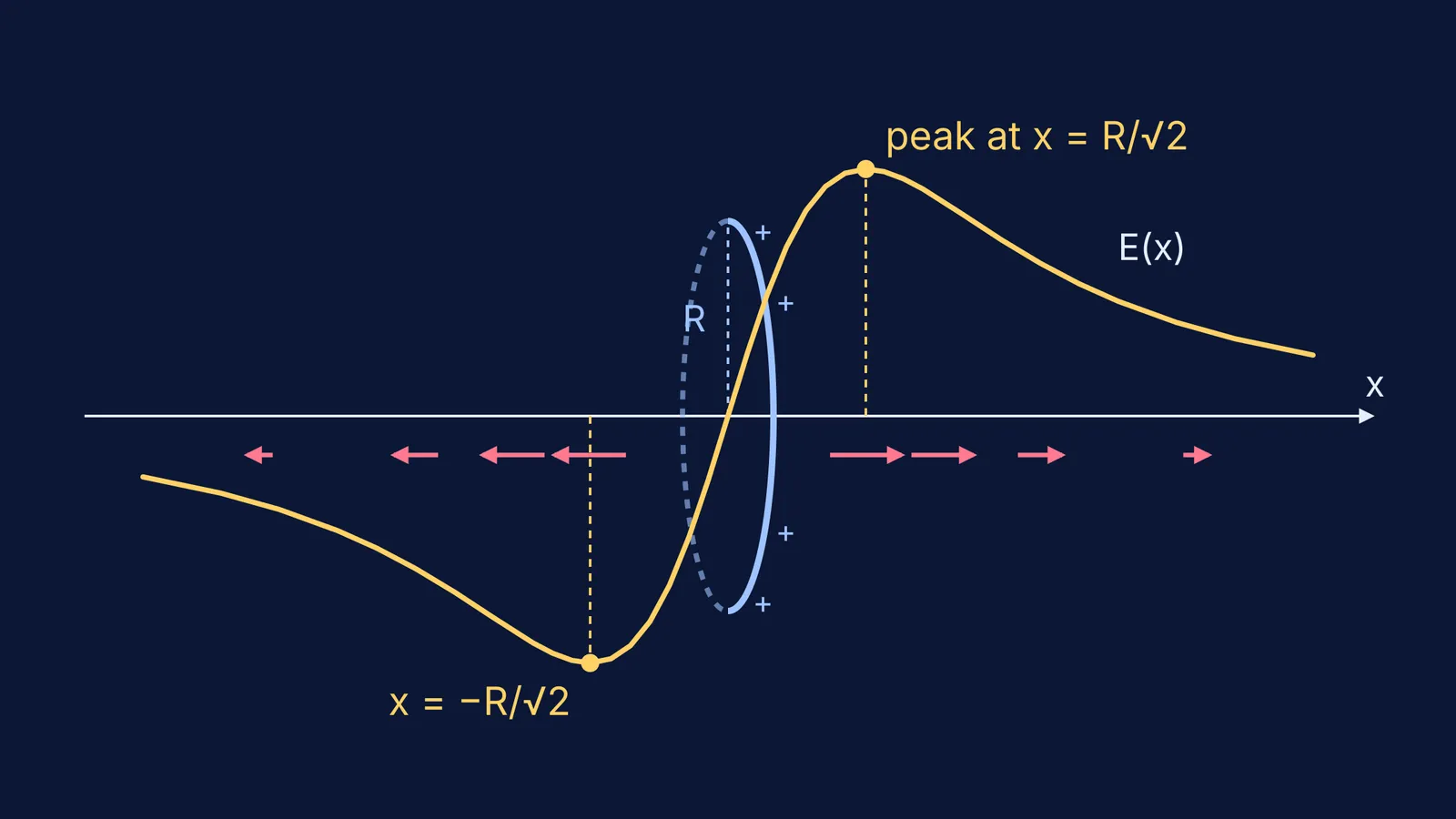
Put a small positive test charge at the centre of a uniformly charged ring and it feels no force at all. Move it far out along the axis and the force fades away again. Somewhere in between, the push is strongest: at x = R/√2, about 0.71 times the radius. Here is the experiment, the proof and a worked example.
What is the electric field on the axis of a charged ring?
For a ring of radius R carrying total charge Q, the field at a distance x along its axis is E = (1/4πε₀) · Qx/(x² + R²)^(3/2), pointing along the axis, as derived in OpenStax University Physics Volume 2, section 5.5.
We write k = 1/4πε₀ from here on. Only the axial part survives because every piece of charge has a partner directly opposite, and their sideways pushes cancel.
At x = 0 the formula gives E = 0. When x is much larger than R, the formula shrinks to kQ/x², so from far away the ring looks like a point charge, as the OpenStax derivation notes.
Zero at the centre and zero far away means the field has to rise and then fall. So it has a maximum.
Where is the electric field on the axis of a ring maximum?
Picture the experiment first. Slide the test charge out from the centre in small steps. Near the centre the push grows quickly; past a certain point it shrinks. The turning point is the maximum.
Now the proof. Treat E as a function of x and set its derivative to zero.
Start with E(x) = kQ · x · (x² + R²)^(−3/2).
Use the product rule: dE/dx = kQ[(x² + R²)^(−3/2) − 3x²(x² + R²)^(−5/2)].
Take out the common factor: dE/dx = kQ(x² + R²)^(−5/2) · (R² − 2x²).
The first factor is never zero, so dE/dx = 0 only when R² − 2x² = 0, which gives x = R/√2.
Is it a maximum and not a minimum? Look at the sign of R² − 2x². For x below R/√2 it is positive, so E is rising. Above R/√2 it is negative, so E is falling. Rising then falling means a maximum. By symmetry there is a matching peak at x = −R/√2 on the other side, where the field points the other way.
Putting x = R/√2 back into the formula gives E_max = 2kQ/(3√3R²), or about 0.385 kQ/R².
How strong is the field at the peak?
Take a ring of radius 10 cm with a charge of 10 nC. Using ε₀ = 8.8541878188 × 10⁻¹² F/m from NIST's CODATA 2022 value, k comes out at about 8.99 × 10⁹ N m²/C², and kQ/R² is about 8,990 N/C.
At x = 5 cm (R/2): E ≈ 0.358 × 8,990 ≈ 3,220 N/C.
At x = 7.07 cm (R/√2): E ≈ 0.385 × 8,990 ≈ 3,460 N/C, the peak.
At x = 10 cm (R): E ≈ 0.354 × 8,990 ≈ 3,180 N/C.
At x = 20 cm (2R): E ≈ 1,610 N/C, while a point charge of 10 nC at 20 cm would give about 2,250 N/C.
The curve is flat near the top, so R/2 and R are both within 10 per cent of the peak. And at 2R the ring is still clearly weaker than a point charge, so the point-charge shortcut needs several radii.
Why does the field peak there, without calculus?
Two effects pull against each other. Each piece of charge sits at distance r = √(x² + R²), so its push weakens as 1/r² as you move out. But only the axial share of that push counts, and that share is x/r. Near the centre the pushes are strong but almost entirely sideways, so they cancel. Far away they point along the axis but are weak. The peak at R/√2 is the best trade-off between strength and direction.
A rise-and-fall like this is easier to feel when you drag the charge yourself. The Fermi Simulation Lab has interactive simulations for ideas that are easier to see than to read, so you can test your prediction before doing the algebra.
How do you use this result in an exam?
Remember the shape: zero at the centre, peak at R/√2, then a slow fall towards kQ/x².
For small displacements near the centre, E is roughly kQx/R³, which is why a charge of the opposite sign released there oscillates; see our post on a charge oscillating on a ring's axis.
To go from a ring to a disc, add up rings; our guide to the electric field of a ring and a disc walks through it.
If the product rule step felt shaky, brush up with the calculus you need for JEE physics.
If you get stuck on a variant, such as a ring with a charge at its centre, the Fermi Problem Library has a step-by-step solver that explains the reasoning rather than printing an answer.