On this page
Rereading a chapter feels productive, but mostly it checks whether the page looks familiar. A crossword built from the chapter's key terms asks for more: read a definition, then produce the word from memory.
Why does a crossword work as a recall test?
Each clue makes you pull a term out of your own head, and that act of retrieval strengthens the memory.
In a 2006 study in Psychological Science, Roediger and Karpicke found that students who took recall tests on prose passages remembered more 2 days and 1 week later than students who restudied the passages, even though restudying did better on a test 5 minutes later.
A 2013 review of ten study techniques by Dunlosky and colleagues rated practice testing and distributed practice as high utility, and rereading and highlighting as low utility.
Crosswords themselves have only been tested in small studies. In a 2021 study of 83 speech therapy students in Iran, the group taught with lectures plus crossword puzzles scored higher than the lecture-only group straight after teaching and one month later. That is one course at one university, so treat the crossword as a friendly wrapper around retrieval practice, not magic of its own.
How do you make a crossword from chapter terms using AI?
Chatbots are usually good at writing clues and less reliable at drawing a grid where every letter lines up. So split the job.
List 12 to 15 terms from the chapter you must know: units, laws, named quantities, processes.
Paste the list into the chatbot with a prompt like: "Write one crossword clue for each of these terms from my Class 11 physics chapter on work, energy and power. Each clue should be a definition or a use, not a textbook sentence with a blank. Give the letter count. Put the answer key at the very end."
Check every clue against your textbook. If a clue is wrong, or fits two terms, rewrite it.
Ask the chatbot to arrange the words into a grid and check each crossing yourself. If the letters do not line up, use a free online crossword maker, or keep a numbered clue list.
Hide the answer key and put the solve date in your calendar.
What does a finished chapter crossword look like?
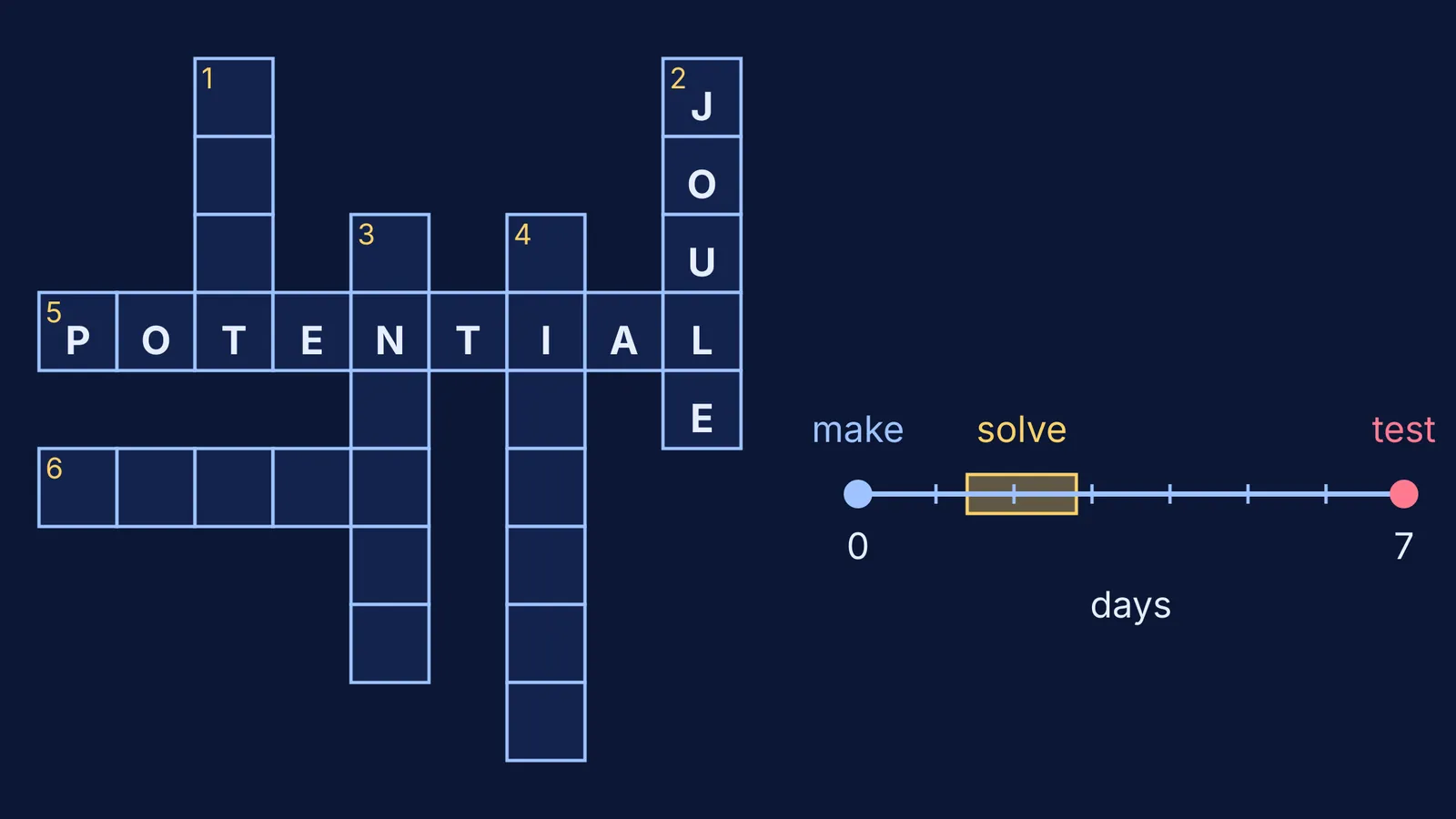
Here is a small one for the Class 11 chapter on work, energy and power. The grid is the image at the top of this post.
1 down: SI unit of power (4)
2 down: SI unit of work and energy (5)
3 down: The capacity to do work (6)
4 down: Energy a body has because it is moving, ½mv² (7)
5 across: Energy stored because of position or configuration, such as mgh (9)
6 across: Rate of doing work (5)
Answers: 1 WATT, 2 JOULE, 3 ENERGY, 4 KINETIC, 5 POTENTIAL, 6 POWER. A full chapter crossword would add slippery terms such as the work-energy theorem.
When should you solve it?
A few days later, not the same evening, when the answers are still fresh and the crossword feels easy.
In a study of more than 1,350 people, Cepeda and colleagues found that when the final test was a week away, the best gap before a review was about 20 to 40% of that week. For a unit test in 7 days, that points to solving the crossword roughly one and a half to three days after you study the chapter.
A simple plan:
Day 0: finish the chapter, make the crossword, hide the key.
Day 2 or 3: solve it with the book closed, in 15 minutes at most, then mark it.
Day 6: redo only the clues you missed, plus a few from older chapters.
To fold older chapters in, see our guide to a weekly cumulative quiz with AI. For the long view, read what Harry Bahrick learned about memory over 50 years.
What should you do with the clues you get wrong?
Sort each miss:
Blank: make it a flashcard, as in our guide to turning your notes into active recall cards with AI.
Wrong term from the same chapter, such as POWER for ENERGY: write one line on how they differ, with units.
Right word, but you could not use it in a problem: do two problems that need it.
The last kind needs more than a definition. The Fermi Concept Library has a lesson for every concept in physics, chemistry, biology, mathematics and computing, and Fermi's AI tutor works out what you already know and builds a plan for the session, so a missed clue becomes a short lesson instead of a guess.
Make one crossword for the chapter you finish this week, and put the solve date two or three days out.