On this page
You are revising Breathing and Exchange of Gases, and one line keeps nagging: why does oxygen leave the alveoli and enter the blood, and not the other way round? An AI tutor can explain this well, but it can also give you numbers that differ from your textbook. Here is how to get the explanation and then check every value against NCERT.
Why does oxygen move from alveoli into blood?
Gases in the lungs move by simple diffusion, from where their partial pressure is higher to where it is lower. The Class 11 NCERT Biology chapter Breathing and Exchange of Gases defines partial pressure as the pressure contributed by an individual gas in a mixture of gases, written pO2 for oxygen and pCO2 for carbon dioxide.
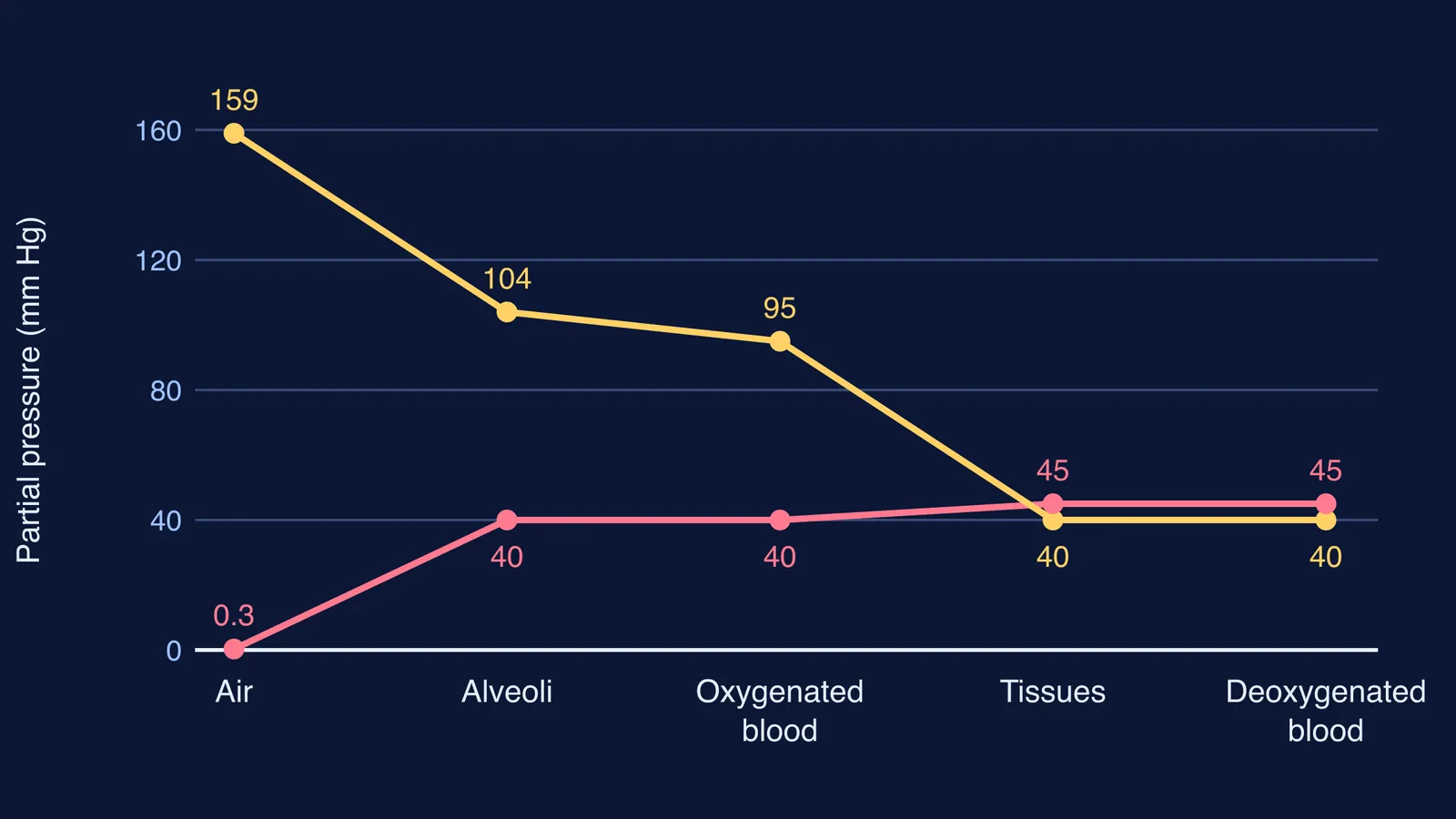
In NCERT's Table 14.1, alveolar air has a pO2 of 104 mm Hg, while the deoxygenated blood arriving in the lung capillaries has a pO2 of 40 mm Hg. That 64 mm Hg difference drives oxygen into the blood. Carbon dioxide runs the opposite way: 45 mm Hg in deoxygenated blood against 40 mm Hg in the alveoli.
That CO2 gap is only 5 mm Hg, and this is where many students get stuck. The same chapter gives the answer: the solubility of CO2 is 20-25 times higher than that of O2, so far more CO2 crosses the membrane per unit difference in partial pressure.
If Dalton's idea of partial pressure itself feels shaky, start with our story of how John Dalton worked out the law of partial pressures.
What partial pressure values does NCERT give?
These are the values in Table 14.1 of the NCERT chapter, all in mm Hg:
Atmospheric air: O2 159, CO2 0.3
Alveoli: O2 104, CO2 40
Deoxygenated blood: O2 40, CO2 45
Oxygenated blood: O2 95, CO2 40
Tissues: O2 40, CO2 45
Follow oxygen's path from air to alveoli to oxygenated blood to tissues, and its partial pressure falls at every step: 159, 104, 95, 40. That falling pattern is the core of the explanation for oxygen. For more practice, read our walk-through of the partial pressure table for gas exchange.
Other courses round these numbers. A pulmonary physiology text from Virginia Tech Carilion School of Medicine/07:_Fundamentals_of_Gas_Exchange/7.01:_Partial_pressures) gives alveolar and arterial pO2 as about 100 mm Hg.
How do you ask an AI tutor about partial pressure doubts?
Ask for reasoning, not a definition. Here is a script that works:
"Explain why oxygen moves from the alveoli into the blood using only partial pressures."
"List the pO2 and pCO2 values you used for each site, and say which textbook they match."
"The CO2 gradient at the alveoli is small. Why is that enough?"
"Now ask me two questions to check I understood."
The last prompt matters most. Saying the idea back in your own words shows you whether you understood it or only read it.
Fermi's AI tutor is built to teach this way: it holds a line of reasoning across a session, notices where you are stuck, and checks understanding as it goes. If the gap is an earlier idea, such as what pressure means for a gas, the Fermi Concept Library has a lesson for every concept in physics, chemistry, biology, mathematics and computing.
How do you check the AI's values against NCERT?
Keep Table 14.1 from the NCERT chapter open beside the chat and run these five checks on every answer.
Direction. Each gas must move from higher to lower partial pressure. If the AI says oxygen moves into the blood at the tissues, it is wrong.
Values. Match each number to the table and note any that differ.
Arithmetic. At the alveoli the O2 gradient is 104 - 40 = 64 mm Hg, and the CO2 gradient is 45 - 40 = 5 mm Hg.
The CO2 reason. A good answer mentions that CO2 is 20-25 times more soluble than O2, not just the gradient.
The air value. NCERT's 159 mm Hg for atmospheric O2 should be close to 20.9% of 760 mm Hg, the figures in the Virginia Tech Carilion text/07:_Fundamentals_of_Gas_Exchange/7.01:_Partial_pressures). Since 0.209 x 760 = 158.8, it checks out.
What does a wrong AI answer look like?
Suppose the AI writes: "Oxygen diffuses from the alveoli (pO2 104 mm Hg) into oxygenated blood (pO2 95 mm Hg) because of the concentration gradient." Both numbers match NCERT, but the blood that picks up oxygen in the lungs is deoxygenated blood at 40 mm Hg, not oxygenated blood at 95. So the gradient is 64 mm Hg, not 9. NCERT itself says pressure/concentration gradient, so that wording is fine; the error is the blood value.
Tell the AI exactly what it got wrong and ask it to rewrite the answer. For more slips to watch for, see our guide to checking AI answers on human physiology facts.