

On this page
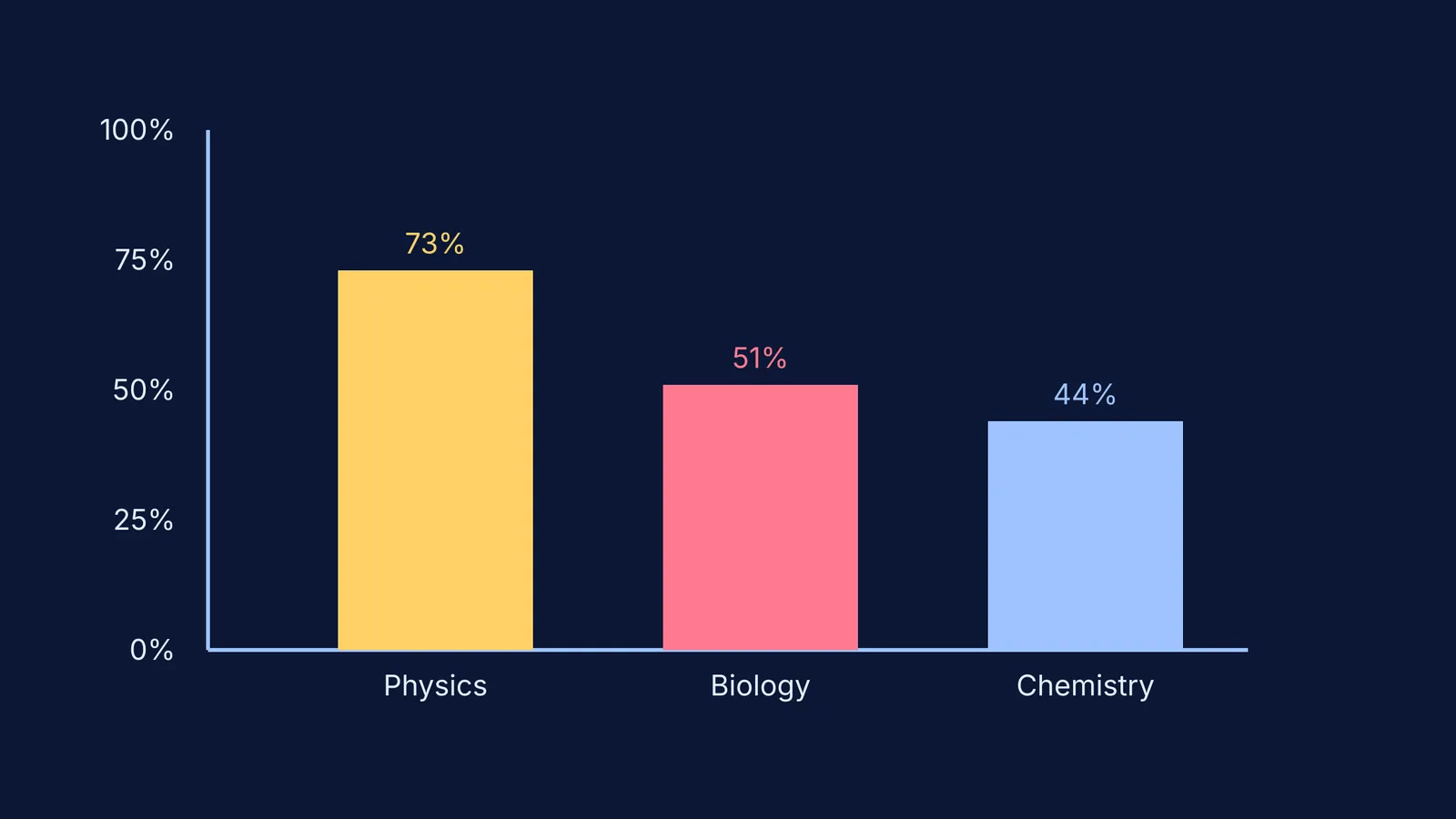
Large language models like ChatGPT have become popular study tools, but relying on them blindly for NEET biology is a risk. A 2024 study published in JMIR Medical Education tested AI models on the NEET 2023 paper and found that while GPT-4 scored a solid 73% in physics, it managed only 51% accuracy in biology.
Why does a system that passes professional medical licensing exams fail a premedical admissions test? The problem is not intelligence; it is the syllabus constraint. NEET requires absolute obedience to the Class 11 and 12 NCERT textbooks. AI models, however, draw their knowledge from global medical literature, clinical guidelines, and university-level textbooks, which often contradict the simplified facts taught in Indian high schools.
Why does AI contradict your textbook?
When an AI reads a prompt about human physiology, it retrieves the most statistically common medical consensus. In actual clinical practice, human biology is messy. Heart rates vary dramatically by age, kidney function is measured in broad, flexible ranges, and the definitions of diseases constantly evolve.
However, the National Testing Agency (NTA) sets the NEET answer key strictly according to the published lines of NCERT. High school textbooks present biology as a set of deterministic, single-value facts to build a foundational understanding. If you mark a medically accurate answer in the exam that differs from the NCERT value, you will lose four marks and pick up a negative mark. For students trying to use NCERT lines for NEET biology, this AI hallucination is dangerous.
What normal values does AI get wrong?
If you ask a general chatbot for standard physiological values, you will likely get clinical ranges. Here is how they clash with what you must write in the exam:
Breathing rate: If you ask an AI for the normal respiratory rate of an adult, it will usually quote the standard medical range of 12 to 20 breaths per minute. However, the NCERT Class 11 *Breathing and Exchange of Gases* chapter explicitly states that a healthy human breathes 12-16 times/minute.
Erythrocyte count: General medical sources define the normal red blood cell (RBC) count as 4.7 to 6.1 million cells per cubic millimetre for men, and lower for women. If you rely on this, you will miss the NCERT *Body Fluids and Circulation* fact, which states unequivocally that a healthy adult man has 5 to 5.5 millions of RBCs mm-3 of blood.
Glomerular Filtration Rate (GFR): A clinical AI might tell you that a normal GFR is anything above 90 mL/min/1.73m², depending on body surface area. For NEET, the only acceptable fact is from the *Excretory Products and Their Elimination* chapter: the GFR in a healthy individual is exactly 125 ml/minute, which translates to 180 litres per day.
Life span of red blood cells: When asked how long RBCs live, an AI trained on medical databases might respond with a range of 100 to 120 days. The NCERT textbook does not provide a range; it states that RBCs have an average life span of 120 days before being destroyed in the spleen.
What is the danger of statement-based questions?
The NTA has heavily shifted the exam pattern towards assertion-reason and statement-based formats. In these questions, precision is everything. If a question presents the statement "The GFR in a healthy human is 125 ml/minute," an AI tutor might incorrectly classify the statement as false, arguing that GFR is a range and depends on age.
If you internalise this logic, you will struggle with the exam pattern. This is why students must be careful when preparing for statement-based questions in NEET. The AI is technically right, but exam-wise, it is completely wrong.
How to check AI answers against NCERT?
Treat any AI-generated fact as a starting point, not the final word. When revising human physiology, use this simple method to stay safe:
If you are tired of constantly verifying chatbot outputs, you might wonder: can AI tutors teach better than chatbots that give answers? The key is using a tool that respects your specific syllabus.
Fermi's AI tutor is built differently. The tutor teaches rather than answers: it holds a line of reasoning across a session, notices where a student is stuck, and builds a plan for the session without dragging you into university-level medical tangents.
For students who are strong in biology but need help with physics, the platform adapts to your level and focuses on the syllabus. You can also explore the Fermi Concept Library, which contains every concept in biology, chemistry, and physics, each with its own lesson and its place in the map.
Instead of fighting with an AI over whether a breathing rate is 16 or 20, choose a tool that knows what exam you are writing.


