

On this page
The NCERT Class 12 chapter on aldehydes, ketones and carboxylic acids ends with an exercise (8.13) asking for simple chemical tests to distinguish seven pairs of compounds, from propanal and propanone to benzaldehyde and acetophenone (NCERT Chemistry Part II, Unit 8). An AI chatbot will answer questions like these in seconds. The catch is that a confident answer can still name a test that does not work, or describe a colour change that never happens.
This is a known weakness, not a guess. In ChemBench, a study published in Nature Chemistry in 2025, Adrian Mirza, Kevin Maik Jablonka and colleagues tested large language models on more than 2,700 chemistry question-answer pairs (Mirza et al., 2025). On average the best models beat the best human chemists in the study, yet they still struggled with some basic tasks and gave overconfident predictions. So let the AI draft the answer, and let your book decide whether it is right.
What should you ask the AI for?
A vague question gets a vague answer. Ask for one test and make the AI commit to what happens in each tube. You can copy this:
"Give me one simple chemical test to distinguish [compound A] from [compound B]. Name the reagent and the condition. Say exactly what compound A shows and what compound B shows. Then name the structural feature that causes the difference."
Each part of that prompt gives you something to check. The reagent and observation can be matched against your book. The structural feature tells you whether the AI understood why the test works, or just matched a familiar pair of words.
How do you check each observation the AI claims?
Open your textbook next to the answer and go through these five checks. Section 8.4 of the NCERT chapter describes Tollens' test, Fehling's test and the iodoform reaction.
Is the test in your book? If the AI names a reagent your syllabus never mentions, ask it for one that is in the book.
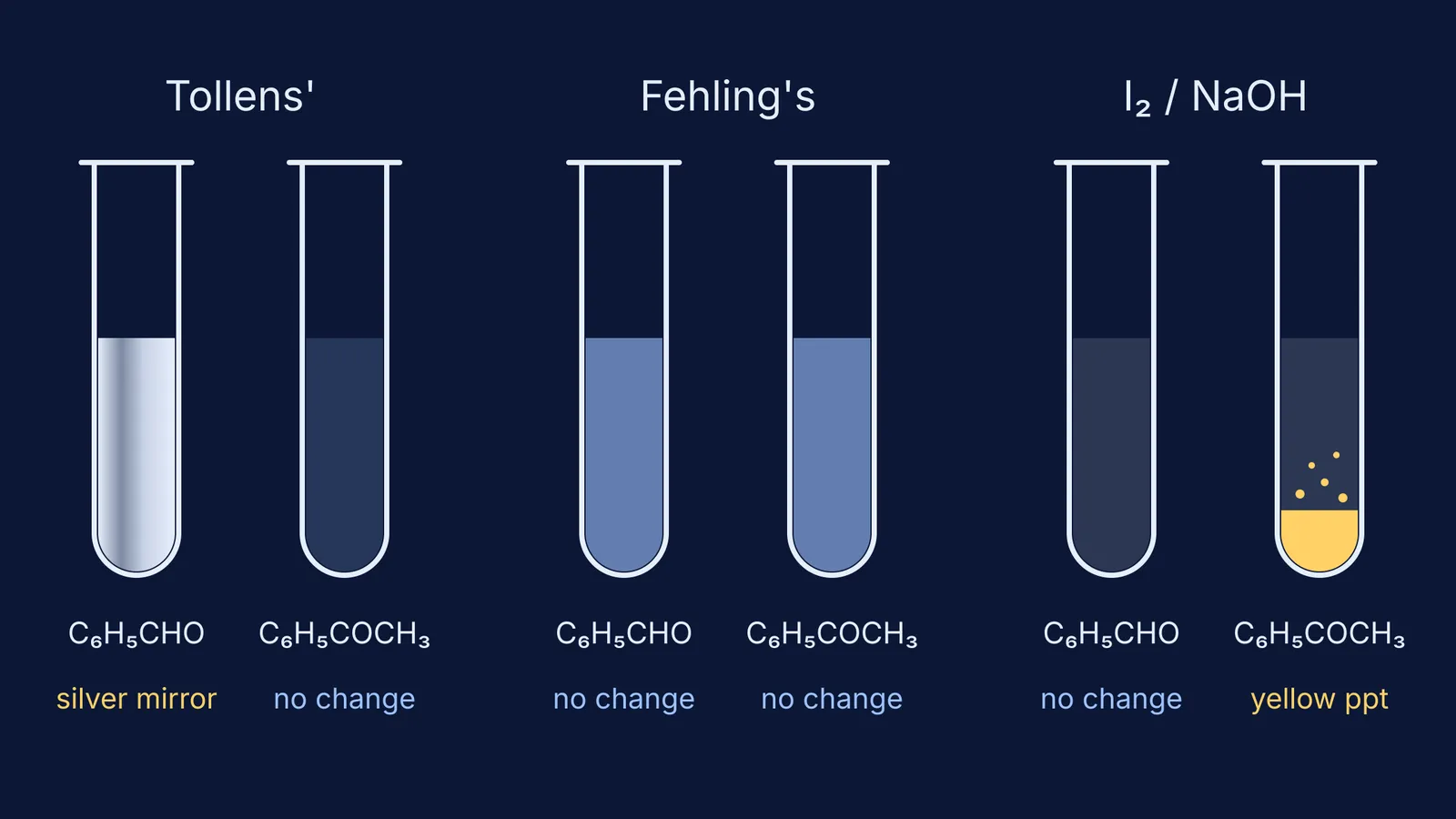
Is the observation what the book says? NCERT says Tollens' reagent gives a bright silver mirror with aldehydes and Fehling's reagent gives a reddish brown precipitate. Its Example 8.4 describes a yellow precipitate on heating with iodine and sodium hydroxide.
Does the book list an exception? NCERT says plainly that aromatic aldehydes do not respond to Fehling's test.
Does the structure really have the feature? The iodoform test detects a CH3CO group, or a CH3CH(OH) group that is oxidised to one, according to NCERT. Draw both structures and look for it.
Do the two compounds give different results? A test that is positive for both, or negative for both, tells them apart no better than doing nothing.
Worked example: benzaldehyde or acetophenone?
Say the AI replies: "Use Fehling's test. Benzaldehyde gives a red-brown precipitate; acetophenone does not." It sounds right, since benzaldehyde is an aldehyde and acetophenone is a ketone. Now run the checks.
Check 1 passes: Fehling's test is in the book.
Check 3 fails: benzaldehyde is an aromatic aldehyde, and the book says aromatic aldehydes do not respond to Fehling's test.
So check 5 fails too: neither tube gives the red-brown precipitate, and the test tells you nothing.
Two tests do work. Tollens' test: benzaldehyde, an aldehyde, gives a silver mirror on warming, and acetophenone, a ketone, does not. The iodoform test: acetophenone has a CH3CO group, and NCERT's Example 8.4 shows it giving a yellow precipitate with iodine and sodium hydroxide, while benzaldehyde has no such group.
The same checks catch a different mistake with ethanal and propanal. An AI may suggest Tollens' test, but both are aldehydes, so both give a silver mirror and check 5 fails. The iodoform test works: ethanal, CH3CHO, has a methyl group on the carbonyl carbon and gives the yellow precipitate, while propanal, CH3CH2CHO, does not.
This method carries over to other chapters. Try it on the Lucas test for primary, secondary and tertiary alcohols or on Seliwanoff's test for glucose and fructose. If the AI also gives you a mechanism, here is how to check AI-generated organic mechanism arrows.
What if the AI and your book disagree?
For board exams and entrance tests, write what your textbook says. Then paste the relevant line from the book into the chat and ask the AI to redo its answer. If the two still disagree, take the question to your chemistry teacher.
If the disagreement shows you have a gap in the idea underneath, such as why ketones resist mild oxidising agents, the Fermi Concept Library has a lesson on every chemistry concept, so you can fix the idea rather than memorise one more pair. Fermi's AI tutor teaches instead of just answering: it decides whether to explain, ask or show, and checks your understanding as it goes.
Next time an AI gives you a distinguishing test, keep your book open beside it and run the five checks before you trust it.


