

On this page
Students are increasingly using AI chatbots to help them study organic chemistry. While these tools can often write fluent descriptions of a reaction, they can stumble when generating the actual mechanistic steps.
Because many AI models are trained heavily on text rather than a strict physics engine, they sometimes "hallucinate" the electron-pushing arrows. They might draw an arrow starting from a proton, or invent a step that breaks the fundamental laws of chemistry.
Why do AI tools hallucinate reaction mechanisms?
Large language models predict the next most likely word or token based on patterns in their training data. When it comes to arrow pushing, the underlying logic is not linguistic but physical: it represents the actual movement of electrons from regions of high electron density to regions of low electron density.
If the AI relies only on text patterns without a structural chemistry solver to enforce physical constraints, it can easily string together a sequence of steps that sounds plausible but is physically impossible. For example, it might correctly state that water acts as a nucleophile, but then draw the arrow backwards.
This means you cannot treat an AI's mechanism as a flawless answer key. Instead, you must use it as a draft that you actively verify.
How do you check an AI organic reaction mechanism?
To catch hallucinations, you need to check the AI's work against the fundamental rules of curved arrow notation. If a step breaks any of these rules, the mechanism is wrong and needs to be corrected.
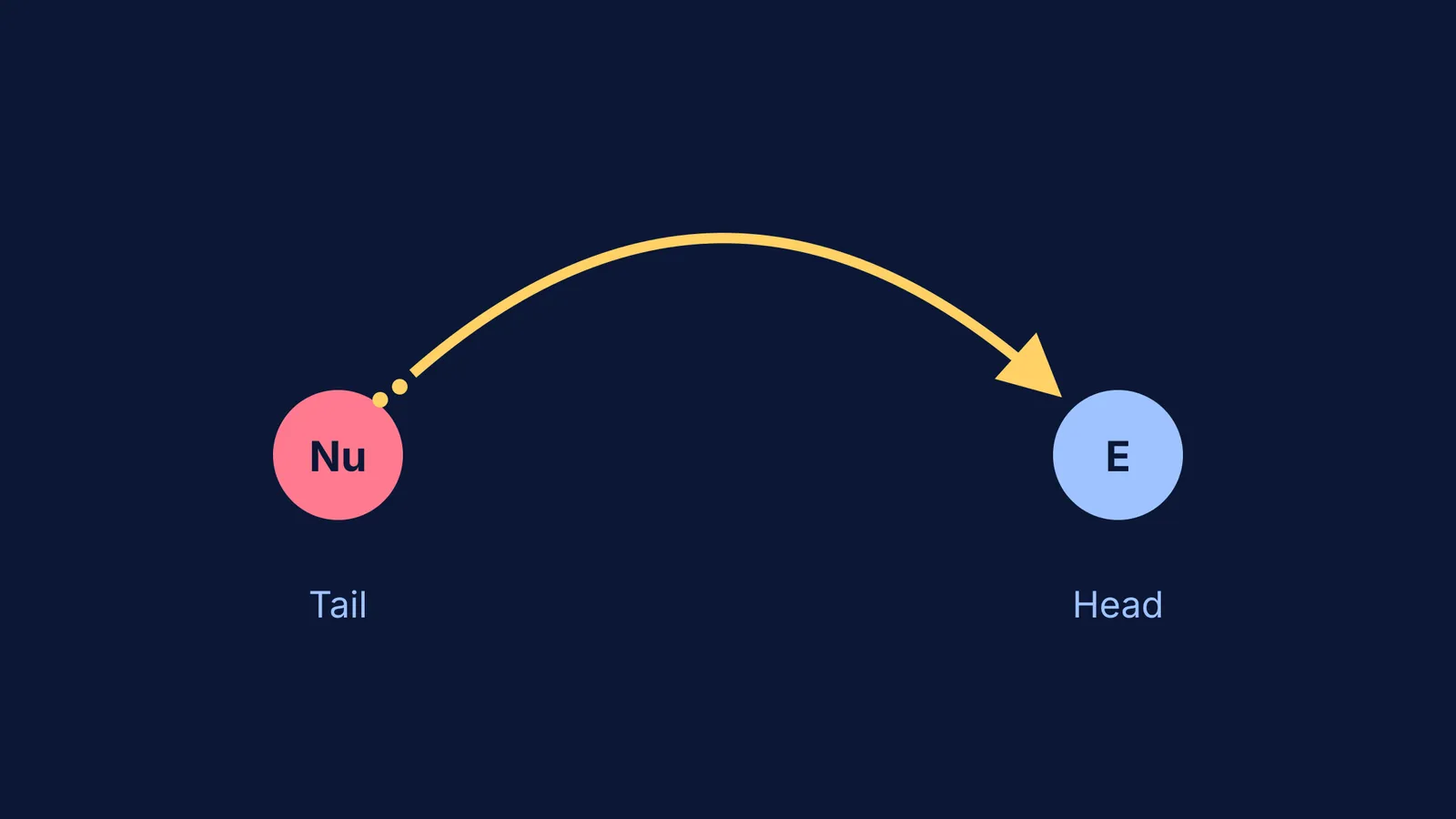
Does every arrow start at an electron source? The most common AI mistake is drawing an arrow starting from an atom, such as a positively charged hydrogen ion (H⁺). Curved arrows represent the movement of electrons, not atoms. The tail of an arrow must always start at an electron source. This can only be a lone pair of electrons or a covalent bond (a sigma or pi bond). If an AI draws an arrow pointing away from a bare nucleus or a positive charge, it has failed this check. Always remember that electrons flow from rich to poor.
Does every arrow point to a valid destination? The head of the arrow shows where the electrons are going. The destination must be either an atom (where the electrons will become a new lone pair) or a bonding region between two atoms (where they will form a new bond). If an arrow ends in empty space, or points to an atom that cannot accept electrons, the mechanism is incorrect. Checking these movements is especially important when evaluating resonance structures, where electrons shift but the atoms themselves must not move.
Are the correct type of arrows used? In organic chemistry, the shape of the arrow head matters. A standard double-barbed arrow represents the movement of an electron pair, which is what you see in most polar reactions. However, if the reaction involves free radicals (unpaired electrons), you must use single-barbed arrows, often called fishhooks. Each fishhook moves exactly one electron. AI tools sometimes confuse the two, using a polar arrow for a radical step or vice versa.
Do the charges balance? At every single step of a mechanism, the total net charge must be conserved. If your starting materials have a net charge of −1, the products of that exact step must also have a net charge of −1. If an AI mechanism shows a neutral nucleophile attacking a neutral electrophile, but only one positive charge appears in the product with no corresponding negative charge, an electron has effectively disappeared. You should count the formal charges at the start and end of every single step to ensure nothing is lost.
Does it break the octet rule? A classic hallucination in AI-generated chemistry is the "Texas carbon"—a carbon atom drawn with five bonds. Second-row elements like carbon, nitrogen and oxygen cannot exceed eight valence electrons. If an AI's curved arrow forms a new bond to a carbon atom that already has four bonds, another bond to that carbon must break simultaneously. If the AI forgets to draw the second arrow breaking the old bond, the mechanism violates the octet rule.
Moving beyond answer bots
When you are stuck on a difficult mechanism, you need more than a final answer that you have to double-check for basic errors. Fermi's AI tutor teaches rather than just answering. It works out what you already know, builds a plan for the session, and holds a line of reasoning—drawing the figure correctly and checking your understanding as it goes.
Reviewing mechanisms actively, rather than reading them passively, builds the intuition you need for the exam. By checking the arrows, charges and octets yourself, you turn an AI's potential mistake into a powerful learning exercise.


