On this page
Put four paper discs on a plate of bacteria, leave it overnight, and clear rings appear around them. The question students and examiners ask is which disc makes the widest ring, and what that tells you about strength and resistance. Make a prediction before you read on.
What is a zone of inhibition on a bacteria plate?
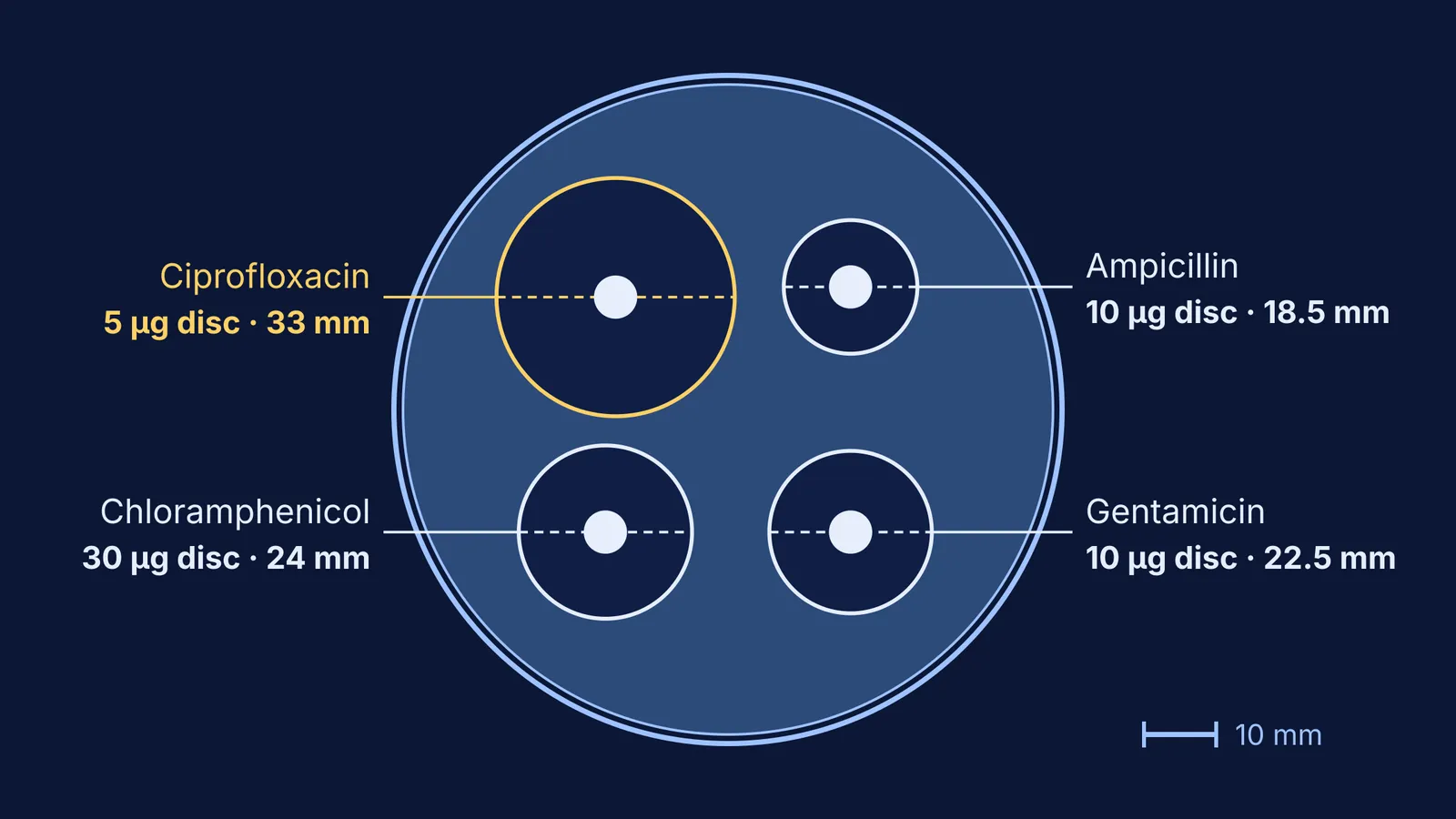
In the disc diffusion test, bacteria are spread as an even lawn over agar and small paper discs soaked with antibiotics are placed on top. The drug spreads out from each disc, so its concentration is highest next to the disc and falls with distance, and no colonies grow where it stays above the level that stops them (disk diffusion test overview). That clear circle is the zone of inhibition, measured as a diameter in millimetres.
The standard method traces back to a 1966 paper by A. W. Bauer, W. M. M. Kirby and colleagues at the University of Washington (Bauer et al., American Journal of Clinical Pathology), which is why you will see it called the Kirby-Bauer test. The EUCAST disk diffusion manual specifies Mueller-Hinton agar 4.0 ± 0.5 mm deep, an inoculum matched to a 0.5 McFarland standard, 6 mm paper discs, and incubation at 35 ± 1°C for 18 ± 2 hours for E. coli. Zones are read by eye to the nearest millimetre with a ruler or calliper.
Which antibiotic disc gives the widest clear zone?
Here is the prediction game. One plate of E. coli ATCC 25922, the fully susceptible strain labs use for EUCAST quality control, gets four discs:
Ampicillin, 10 µg
Gentamicin, 10 µg
Chloramphenicol, 30 µg
Ciprofloxacin, 5 µg
Now the real numbers. The EUCAST quality control tables list the zone this strain should give in a correctly run test. The ampicillin target is 18-19 mm, gentamicin 22-23 mm, chloramphenicol 24 mm and ciprofloxacin 33 mm. The disc with the least drug makes the widest zone.
The reason is potency. The same table gives this strain's minimum inhibitory concentration (MIC), the lowest concentration that stops growth: 0.008 mg/L for ciprofloxacin and 4 mg/L for ampicillin. So ciprofloxacin works at a concentration 500 times lower, and the zone edge sits much further out, where only a trace of drug has arrived. How fast a drug spreads matters too: large or water-repelling molecules diffuse slowly through agar and make smaller zones than their potency suggests (disk diffusion test overview). Our random walk simulation of diffusion shows why spreading slows with distance.
Does a bigger zone always mean a stronger antibiotic?
No. Each drug and organism pair has its own breakpoints, the zone sizes that decide whether bacteria count as susceptible or resistant. In the EUCAST breakpoint tables for E. coli and its relatives, a 10 µg ampicillin zone of 14 mm or more is susceptible. For a 5 µg ciprofloxacin disc the cut-offs are 25 mm or more for susceptible and under 22 mm for resistant.
Worked example: a test strain gives a 20 mm zone around both discs.
Ampicillin, 20 mm: at least 14 mm, so susceptible.
Ciprofloxacin, 20 mm: under 22 mm, so resistant.
Same ruler reading, opposite verdicts: the ciprofloxacin zone is 13 mm short of the 33 mm the EUCAST quality control strain should give.
What makes the zone bigger or smaller?
Use these for a second round of predictions. Every effect below is stated in the EUCAST disk diffusion manual:
Deeper agar: smaller zones. Shallower: larger.
Denser inoculum: smaller zones. Lighter: larger.
Plates left at room temperature after the discs go on: wrongly large zones.
Discs stored badly: they lose potency, and zones shrink.
Incubating too long: growth creeps into zones and can look like resistance.
So a school plate can rank discs differently from the official numbers. Change one variable at a time and record your prediction first, as in our potato osmosis experiment write-up.
Why does resistance on a plate matter outside the lab?
The World Health Organization's fact sheet on antimicrobial resistance says bacterial resistance was associated with more than 4.7 million deaths worldwide in 2021. It says misuse and overuse, such as taking antibiotics when they are not needed or taking the wrong type, are driving the spread of resistance. Whether and which antibiotic to take is a doctor's decision, never a guess from a zone you measured.
Resistance spreads the way any useful trait does: the drug removes susceptible cells and the survivors multiply. Our natural selection simulation lets you watch that happen. Diffusion gradients and selection are ideas that are easier to see than to read, which is what the Fermi Simulation Lab is for. If a breakpoint question still feels shaky, Fermi's AI tutor can work out what you already know and build a plan for the session.
Next time you see a plate of discs, rank the zones first, then ask: compared with which breakpoint?