On this page
You found the right image for your project: a glacier or a cyclone seen from space. Before it goes on a slide, check where it came from. Some AI image tools now attach two kinds of label to what they make. Both help, neither is proof, and knowing why tells you which checks to run instead.
What is an AI watermark, and what are Content Credentials?
An invisible watermark is a signal hidden in the pixels of an image, which a matching detector can read but your eye cannot. Google's SynthID is a well-known example: Google DeepMind says it is added the moment content is created and is designed to stand up to cropping, filters and compression. On 20 May 2025 Google said that over 10 billion pieces of content had been watermarked with SynthID, and began rolling out a SynthID Detector portal to early testers.
Content Credentials are signed metadata: a record attached to the file, not hidden in the picture. They follow an open standard from the Coalition for Content Provenance and Authenticity (C2PA), which says they work “like a nutrition label for digital content”. A credential can record who made a file, which tools were used and which edits followed, and the Content Authenticity Initiative runs a Verify website where anyone can inspect one.
Can AI watermarks and Content Credentials be removed?
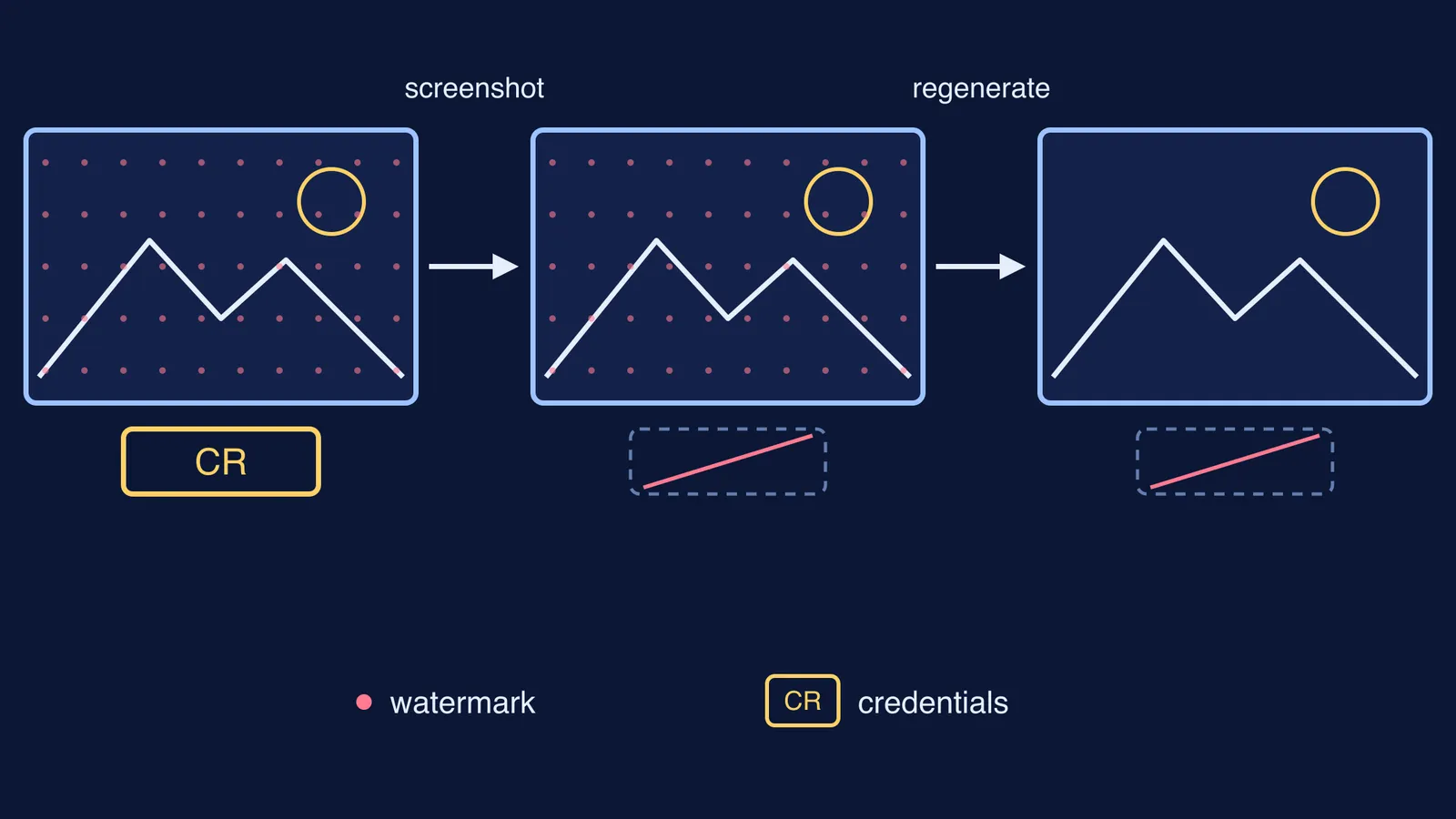
Yes, and the companies that add them say so. When OpenAI began adding Content Credentials to its images in February 2024, it said the metadata “can easily be removed either accidentally or intentionally”, that most social media platforms remove metadata from uploaded images, and that taking a screenshot can also remove it (The Register). It added that an image lacking the metadata “may or may not” have been made with its tools.
Asked whether provenance metadata can be removed, the C2PA's own explainer answers: “Yes it can.” It also warns that provenance information “alone cannot tell you whether the digital content is true, accurate or factual.”
Hidden pixel watermarks are harder to shift, but not safe. A study by Mehrdad Saberi and colleagues (arXiv:2310.00076) found that diffusion purification, which makes only small changes to an image, removes subtle watermarks; stronger ones fell to a different attack. The team also showed the reverse trick: adding watermark-like noise to a real photo so a detector calls it watermarked.
India now requires labels too. Amendments to the IT Rules, notified on 10 February 2026 and in force from 20 February, say permitted synthetic content must be prominently labelled and carry permanent metadata or provenance markers, and platforms may not enable their removal, according to a Hogan Lovells summary. The rules cannot stop a screenshot being shared elsewhere.
How can you tell if an image was made by AI?
Run these five checks in order, and stop when you have an answer you could defend.
Read any label. Upload the original file, not a screenshot, to the Content Credentials Verify site. If you suspect a Google tool, you can upload it to Gemini and ask whether Google AI made it.
Find the earliest copy. Run a reverse image search and look for the first place the picture appeared. A photo of a real event should lead back to a news agency, an archive or a named photographer.
Judge the source, not the picture. Who posted it, and how would they know? A museum, a government archive or a journal beats an anonymous page with no date.
Test it against what you know. For science images, check labels, counts and shapes against your textbook. Our guide on why AI cannot draw accurate diagrams shows the usual slips.
If you still cannot tell, do not use it as evidence. Use it, if at all, as a labelled illustration, or swap it for an image whose source you can name.
For visual tells such as hands, text and lighting, see how to spot AI-generated images and video.
What should you write in your school project?
Say you want a photo of lightning over a city for a physics poster on electric discharge. You save one from a social post, and the Verify site finds no Content Credentials. That settles nothing, so you go to check 2. A reverse search finds an earlier copy on a photo agency page with the photographer's name and date. You cite that page, not the social post:
Caption: Lightning over a city at night.
Credit: photographer's name, agency, date taken, link to the agency page.
If the earliest copy is instead an AI art account, say so plainly: “AI-generated illustration, made with the named tool on this date; not a photograph.” Our guide to citing AI in a school project has the full format.
If you need a diagram of a concept and are not sure the one you found is right, Fermi's AI tutor draws the figure and checks your understanding as it goes, so you can compare a picture with the science behind it.
Next time an image looks perfect, spend two minutes on checks 1 and 2 before it goes on a slide.