

On this page
A film star "announcing" a free scheme, a strange animal on the family WhatsApp group: you have probably wondered whether something like this was made by AI. Here is a five-minute checklist, and why it ends with a source check, not a gut feeling.
Can you tell an AI image just by looking?
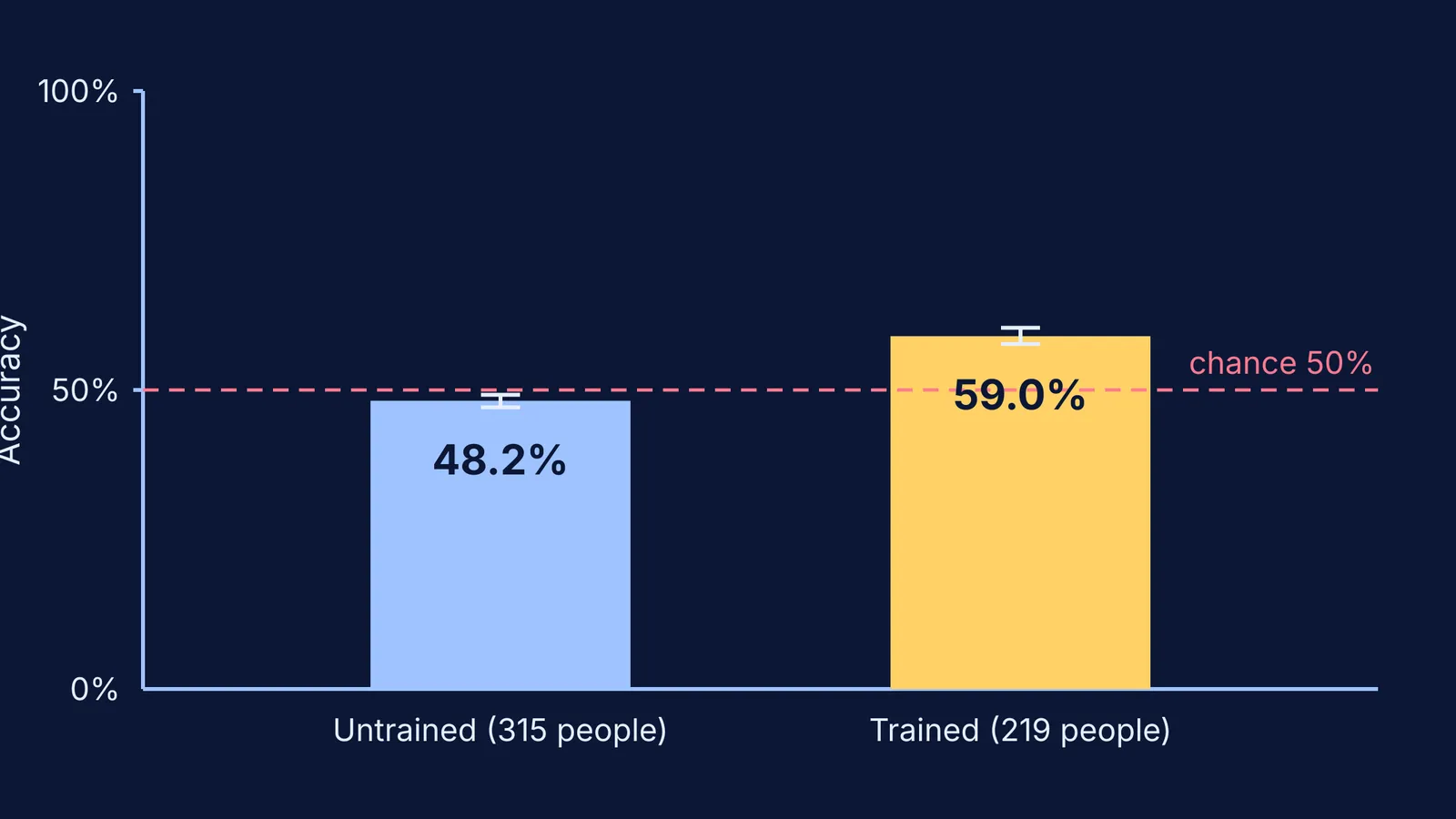
Often, no. In a 2022 study in PNAS, Sophie Nightingale and Hany Farid asked 315 people to sort real faces from AI-synthesised ones. Their average accuracy was 48.2%, close to the 50% you would get by tossing a coin. A second group of 219 people received training and feedback after every answer, and reached 59.0%.
The researchers chose AI faces without obvious glitches, and those are exactly the fakes that get forwarded. Your eyes give you reasons to check, not a verdict.
What should you check in the picture itself?
Researchers at Northwestern University wrote a guide to spotting AI-generated images that sorts the giveaways into five groups: anatomical, stylistic, functional, violations of physics, and sociocultural. As a checklist:
Hands and bodies. Count the fingers. Check teeth, ears, and limbs that bend wrongly or vanish behind objects.
Text. Zoom into shop boards, number plates, banners and T-shirts. Melted letters, nonsense words or a Hindi sign that is not quite any word are warning signs.
Light and shadows. With one sun, shadows fall away from it in roughly the same direction. Reflections in mirrors, water and spectacles should match what is in front of them.
Things that would not work. Earrings that do not match, a bicycle with no chain, glasses that merge into the face.
Too-perfect style. Glossy, poreless skin, film-poster lighting at a roadside tea stall, a background that dissolves into blur.
Does the scene make sense? A uniform, festival or public figure in the wrong place or season.
How do you check a video?
Use the same list, frame by frame. Pause and look at hands, teeth and any text in the background. Watch the edges of the face when the head turns, whether the lips match the words, and whether earrings, glasses or hair change between shots. Blurry re-uploads hide these flaws, so treat poor quality as a reason to find the original.
How do you trace where an image came from?
This step does more work than any visual clue.
Reverse image search. Google's About this image tool shows when Google first indexed the image and similar ones, where it may have first appeared, and where else it has been seen, including fact-checking sites.
Content Credentials. The C2PA standard lets cameras and editing apps attach a record of where a file came from and how it was changed. The C2PA FAQ notes that this record can be separated from the file, so a missing label proves nothing either way.
Watermarks. Google DeepMind's SynthID adds an invisible watermark to images, video, audio and text made with Google's AI tools. It can only tell you about content from tools that use it.
The source. Who posted it first? Is a reliable news outlet reporting the same event with its own pictures? For claims about the Government of India, the PIB Fact Check unit accepts queries on WhatsApp at +91-8799711259.
Why is no single sign proof?
Every clue cuts both ways. Real photos have motion blur, double shadows from two lights, and phone beauty filters that make skin look plastic. AI tools keep improving, so a giveaway that works today may not work next year. Automatic detectors misfire too, as our explainer on why AI-writing detectors give false positives shows for text.
A worked example, and what to say
Here is a made-up case. A forward shows a crocodile on a flooded street outside a school, captioned "School closed tomorrow". You run the list. The school's name board is unreadable mush: a warning. The shadows look consistent: no help either way. A reverse image search finds no earlier copy, no news outlet mentions a crocodile, and the earliest post comes from an account that shares AI art. The school's website says nothing about a closure.
Verdict: very likely AI-made, and in any case unconfirmed. No single clue decided it; several independent checks pointing the same way did.
If a relative forwarded it, you could reply: "I checked: this appears nowhere except this forward, and the school has announced nothing. Let's wait for the official notice." It corrects the claim without embarrassing anyone.
This is the same habit as checking an AI's references, explained in how to check sources and citations that AI made up: trace the claim back to where it started.
The shadow and reflection checks are also plain physics: light travels in straight lines, and reflections follow the law of reflection. If those ideas feel shaky, the Fermi Concept Library has a lesson for every concept in physics, and Fermi's AI tutor can draw the figure and work through it with you.


