

On this page
If you ask a general AI model to draw a free-body diagram of a block on a ramp or trace a light ray through a glass slab, the result will look incredibly polished. The lines will be crisp, the angles neat, and the labels beautifully formatted. But if you look closely at the physics, you will often find that the diagram is fundamentally wrong.
Arrows might point the wrong way, lenses might bend light backwards, and friction might act in the direction of motion. This happens because AI draws what looks plausible, not what is physically true.
Can AI draw physics diagrams accurately?
The short answer is no. Modern Multimodal Large Language Models (MLLMs) are brilliant at describing general images and recognizing everyday objects, but they struggle with the precise spatial and symbolic relationships that physics demands.
A 2024 study using the OlympiadBench assessment found that a leading vision model achieved just 10.74% accuracy in physics. This strikingly low score comes down to a failure in multi-step visual reasoning. When an AI looks at an inclined plane, it sees a triangle and a square. It does not possess an internal model of Newton's laws to verify that the normal force must be exactly perpendicular to the surface.
This gap extends directly to generating diagrams. The 2026 OmniPhys benchmark, which tests AI on 15,246 questions and 19,850 images across all educational levels, revealed that AI models have significant gaps in generating structured physics visuals. They frequently "hallucinate" physical elements—adding force vectors that violate conservation laws or drawing magnetic field lines that cross each other.
Why do AI diagrams fail at spatial reasoning?
Physics diagrams are not just pictures; they are visual mathematics. Every line length, angle, and intersection carries quantitative meaning. AI models, built largely on pattern recognition and probability, fail here for three main reasons:
Vector hallucination: When asked to draw a free-body diagram, an AI might add forces that do not exist just to balance the picture visually. It might ignore the fact that an object accelerating downwards must have a net force pointing down—for instance, when calculating the normal force on a car over a hump—drawing all arrows with equal lengths instead.
Spatial coordination: Models struggle heavily with 3D-to-2D projections. Tasks involving the right-hand rule or identifying the direction of magnetic fields from a 2D sketch regularly confuse them. They cannot easily rotate objects in their "mind's eye."
Symbolic misalignment: Text labels like v for velocity or B for a magnetic field are often detached from their correct visual components in the generated image, leading to confusing and contradictory diagrams.
Why you should sketch your own
The act of drawing a diagram is a critical step in solving any physics problem. It forces you to translate an abstract text description into a concrete physical model. When you let an AI do this for you, you skip the most important phase of learning.
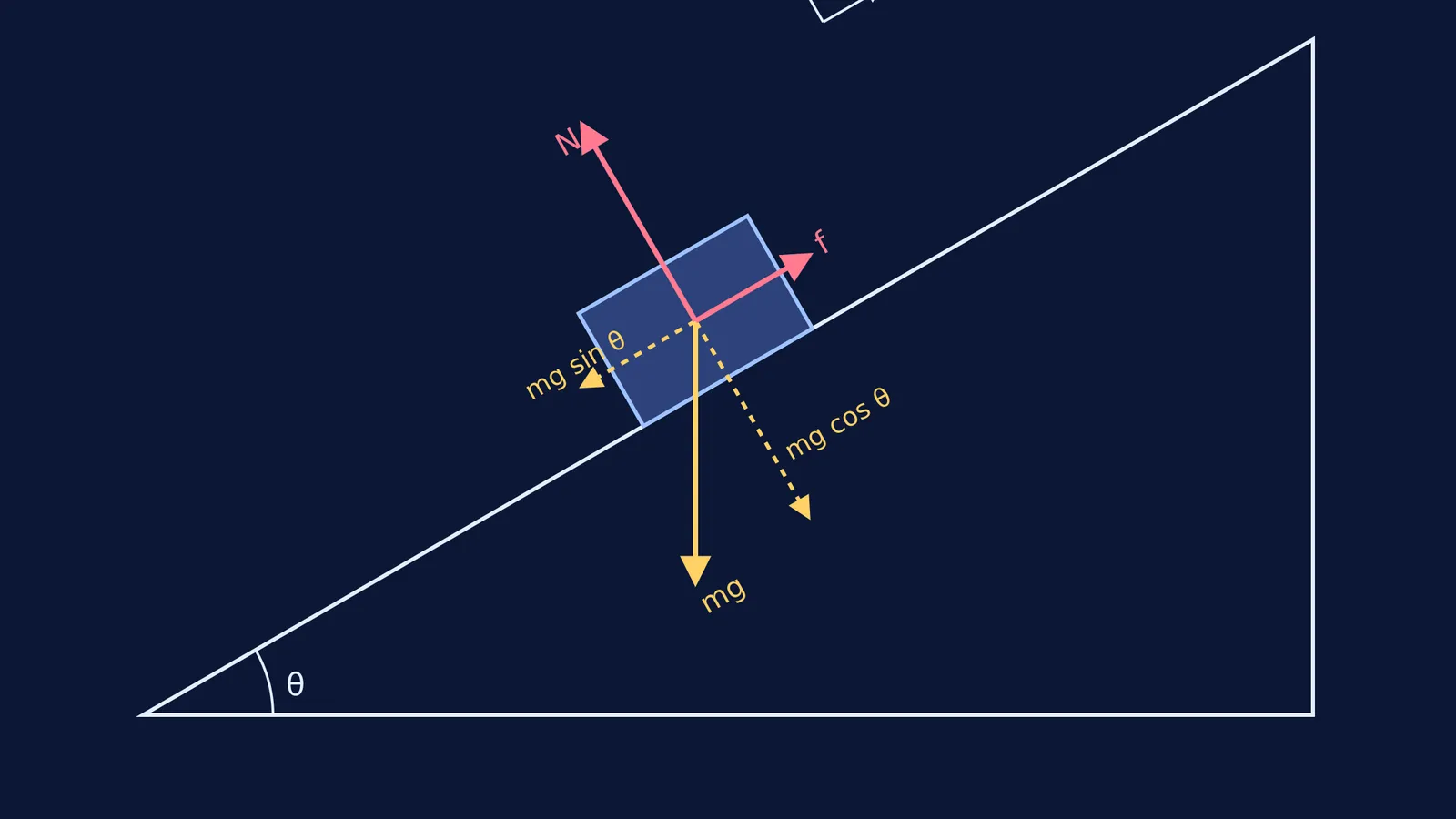
Drawing your own diagrams builds your spatial intuition. When you sketch a block on an incline, you actively decide where gravity points, how the normal force aligns with the surface, and which way friction resists motion. This active processing locks the concepts into your memory far better than passively looking at a screen.
If you are unsure how to start, the Fermi Problem Library has worked problems with a step-by-step solver that explains the reasoning rather than printing an answer. It helps you build a plan step-by-step and teaches through the reasoning.
When visualising complex, dynamic systems—like electric fields or orbital mechanics—static diagrams can only do so much. This is where interactive tools shine. The Fermi Simulation Lab provides interactive simulations for the ideas that are easier to see than to read, allowing you to manipulate variables and watch the physical laws play out in real time.
If you want a complete learning experience, Fermi is an AI-powered STEM learning platform that combines university-level courses from working scientists with a one-to-one AI tutor that teaches, explains and works through problems alongside the student.
A checklist for your physics diagrams
To ensure your diagrams are accurate and genuinely helpful for solving problems like calculating the time for a block to slide down a rough incline, use this quick checklist every time you sketch:
Isolate the object: Draw only the object you are analysing. Leave out the background, ropes, or surfaces, replacing them with the forces they exert.
Start from the centre: Draw all force vectors starting from the object's centre of mass.
Check the lengths: If the object is accelerating, the net force vector in that direction must be visibly longer. If it is at constant velocity, opposite forces must be equal in length.
Resolve components: Draw dashed lines for components (like mg sin θ and mg cos θ) so you do not confuse them with actual, separate forces.
Define axes: Always draw a small coordinate system (x and y axes) next to your diagram, especially for inclined planes where tilted axes simplify the maths.
Drawing diagrams is a skill that improves with practice. By sketching them yourself, you train your brain to see the physics behind the words.


