
On this page
You have just solved a projectile problem. The test is whether you can solve the next one when it looks different. Asking an AI for "similar questions with different numbers" is a start, but if every variant only swaps values, you mostly practise plugging in. A better request climbs three rungs: change the numbers, then the setup, then the question.
Why are new numbers not enough?
In a 1981 study, Michelene Chi, Paul Feltovich and Robert Glaser had physics experts and novices sort problems. They found that experts "initially abstract physics principles", while novices base their approach "on the problem's literal features" (Chi, Feltovich and Glaser, 1981).
Variants that change only the numbers keep those literal features fixed, so they never test whether you can spot the principle under a new surface. Changing the setup and the question does.
Comparing helps too. A meta-analysis of 57 experiments found that learning by comparing cases usually beat studying one case at a time or traditional instruction, with an average effect size of d = 0.50 (Alfieri, Nokes-Malach and Schunn, 2013). Asking learners to find the similarities between cases was linked to greater learning.
How do you ask AI for similar questions with different numbers?
Ask for three rungs, one at a time, and solve each before you move up.
Numbers: "Give me the same problem with different values. Don't solve it."
Setup: "Keep the same physics but change the situation, such as a new starting condition or an angle."
Question: "Keep my original situation but ask for a different unknown, or make me work backwards from the answer."
Then add one line: "After my three answers, tell me what the three problems have in common." That is the comparison step.
What does this look like on a real problem?
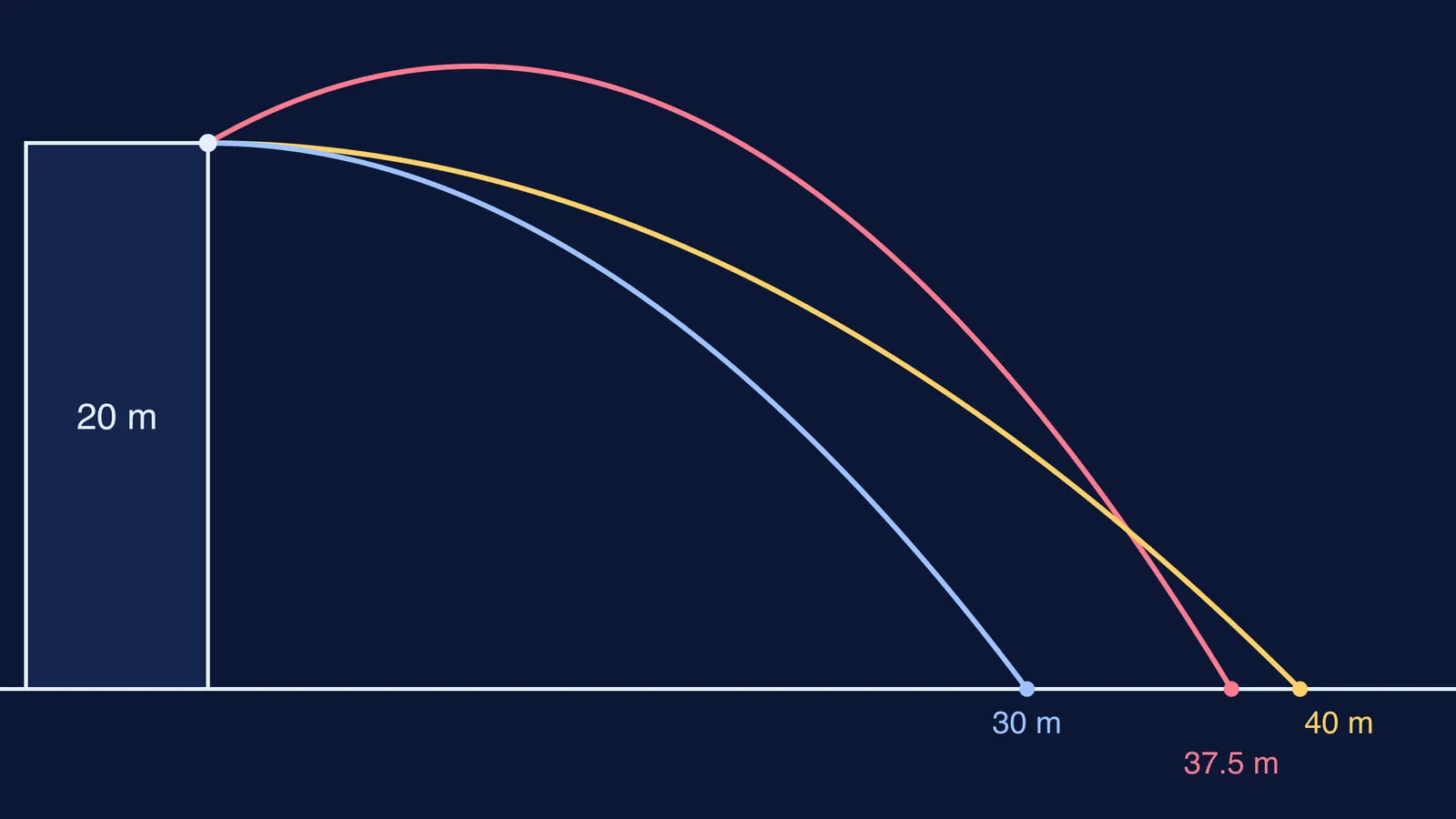
Original: a ball is thrown horizontally at 15 m/s from a 20 m cliff (g = 10 m/s²). How far from the base does it land? The fall time comes from 20 = ½ × 10 × t², so t = 2 s, and the ball lands 15 × 2 = 30 m out.
Rung 1, numbers: thrown at 20 m/s from the same cliff. The time is still 2 s because the height did not change, so it lands 40 m out.
Rung 2, setup: thrown at 15 m/s but 30° above the horizontal. Now the vertical motion starts at 7.5 m/s upward, so −20 = 7.5t − 5t², which gives t ≈ 2.89 s and a range of about 12.99 × 2.886 ≈ 37.5 m. Reusing "t = 2 s" gets this wrong, which is why it is worth doing.
Rung 3, question: the original throw, but find the velocity at landing. Vertical speed is 10 × 2 = 20 m/s and horizontal stays 15 m/s, so the ball hits at 25 m/s, about 53° below the horizontal.
What the three share: horizontal and vertical motion are independent, and the time comes from the vertical motion alone. Saying that sentence is the transfer.
How do you check the variants AI gives you?
AI makes mistakes, often in a changed setup. Run these checks.
Is it solvable? A new setup can leave out a value or contradict itself; our guide on checking that an AI practice question can actually be solved walks through the tests.
Units and size: is the unit right and the size sensible?
A limiting case: set the angle in rung 2 to 0° and you should get back the original 30 m.
Your attempt first: see the AI's solution only after you answer, and compare steps, not just answers.
In a field experiment with nearly a thousand high school maths students, those who practised with unrestricted GPT-4 scored 17% lower, once it was taken away, than students who never had it; a version with learning safeguards largely avoided the harm (Bastani and colleagues, PNAS, 2025). The variants only work if the solving stays with you.
When your answer and the AI's disagree and you can't find the wrong step, the Fermi Problem Library has worked problems with a step-by-step solver that explains the reasoning rather than printing an answer. If you keep failing the same rung, Fermi's AI tutor notices where you are stuck and decides whether to explain, ask or show.
How should you fit variants into a study week?
Pick the one or two problems from each session that felt easiest; those are the ones you may have memorised rather than understood.
On the day: climb all three rungs for those problems.
A few days later: ask for a fresh rung 2 and rung 3, notes closed.
Once the rungs feel easy: mix chapters, as in this plan for building an interleaved practice set with AI.
For quick number swaps to build speed before a test, see practising with changed numbers using AI. Parents can ask one question: "What stayed the same across your three problems?"