

On this page
If you are preparing for a major exam, you probably spend most of your time working through chapter-wise problem sets. You read the theory on thermodynamics, then you solve 30 thermodynamics problems. This is how most textbooks are structured.
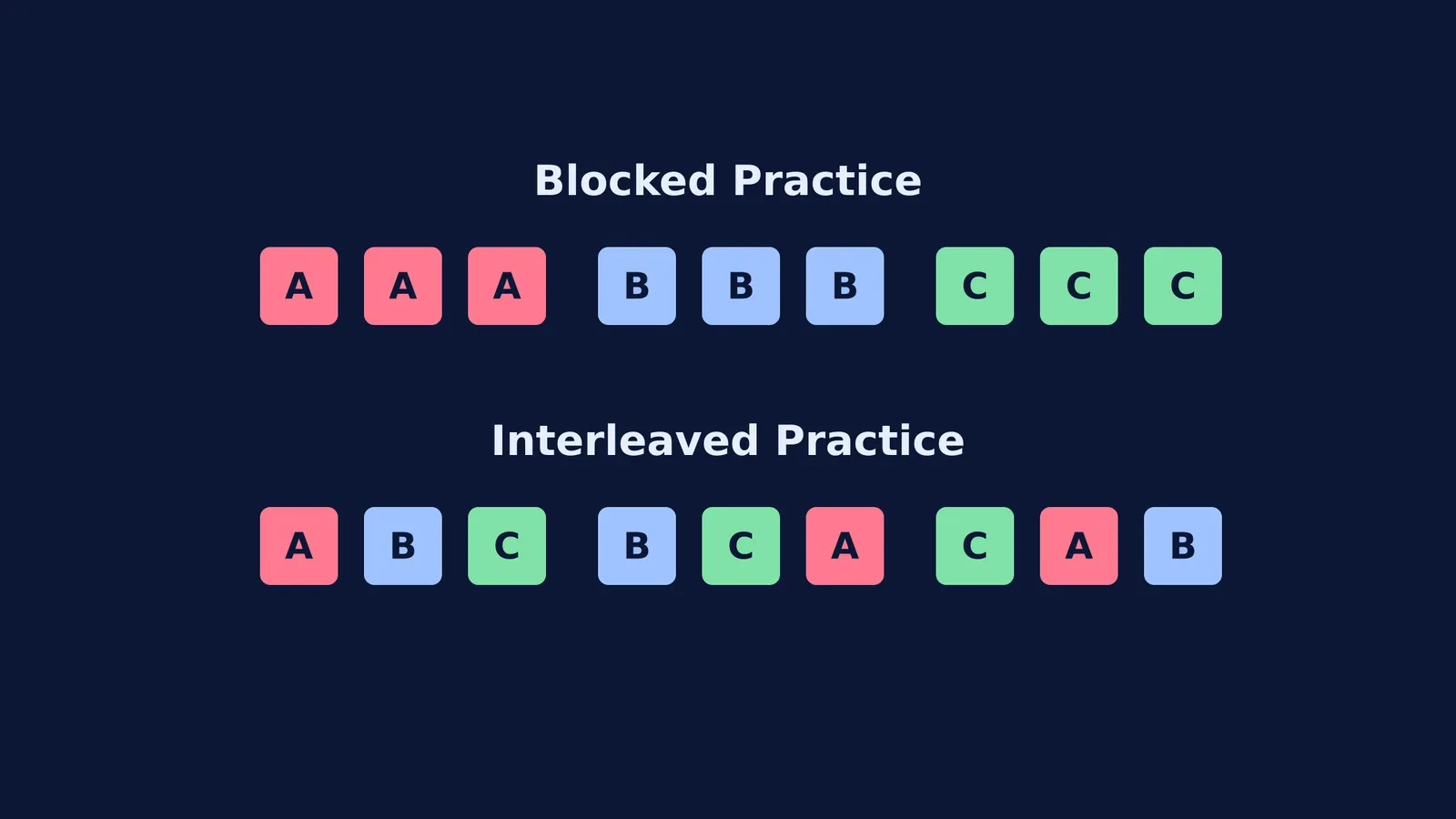
However, cognitive scientists have found that this approach—called blocked practice—can create a false sense of security. When you mix different types of problems together in a single session, a technique known as interleaved practice, your ability to solve problems under exam conditions improves dramatically.
Why does blocked practice create an illusion of mastery?
In blocked practice, you solve problems of the same type back-to-back. If you are studying quadratic word problems in Class 10, you already know before you read the fifth question that you need to set up a quadratic equation. The textbook has done half the work for you by telling you which method to apply.
In a real exam, problems are not grouped by chapter. You might face a kinematics question, followed by thermodynamics, followed by optics. The hardest part of the exam is often not doing the math, but identifying which concept the question is testing. Blocked practice deprives you of the opportunity to practice this crucial skill, leading to an illusion of mastery. You feel confident because you are getting the answers right, but you are only practicing the execution, not the diagnosis.
How does interleaved practice improve exam performance?
Interleaved practice forces you to shift gears. By mixing different problem types—such as alternating between coordinate geometry and equations with modulus—you force your brain to constantly retrieve different strategies.
The impact of this simple change is substantial. A randomized controlled trial published in the *Journal of Educational Psychology* tested this with 787 seventh-grade mathematics students from five Florida public schools (Rohrer et al., 2020). Over several months, students were assigned to either an interleaved practice schedule or a traditional blocked schedule. When the researchers gave the students an unannounced test 30 days after the practice period ended, the results were stark. The students who used interleaved practice scored 61%, while the blocked practice group scored just 38%.
Interleaving teaches you how to match the problem to the correct procedure. It also improves long-term retention because the effort required to recall different methods strengthens your memory.
Can you make mixed topic practice questions with AI?
Yes. One of the main challenges of interleaved practice is that most workbooks and coaching modules are strictly chapter-wise. Creating your own mixed problem sets by flipping through different books takes time. An AI tutor is an excellent tool for generating random, mixed-topic sets on demand.
When you use Fermi's AI tutor, it naturally supports this kind of learning. Instead of just giving you answers, Fermi holds a line of reasoning across a session. If you ask it to test you on a mix of topics, it works out what you know and builds a plan for the session, checking your understanding as it goes. Because it teaches rather than simply answers, it can notice where you are stuck—whether you failed to identify the topic or just made an arithmetic error—and decides whether to explain, ask, or show the next step.
If you prefer to browse individual problems, the Fermi Problem Library offers a step-by-step solver that explains the reasoning for diverse concepts.
How to prompt your AI for mixed practice sets?
If you are using a standard conversational AI to generate your daily practice, you must be specific to ensure it does not accidentally give away the topic.
Set the context: "I am preparing for the JEE Main exam. I have completed the chapters on Kinematics, Laws of Motion, and Work, Energy and Power."
Define the format: "Generate a 10-question practice set mixing problems from these three chapters."
Hide the hints: "Crucial rule: Do not group the questions by chapter. Randomise the order completely. Do not include any headings or hints that reveal which chapter a question belongs to."
Control the output: "Give me only the questions first. Do not show the solutions or the final answers until I submit my attempts. Ask me to provide my answers one by one."
By explicitly telling the AI to hide the chapter names, you simulate exam conditions. Every time you sit down to practice, you will have to read the problem carefully, decide which physics principle applies, and then execute the math. Over time, this diagnostic practice will translate directly into higher exam scores.


