On this page
When you follow a worked example in a textbook, it is easy to nod along. The logic flows, the steps make sense, and the final answer drops out neatly. But recognizing a correct solution is not the same as being able to build it yourself.
What is the illusion of mastery?
When you read a solution and immediately try a nearly identical problem from the same textbook section, you are largely relying on short-term memory. This creates what psychologists call the "illusion of mastery." You feel like you have learned the concept because the current problem feels easy, but you have often only memorised the template for that specific question type.
A classic 2010 study by Kelli Taylor and Doug Rohrer in *Applied Cognitive Psychology* showed how dangerous predictable practice can be for mathematics learning. In their experiment, students who were forced to mix up their practice scored 77% on a test the next day, while those who practiced predictable problems scored just 38% (Taylor & Rohrer, 2010).
If you want to move from memorising a template to understanding the underlying physics or maths, you must force your brain to do the work of choosing and applying the strategy. Simply re-reading a textbook chapter rarely achieves this.
Why does changing the numbers break the template?
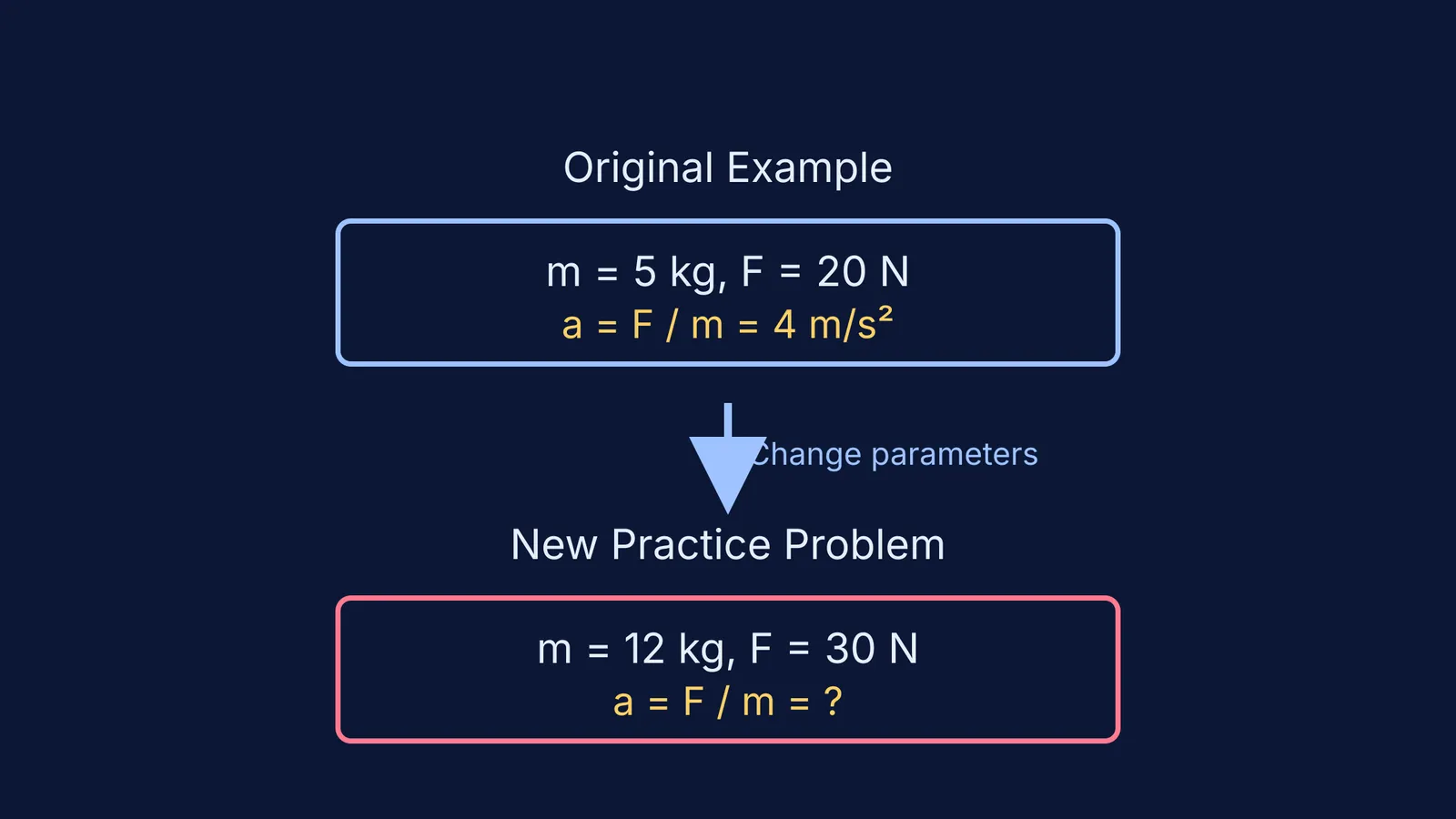
Instead of searching for a completely new worksheet, you can use the exact problem you just studied. Changing the parameters—the masses, the forces, the concentrations, or the probabilities—strips away the surface features and forces you to confront the structure of the problem.
When you just swap a 5 for a 10 on your own, it is tempting to plug the new number into the final formula. This is where an AI tutor helps. By asking an AI to change the numbers, it can subtly alter the context or constraints so that you cannot blindly copy the previous steps. For example, if you are studying with and without replacement in probability, changing the initial counts completely changes the intermediate fractions you must multiply.
How do you ask an AI tutor for new numbers?
Here is how you can use this technique effectively in your daily study routine:
Study the original example: Read the worked solution carefully until you understand each algebraic step and physical principle.
Ask for a new version: Go to Fermi's AI tutor and type: "Give me this exact problem but change the values and the context. Don't show me the answer yet."
Solve it from scratch: Put the original solution away. Work through the new problem on a blank page without looking back at the template.
Check the reasoning: If you get stuck, the Fermi Problem Library explains the reasoning step-by-step rather than just printing the final number.
Do the new numbers make physical sense?
When you change the values in a problem, the final answer will inevitably change. This is a crucial opportunity to check if the new numbers still make sense in the real world, a skill that is heavily tested in exams.
If you are calculating the distance in the nth second for a falling object, and your new numbers yield a smaller distance for a later second, you know your method is flawed because a falling object should speed up. Checking the physical reality of your new answer is a powerful way to catch algebraic mistakes.
You can push this further by asking the AI to change the unknown variable. If the original problem gave you the initial velocity and asked for the maximum height, ask the tutor to give you the maximum height and ask for the initial velocity. This ensures you understand the relationship between the variables in both directions.
How can you make variable practice a habit?
Practicing with changed numbers or flipped variables will feel slower and harder in the moment than simply doing ten identical problems in a row. You will make more mistakes during the practice session. However, that friction is exactly what builds durable, long-term learning.
By forcing yourself to re-solve rather than just re-read, you guarantee that you are ready for whatever the exam throws at you. The next time you finish reading a challenging solution, do not turn the page. Instead, bring it to the AI tutor, ask for a new set of numbers, and prove to yourself that you truly understand the method.