On this page
You have probably made this table before. A table copied from a guide feels right even when one row is wrong. Below are the correct rows from NCERT, then a way to use AI as a checker, not an author: you write the table, and it only points at the mistakes.
What is the difference between DNA replication and transcription?
Replication copies the whole genome; transcription copies one strand of one stretch of DNA into RNA. NCERT Class 12 Biology says that in replication "the total DNA of an organism gets duplicated", while in transcription "only a segment of DNA and only one of the strands is copied into RNA" (NCERT, Molecular Basis of Inheritance).
The rows, from that chapter unless another source is linked:
Enzyme. Replication uses DNA-dependent DNA polymerase, with DNA ligase joining the fragments. Transcription uses DNA-dependent RNA polymerase: a single one in bacteria, at least three in the eukaryotic nucleus.
Template. In replication both strands act as templates. In transcription only the template strand, the one with 3'→5' polarity, is read; the other is called the coding strand.
Raw material. Replication uses deoxyribonucleoside triphosphates, which also supply the energy. Transcription uses ribonucleoside triphosphates, and adenine pairs with uracil instead of thymine.
Product. Replication gives two DNA double helices, each with one old and one new strand (semiconservative). Transcription gives single-stranded RNA: mRNA, tRNA or rRNA.
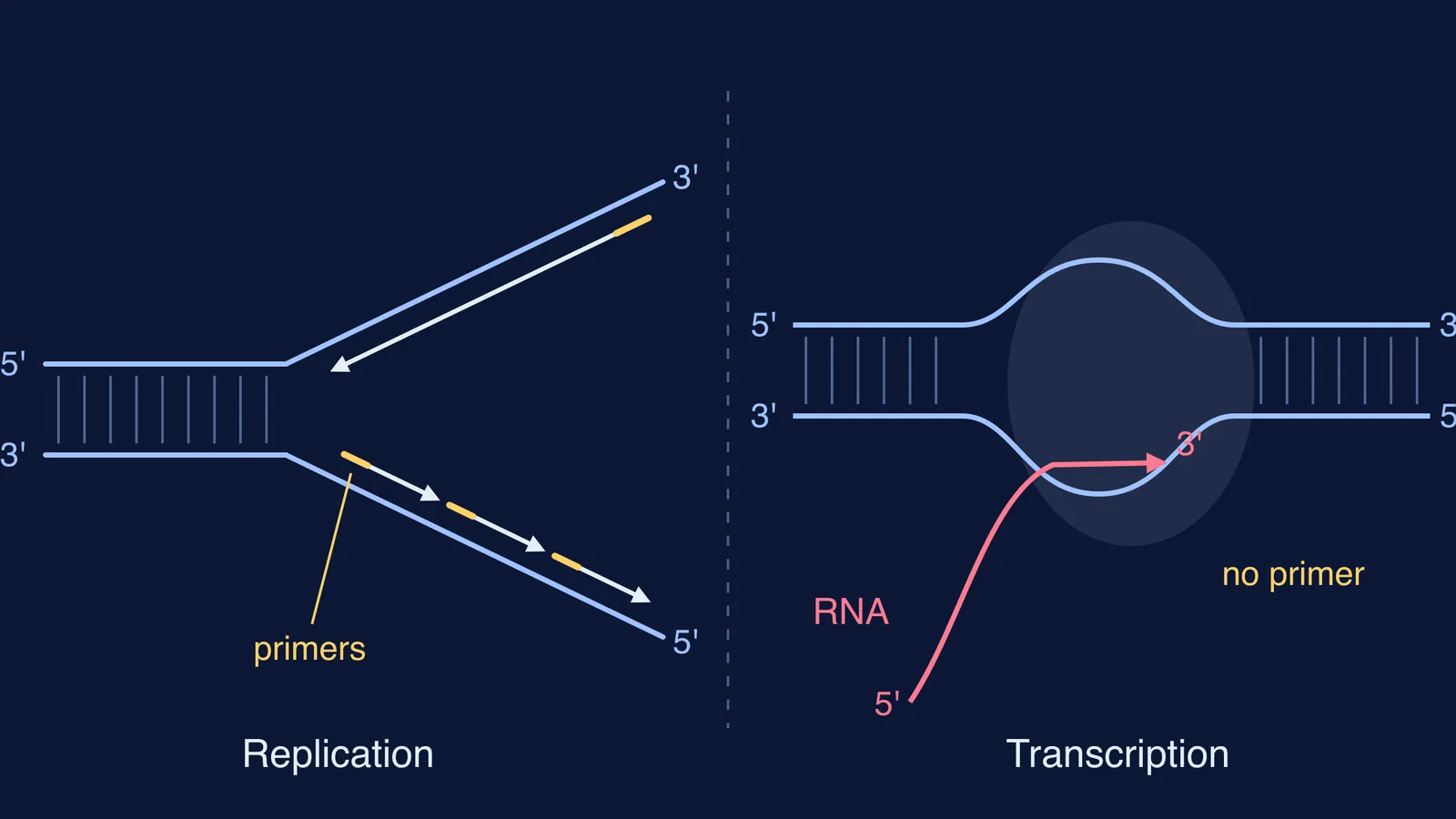
Primer. DNA polymerase needs a free 3'-OH to add to, which primase provides as an RNA primer about five to ten nucleotides long (OpenStax Biology 2e). RNA polymerase needs no primer (Transcription, Wikipedia)).
Direction. Both polymerases build only 5'→3', which is why replication is continuous on one strand and discontinuous on the other.
When. In eukaryotes, replication takes place in the S phase of the cell cycle. NCERT ties no single phase to transcription.
NCERT adds a number worth remembering: E. coli copies its 4.6 × 10^6 base pairs within 18 minutes, which NCERT says means an average polymerisation rate of about 2,000 base pairs per second (NCERT, section 5.4.2). For a longer side-by-side, see DNA replication and transcription compared, point by point.
Why build the table yourself before asking AI?
Because recalling is what makes it stick. In a 2006 study, Henry Roediger and Jeffrey Karpicke found that students who took recall tests on prose passages remembered more two days to a week later than students who restudied them, even though restudying did better on a test five minutes later (Roediger and Karpicke, Psychological Science). Writing the table from memory is that kind of test. Asking an AI to write it for you skips the test and keeps only the reading.
Checking rows is also a narrower job than writing them, and you can verify each verdict against the textbook. The AI can still be wrong while sounding sure, so read what an AI's confidence actually tells you first.
How do you ask AI to flag only the wrong rows?
Close the book. Fill both columns for seven rows from memory: enzyme, template, raw material, product, primer, direction, when. Leave a blank rather than guess.
Paste your table into the AI with this prompt: "Here is my table comparing DNA replication and transcription, for CBSE Class 12. Do not rewrite it. For each row, say only correct or wrong. For a wrong row, quote the wrong phrase and name the NCERT section I should reread. Do not give me the right answer."
Reread that section and correct the row yourself.
Paste the corrected row back and ask: "Is this row now correct? Yes or no, and why."
Where the AI and NCERT disagree, NCERT wins.
A worked example with three planted mistakes
Say your table has these rows:
Primer: "Both need an RNA primer."
Template: "Transcription reads the coding strand."
Product: "Replication makes one new double helix and keeps the old one intact."
A good check flags all three. The first is wrong because only DNA polymerase needs a primer; see why DNA polymerase needs a primer to copy DNA. The second swaps the strands: RNA polymerase reads the template strand, and the RNA matches the coding strand except for uracil in place of thymine. The third describes conservative copying; NCERT section 5.4 shows that replication is semiconservative, using Meselson and Stahl's 1958 experiment (NCERT).
If the check flags a correct row or misses one of these, open NCERT; do not argue with the chatbot.
What if the same row keeps going wrong?
A row you get wrong twice often points to a concept gap, not a memory slip. Swapping the template and coding strands, for example, can mean 5'→3' polarity is not yet clear.
The Fermi Concept Library gives every biology concept its own lesson, so you can study polarity on its own before returning to the table. Fermi's AI tutor notices where you are stuck and decides whether to explain, ask or show, rather than handing over a finished answer.
Tonight, write the seven rows from memory, run the check once, and fix only what it flags.