
On this page
If your child loses the thread halfway through a long explanation, an AI tutor sounds like an obvious fix: it never gets tired, it answers at once, and you can start again as often as you like. But research on AI tutors for ADHD specifically is thin, and the same screen that helps can also pull attention away. Here is what the evidence supports, what can go wrong, and how to set one up at home.
Can an AI tutor help a student with ADHD?
It can help with the parts of studying that ADHD makes hardest, if it is set up well. The US National Institute of Mental Health describes ADHD as a neurodevelopmental disorder marked by inattention, hyperactivity and impulsivity, where inattention means difficulty paying attention, keeping on task or staying organised.
It is not rare in India. A 2022 meta-analysis in the Indian Journal of Pediatrics pooled 19 Indian studies and estimated ADHD in about 63 of every 1,000 children surveyed.
Three features of a good AI tutor line up with established classroom advice:
Short chunks. The CDC's guidance on ADHD in the classroom advises making sure assignments are not long and repetitive, and allowing breaks. A tutor can be told to teach one small step at a time.
Instant feedback. The same CDC page lists immediate positive feedback among the supports that can help. A review of 22 studies covering 1,181 children found that children with ADHD prefer immediate over delayed reward, and that rewards improved task performance somewhat more in children with ADHD.
Restarting without embarrassment. Asking a teacher to explain for the third time is hard. A tutor will go back to the last step as often as needed.
What does the research actually show?
Less than you might hope. A 2023 meta-analysis in JMIR Mental Health pooled 19 randomised trials with 1,843 school-age children and found small improvements in measured inattention and some behaviour ratings from technology-based interventions. Reading fluency, measured in only two of the trials, did not improve significantly. Those trials tested computer training programs, neurofeedback and virtual reality, not chat-style AI tutors.
So treat an AI tutor as a study tool that makes good habits easier, not as a treatment.
What are the risks of an AI tutor for a child with ADHD?
The device is the distraction. The tutor lives on the same phone or laptop as games, videos and chats. One notification can end the session.
It can be wrong. AI tutors make mistakes, and a child who is rushing is less likely to notice. Here is what to say when an AI tutor gives your child a wrong answer.
It can do the work instead. Impulsivity makes "just give me the answer" tempting, and copying an answer skips the practice that builds skill.
Age and privacy. UNESCO's guidance on generative AI in education, as reported by UN News, suggests considering an age limit of 13 for these tools in the classroom and calls for data privacy protection. Check the tool's age rules and what it stores.
How should families set up an AI tutor for ADHD?
Use this checklist before the first session. The block lengths are a starting point to adjust, in the spirit of the CDC's advice to keep assignments short and allow breaks.
Same place, same time, one device. Notifications off, other apps closed.
Write the goal on paper before opening the tutor: one textbook section, or five problems.
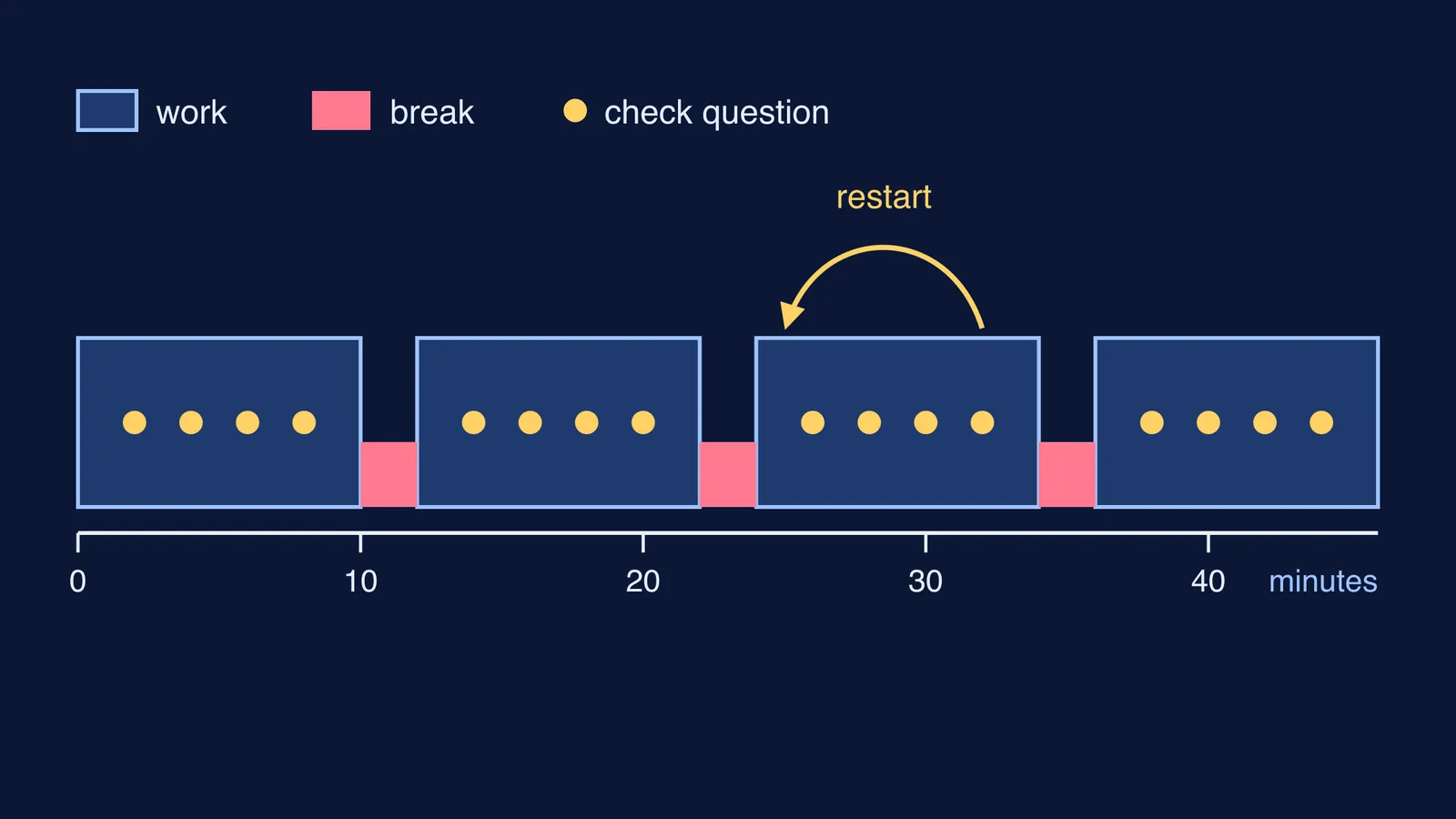
Work in blocks of about 10 minutes, then take a 2-minute movement break. Four blocks is plenty to start.
Ask for short answers. Paste this at the start: "Teach me one step at a time, in no more than four lines. After each step, ask me one question and wait for my answer. Do not give the final answer until I have tried." There are more ways in how to make AI explanations short and focused.
Keep a paper sheet for stray thoughts so they do not become new tabs. This parking-lot sheet for random thoughts shows how.
Agree a restart phrase, such as "I lost it, go back to the last step", so restarting is routine, not a failure.
End with a two-minute check-in away from the screen: your child explains one thing they learned in their own words.
Review once a week together and change one thing at a time.
Fermi's AI tutor works out what a student already knows, builds a plan for the session and checks understanding as it goes, so your child sits down to a clear next step instead of a blank page. For practice, the Fermi Problem Library has a step-by-step solver that explains the reasoning rather than printing an answer.
When should you talk to a professional?
Only a qualified professional can assess ADHD. If attention troubles are affecting marks, friendships or mood, start with your paediatrician or the school counsellor. If your child seems distressed or overwhelmed, India's free, round-the-clock Tele MANAS helpline is on 14416 or 1800-891-4416.
Then start small: one short block tonight, and adjust from there.