

On this page
You ask an AI to explain a physics concept, and it gives you five paragraphs, a bulleted list, and a summary. It feels helpful at first glance, but you probably skim it or close the tab before reading it all.
Why does this happen, and why is it bad for your learning? The answer lies in how our brains process information. When you use AI as a study tool, learning how to limit its output is just as important as knowing what to ask.
Why is it so hard to read long AI answers?
When you read a long block of text on a screen, your brain works harder than it does on paper. A 2018 meta-analysis covering over 170,000 participants found that reading long texts on screens leads to significantly lower reading comprehension than reading on paper (Delgado 2018). When you scroll through an endless AI response on your phone, you are already at a cognitive disadvantage.
On top of the medium, there is the problem of volume. Educational psychologist John Sweller found that our working memory has a severely limited capacity (Sweller 1988). This is the mental workspace where you hold and manipulate new ideas before they can be stored in your long-term memory.
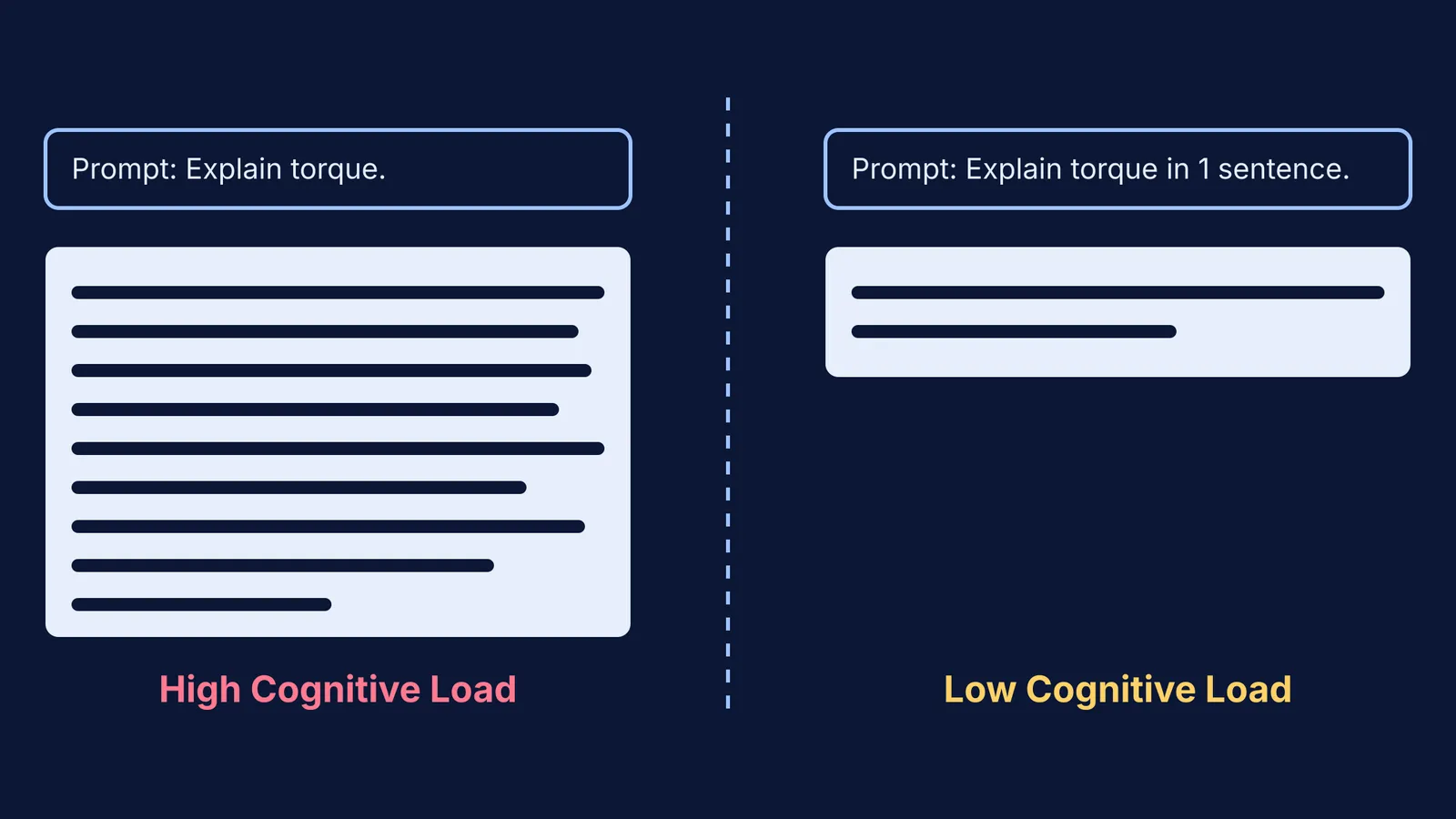
When an explanation includes redundant information—such as background you already know, or extra filler words—your brain has to spend energy processing and filtering it out. This "extraneous cognitive load" leaves you with less mental capacity for actual learning. AI chatbots are built to be polite and thorough, which means their default setting is to over-explain. They often bury the one idea you needed under a mountain of text, forcing your working memory to sort through the noise.
How to make AI explanations shorter?
To get a better answer, you have to explicitly constrain the AI. General purpose language models equate helpfulness with length, so you have to set strict boundaries. Here are three practical prompts you can use to force an AI to keep its cognitive load low:
The length limit: "Explain Lenz's Law in exactly three sentences." This forces the AI to prioritize the most important mechanism over the history of the law or unrelated examples.
The single-idea constraint: "What is the one main reason the sky is blue? Do not give any background." This removes the introduction, the conclusion, and the polite preamble, giving you only the core fact you asked for.
The step-by-step check: "Explain how to balance this chemical equation. Give me only the first step, and wait for me to answer before continuing." This prevents the AI from printing the entire solution at once, keeping your working memory clear for one step at a time.
By limiting the length of the response, you take control of the study session. You stop being a passive reader trying to absorb a textbook chapter, and instead become an active learner working through a specific problem. Active learning is much more effective than passive reading, and keeping your reading materials concise is one of the easiest ways to enforce it.
Using these constraints ensures that every word on the screen is there for a reason. For more ways to interact with AI effectively, you can read our guide on how to Make an AI chatbot quiz you properly.
How does a true AI tutor keep it short?
A standard chatbot prints the whole answer at once because it has no memory of what you already know. It has to guess what you might need, so it gives you everything. This is why you often end up with an essay when you only needed a hint.
Fermi's AI tutor is different. It holds a line of reasoning across a whole session and notices where a student is stuck. Because it works out what you already know and builds a plan for the session, it decides whether to explain, ask, or show—rather than printing a wall of text. By checking your understanding as it goes, the tutor adapts to your working memory and only gives you the information you are ready to process.
If you are wondering whether to rely on just getting the final answers, you can explore whether Hints or answers? What tutoring research says makes a difference for long-term retention. Keeping explanations short and focused is the first step to active learning, making sure your brain is doing the work instead of just scrolling past it.


