On this page
A composite shape is just a few simple shapes stuck together. The hard part is seeing where to cut, and an AI can suggest cuts. Ask it for two different splits, do the arithmetic yourself, and check that both give the same area. If they don't, one split has a gap or an overlap, and finding it teaches you more than the answer would.
Why compare two splits instead of trusting one answer?
Comparing methods side by side has research behind it. In a 2009 study in the Journal of Educational Psychology, Bethany Rittle-Johnson and Jon Star taught 162 seventh- and eighth-grade students to solve equations. Some compared problems solved the same way, some compared different problem types, and some compared different methods for one problem. Comparing solution methods gave the strongest support for both conceptual knowledge and procedural flexibility, which the authors describe as knowing several ways to solve a problem and when to use each.
That study was about algebra, not area, but two splits of one shape are also two methods for one problem.
What should you ask the AI to do?
Let the AI suggest splits; keep the sums for yourself. A script to copy:
"Here is the shape: [describe every side length and where each curve sits]. Don't calculate the area yet."
"Suggest two different ways to split it into rectangles, triangles, semicircles or quarter circles. For each piece, give its dimensions."
"Include one split that adds pieces together and one that subtracts a piece from a bigger shape, if that works here."
After you have worked out both totals: "I got these two totals. Do they match? If not, which piece is wrong?"
Describe the figure in words, corner by corner, so the AI works from your exact lengths rather than guessing from a photo.
Worked example: an L-shaped plot
Take an L-shaped plot. The bottom edge is 10 m long and the left edge is 8 m tall. A 6 m by 5 m rectangle is missing from the top-right corner.
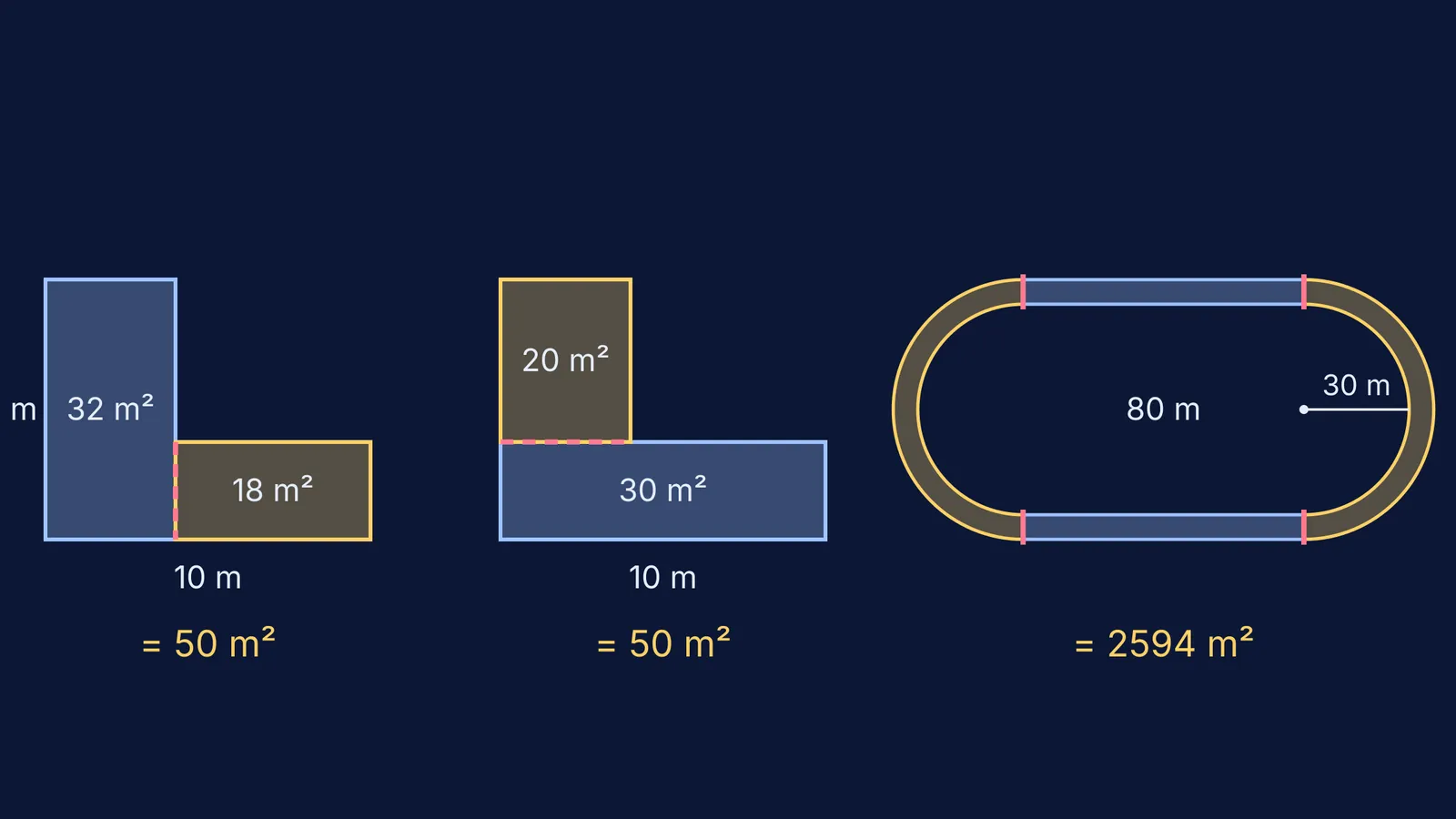
Split A (vertical cut): a 4 m by 8 m rectangle on the left (32 m²) plus a 6 m by 3 m rectangle on the right (18 m²). Total 50 m².
Split B (horizontal cut): a 10 m by 3 m strip along the bottom (30 m²) plus a 4 m by 5 m rectangle on top (20 m²). Total 50 m².
Split C (subtract): the full 10 m by 8 m rectangle (80 m²) minus the missing 6 m by 5 m corner (30 m²). Total 50 m².
A common slip is giving the right-hand piece the full 8 m height, which counts the missing corner as if it were there.
How do you split a running track into rectangles and semicircles?
The formulas are in NCERT's Class 10 chapter Areas Related to Circles, which itself works one example twice: by subtracting a sector from the whole circle, and with a direct formula.
Say a track has two 80 m straights. The inner edge of each curved end is a semicircle of radius 30 m, and the track is 7 m wide, so the outer radius is 37 m. Use π = 22/7.
Split A (outer minus inner): the outer shape is an 80 m by 74 m rectangle plus two semicircles of radius 37 m. The inner field is an 80 m by 60 m rectangle plus two semicircles of radius 30 m. The rectangles differ by 80 × 14 = 1,120 m². The circles differ by 22/7 × (37² − 30²) = 22/7 × 469 = 1,474 m². Total 2,594 m².
Split B (the track itself): two straight strips, each 80 m by 7 m, make 1,120 m². The two curved ends are half-rings that together make one full ring: 22/7 × (37² − 30²) = 1,474 m². Total 2,594 m².
The totals match. For the same outer-minus-inner idea on a rectangular path, see area of a path around a garden.
What should you check when the two totals don't match?
Radius or diameter: did a 60 m width get used as the radius?
Semicircle or full circle: is each curved end half of πr², and do two halves make one circle?
Overlap: does any strip of the shape fall inside two pieces?
Gap: is there a corner that no piece covers?
Units and π: are all lengths in one unit, and did both splits use the same π (22/7 or 3.14)?
If the AI's split itself looks wrong, go through it step by step, as in comparing your method with a model solution. The Fermi Problem Library has worked problems with a step-by-step solver that explains the reasoning rather than printing an answer. Fermi's AI tutor writes on a board and draws the figure as it teaches, so you can see each piece marked out before any numbers go in.
Next time you meet a strange shape, sketch it, ask for two splits, and trust the area only once both agree.